Start With the Right Remote Job Target
Before you start applying, get clear on the type of remote job you actually want. A strong remote job search is not just about typing “remote” into a job board and sending out applications. It starts with a focused target: the role you want, the type of company you want to work for, the schedule you can manage, and the level of flexibility you need.
Remote job postings can mean different things, so read each description carefully. Fully remote usually means you can work from home all the time, but it may still require you to live in a specific state, country, or time zone. Hybrid roles combine remote work with in-office days. Flexible roles may offer some work-from-home options, but they are not always fully remote. You may also see terms like distributed team, remote-first, or work from anywhere. Each can signal a different level of flexibility, so do not rely on the job title alone.
To narrow your search, define your target in practical terms:
- Role: What job titles match your skills and experience?
- Industry: Which fields are hiring for your type of work?
- Schedule: Do you need standard business hours, flexible hours, part-time work, or asynchronous work?
- Location requirements: Are you eligible for roles limited to certain states, countries, or time zones?
- Work style: Do you prefer independent work, frequent collaboration, customer-facing tasks, or project-based responsibilities?
This step matters because remote work rewards clarity. Employers want candidates who understand the role and can explain why they are a good fit for both the job and the work environment. For example, if you are applying for a remote customer support role, your target should include communication skills, comfort with support tools, and the ability to stay organized while helping customers online. If you are applying for a remote project management role, your target should highlight planning, documentation, meeting facilitation, and cross-functional coordination.
A useful exercise is to write a one-sentence job target before you apply. For example: “I am looking for a fully remote customer success role at a U.S.-based software company where I can use my client communication, onboarding, and problem-solving experience.” This sentence can guide your resume, LinkedIn profile, job board searches, and networking messages.
The more specific your target is, the easier it becomes to recognize the right opportunities and ignore poor-fit listings. Instead of applying to every remote job available, you can focus on roles where your skills, experience, availability, and work preferences match what the employer actually needs.
Build a Remote-Ready Resume and LinkedIn Profile
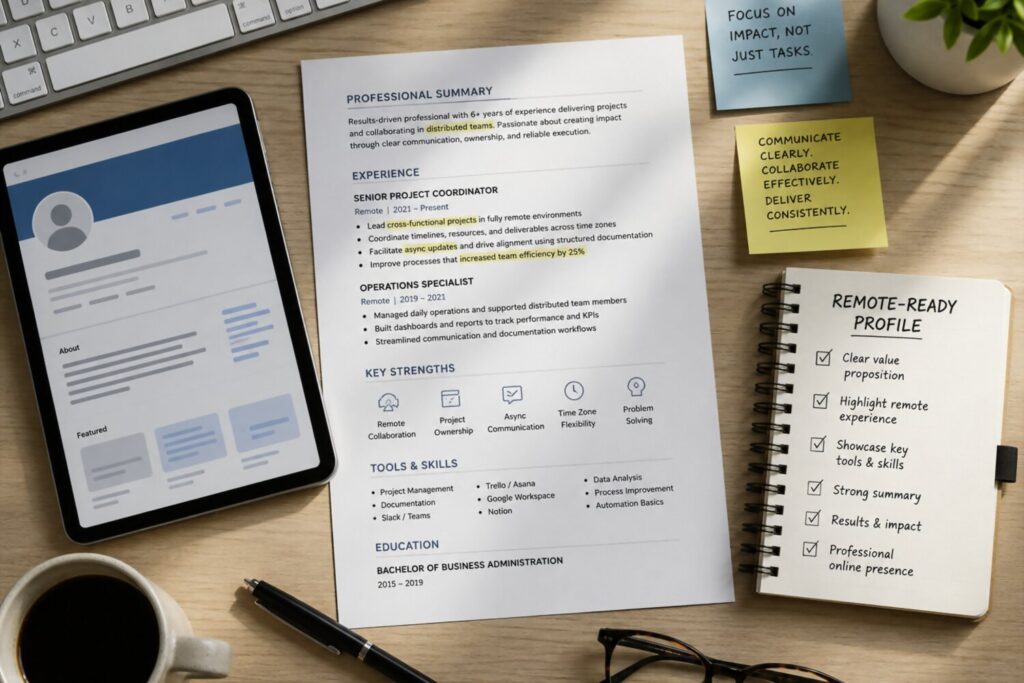
Once you know the type of remote job you want, update your resume and LinkedIn profile so they show more than your job history. For remote roles, employers are often looking for evidence that you can communicate clearly, manage your time, stay accountable, and work well with people you may rarely meet in person. Your application materials should make those strengths easy to see.
Start with your resume. Instead of simply listing responsibilities, focus on outcomes and work habits that matter in a remote setting. Strong bullet points often combine what you did, how you did it, and what changed because of your work. For example, “Managed weekly client updates across email, video calls, and project management software” is more useful than “Communicated with clients.” It shows the setting, the tools, and the skill.
Look for places where you can highlight remote-friendly strengths such as:
- Written communication: documentation, status updates, client emails, knowledge base articles, reports, or meeting notes.
- Self-management: meeting deadlines, prioritizing tasks, owning projects, or working with limited supervision.
- Collaboration: working across departments, time zones, or locations.
- Technology fluency: using tools for video meetings, project tracking, file sharing, customer support, design, analytics, or team communication.
- Measurable results: improved response time, completed projects, customer satisfaction, revenue support, process improvements, or reduced errors.
Your LinkedIn profile should reinforce the same message. Use your headline to make your target clear, especially if your current title does not fully match the remote role you want. In the About section, explain your professional strengths in a direct, credible way. Mention the type of work you do well, the problems you help solve, and the environments where you can contribute. If you have examples of work you can share, add them to the Featured section, such as a portfolio, writing sample, case study, presentation, or project summary.
Our editorial team recommends treating your resume and LinkedIn profile as a matched pair, not separate documents. A recruiter may read both, so the story should be consistent: the same target role, the same core skills, and the same evidence of reliability. That does not mean copying your resume into LinkedIn word for word. It means making sure both materials point toward the same conclusion: you are prepared to do the job and succeed in a remote work environment.
Before applying, compare your resume to the job posting. Adjust your summary, skills, and strongest bullet points to reflect the employer’s language where it accurately matches your experience. Do not add tools, skills, or responsibilities you do not have. A remote job search works best when your materials are both targeted and truthful.
A good remote-ready profile answers the employer’s main question before the interview: Can this person do strong work without constant in-person supervision? Your resume and LinkedIn profile should make the answer clear.
Create a Focused Remote Job Search System
A remote job search can become overwhelming quickly if you rely on memory, browser tabs, or scattered saved posts. Because remote openings often attract candidates from a wider geographic area, it is important to stay organized and apply with intention. A simple search system helps you track the right opportunities, avoid duplicate applications, and improve your strategy over time.
Start by choosing a manageable weekly application goal. The right number depends on your schedule, experience level, and how much tailoring each application requires. A focused goal might be five to ten strong applications per week, rather than dozens of rushed submissions. The aim is not to apply everywhere; it is to consistently apply to roles where your skills, experience, location, and availability match the employer’s needs.
Use a spreadsheet, job-search app, or project management tool to track each opportunity. At minimum, include columns for:
- Company name
- Job title
- Remote type: fully remote, hybrid, location-restricted remote, or flexible
- Job posting link
- Date found
- Date applied
- Resume version used
- Contact or referral name
- Follow-up date
- Status: saved, applied, interviewing, rejected, offer, or closed
- Notes about requirements, interview details, or concerns
This tracker becomes more useful when you review it weekly. Look for patterns. Are you getting responses from certain industries, job titles, or company sizes? Are you applying to roles that require tools or experience you do not yet have? Are many postings location-restricted even though they appear remote at first glance? These details can help you refine your search instead of repeating the same approach.
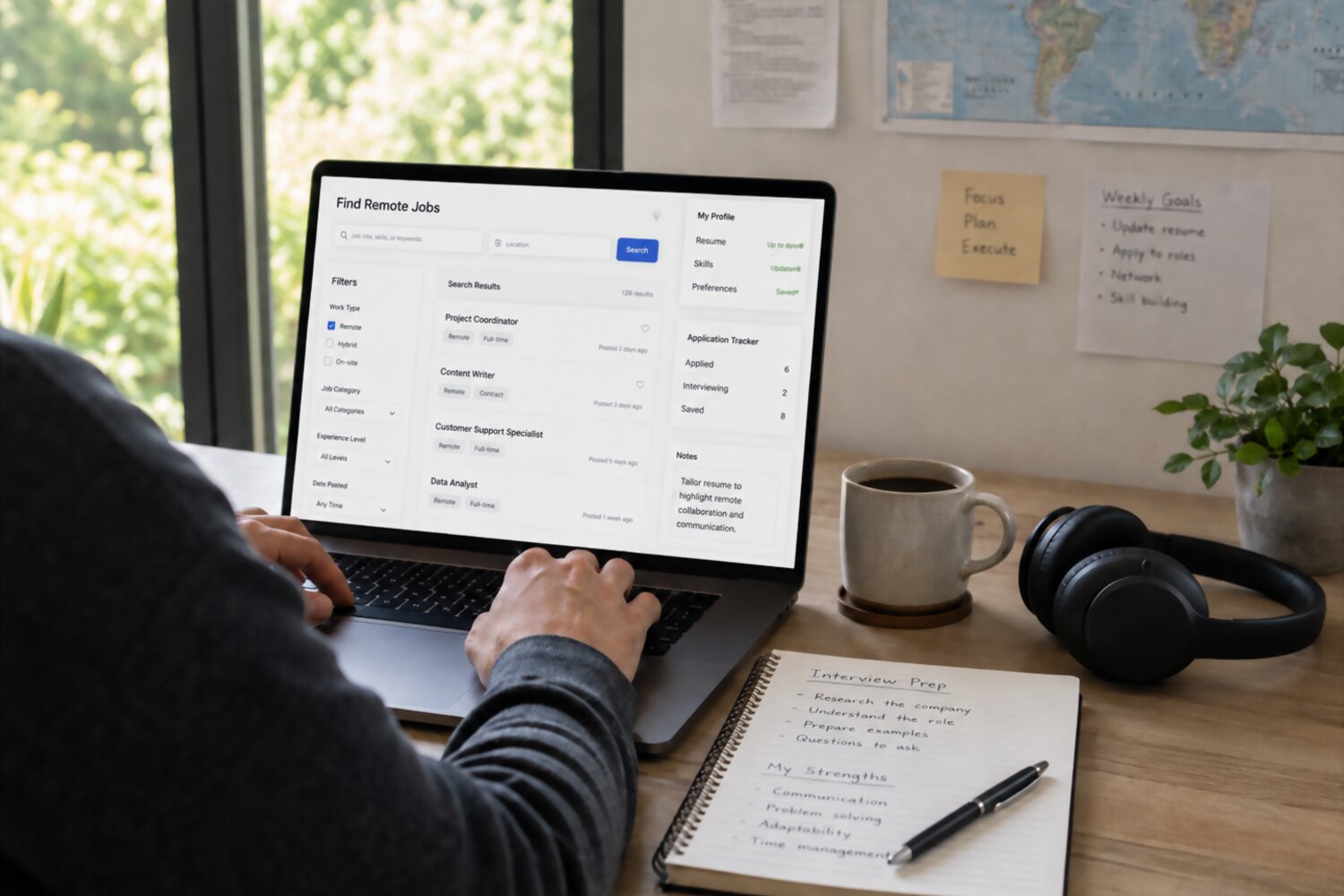
Build a routine around your system. For example, you might spend one day finding new roles, another day tailoring resumes, and another day following up or networking. You can also save search filters on job boards so you are not starting from scratch each time. Useful filters often include remote status, job function, experience level, posting date, and location requirements.
A focused system also helps you protect your time. Not every remote listing deserves an application. Before applying, check whether the role matches your core target, whether the responsibilities are clear, and whether the company provides enough information to evaluate the opportunity. If a posting is vague, outdated, or inconsistent, it may be better to move on.
The best remote job search plan is both structured and flexible. Use your system to stay consistent, but adjust it as you learn what works. Over time, your tracker should show more than where you applied. It should show which types of opportunities are worth your attention and which ones are not.
Use the Best Places to Find Legitimate Remote Jobs
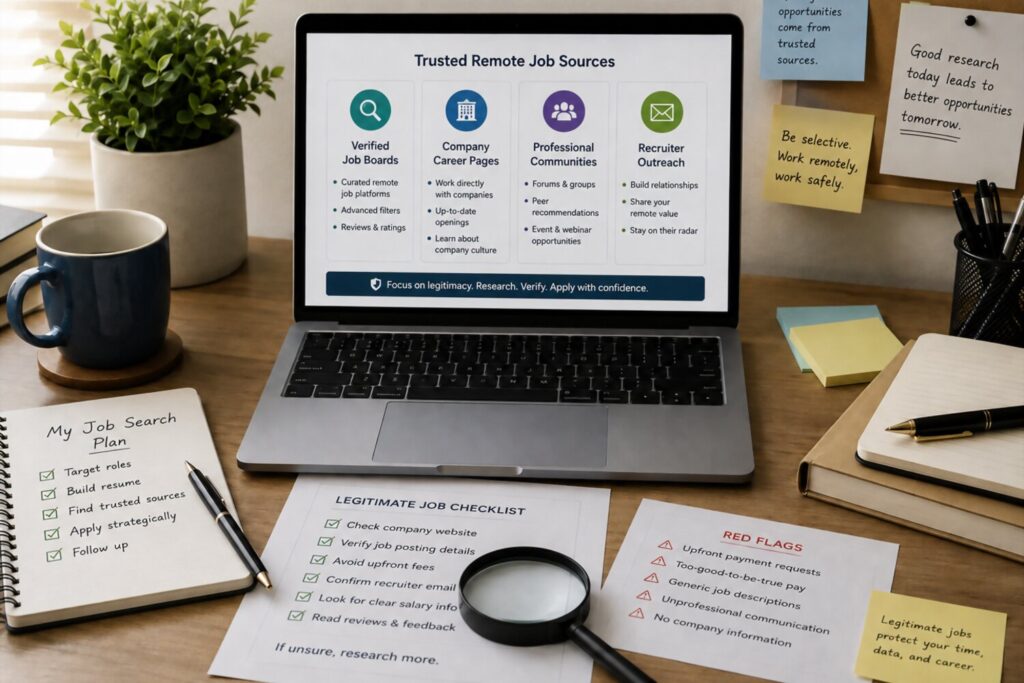
Finding a remote job is easier when you know where to look and how to filter results. Many job boards include remote roles, but not every listing is accurate, current, or truly remote. A smart search uses several sources, compares details carefully, and focuses on roles that match your target.
Start with remote-specific job boards. These sites are built around remote work, so they can help you find roles faster than broad job boards alone. They often include jobs in customer support, marketing, software development, design, writing, operations, sales, finance, and project management. Even when you use these sites, read the full description before applying. Some remote jobs still require you to live in a certain country, state, or time zone.
Next, use major job platforms with strong filters. LinkedIn, Indeed, Glassdoor, Google Jobs, and similar platforms can be useful if you search with the right terms and settings. Try combining your target job title with phrases such as:
- “remote”
- “work from home”
- “distributed team”
- “remote-first”
- “U.S.-based remote”
- “location flexible”
- “work from anywhere”
- “asynchronous team”
Do not rely only on the remote filter. Some postings are labeled remote but later mention office requirements, travel expectations, or location restrictions. Always scan the job description for details about where you can work, expected hours, equipment, team communication, and whether the company has a remote-work policy.
Company career pages are another valuable source. If you know the types of companies you want to work for, create a list of target employers and check their career pages directly. This can help you find openings that may not appear at the top of large job boards. Look for pages with filters such as “remote,” “distributed,” “virtual,” or “home-based.” You can also sign up for job alerts from companies that regularly hire for your skill set.
Professional communities can also lead to strong opportunities. Industry Slack groups, newsletters, alumni groups, online forums, and professional associations often share roles before they become widely visible. These spaces can be especially useful because they give you context about the company, the team, or the hiring manager. When participating, focus on being helpful and professional rather than only asking for leads.
A balanced search might include three channels: remote job boards for volume, company career pages for targeted opportunities, and professional communities for relationship-driven leads. Using all three gives you a broader view of the market without turning your search into random scrolling.
As you search, save only the listings that match your role target, location eligibility, experience level, and preferred work style. The goal is not to find every remote job online. The goal is to build a reliable pipeline of legitimate opportunities where you can make a strong, relevant application.
Research Companies Before You Apply
Before you spend time tailoring a resume or writing a cover letter, take a few minutes to research the company behind the remote job posting. This step helps you apply more strategically, prepare stronger interview answers, and avoid roles that may not match your work style. A job can look appealing at first glance, but the company’s culture, communication habits, and remote-work expectations matter just as much as the job title.
Start with the company’s website. Look for signs that remote work is a real part of how the organization operates, not just a temporary option or recruiting phrase. A company that supports remote employees may mention distributed teams, remote onboarding, flexible communication, collaboration tools, team documentation, or location-specific hiring requirements. If the careers page clearly explains how remote work functions, that is usually more helpful than a vague line saying “remote available.”
Next, review the job posting closely. Strong remote job descriptions usually explain where the employee can work, what hours or time zones are expected, how the team collaborates, and whether travel or office visits are required. Vague descriptions are not automatically bad, but they do require more caution. If the posting does not explain key details, make a note to ask about them during the recruiter screen.
Use this simple checklist as you evaluate a company:
| What to Check | Why It Matters |
|---|---|
| Remote policy | Helps you understand whether the role is fully remote, hybrid, flexible, or location-restricted. |
| Time zone expectations | Shows whether the work schedule fits your availability and daily routine. |
| Communication style | Gives clues about meetings, written updates, async work, and collaboration habits. |
| Team structure | Helps you see whether you would work independently, cross-functionally, or closely with a manager. |
| Career page details | Indicates how clearly the company explains its hiring process and work environment. |
| Employee feedback | Can reveal patterns about management, workload, communication, and remote support. |
When reading employee reviews, look for patterns rather than relying on one strongly positive or negative comment. Every workplace has different experiences across teams and managers. Pay attention to repeated themes, especially around communication, workload, leadership, flexibility, and expectations for availability.
It is also useful to research the company’s recent activity. Check whether it is actively hiring, launching products, expanding into new markets, or changing direction. This can help you understand what problems the company may be trying to solve and how the open role fits into its priorities. In an interview, this research can help you ask better questions and show that you are interested in the actual organization, not just the remote label.
Good research does not need to take hours. For most roles, a focused 10- to 15-minute review is enough to decide whether the opportunity deserves a tailored application. Your goal is to answer three practical questions: Is this role truly remote in a way that works for me? Does the company appear organized and credible? Can I explain why I am a strong fit for this specific opportunity?
The better you understand the company before applying, the easier it becomes to write a relevant application, avoid poor-fit roles, and enter interviews with confidence.
Avoid Remote Job Scams and Low-Quality Listings

Remote job searches can attract legitimate opportunities, but they can also expose job seekers to misleading posts, vague offers, and scams. Because many remote hiring processes happen online, it is important to slow down and verify the opportunity before sharing personal information, completing unpaid work, or accepting an offer.
Start by reviewing the job posting carefully. A credible listing should explain the role, responsibilities, required qualifications, hiring process, and company name. It should also give enough detail to help you understand what the work involves. Be cautious with posts that promise unusually easy work, use unclear job titles, or focus more on quick money than real responsibilities. A legitimate employer should be able to explain what you will do, who you will work with, and how success will be measured.
Watch for common warning signs, including:
- Requests for money upfront, such as fees for training, equipment, software, background checks, or application processing.
- Pressure to act immediately, especially if the recruiter discourages you from asking questions.
- Vague or inconsistent communication, including messages with poor formatting, unclear company details, or shifting job descriptions.
- Unprofessional email addresses, especially messages sent from personal accounts instead of company domains.
- Requests for sensitive information too early, such as banking details, government identification numbers, or copies of personal documents before a formal hiring process.
- Interviews conducted only through text messaging, with no clear recruiter identity, company email, or verifiable process.
- Offers without a real interview, especially if the company has not assessed your qualifications.
Before moving forward, verify the company through its official website and career page. If the job was posted on a third-party job board, check whether the same opening appears on the company’s own site. Look up the recruiter on LinkedIn or the company team page, and confirm that their email domain matches the company’s official domain. If something feels off, contact the company directly through a verified channel rather than replying to the suspicious message.
It is also worth distinguishing between a scam and a low-quality listing. Some jobs are real but still may not be a good fit. A posting may be too vague, under-explain expectations, require constant availability, or label itself “remote” while demanding frequent office visits. These roles may not be fraudulent, but they can still waste your time if they do not match your goals.
A good rule is to treat urgency as a reason to pause, not rush. Real employers expect candidates to ask reasonable questions about the role, schedule, hiring steps, equipment, and work expectations. You do not need to share sensitive personal information before you understand who you are dealing with and why that information is needed.
Protecting yourself does not mean being fearful. It means being professional and careful. When you verify postings, check company details, and trust your judgment when something seems inconsistent, you can focus your energy on remote opportunities that are credible, relevant, and worth pursuing.
Network for Remote Opportunities Without Being Pushy
Networking can make your remote job search more focused and less dependent on job boards alone. Many remote roles still move through referrals, professional communities, and informal recommendations, so it helps to build relationships before you need to ask for anything. The goal is not to pressure people for a job. It is to learn, stay visible, and make it easy for the right people to connect you with relevant opportunities.
Start with people who already know your work. Former coworkers, managers, classmates, clients, vendors, and professional contacts are often the easiest place to begin because they have some context for your skills. Send a short, specific message that explains what you are looking for and why you are reaching out. For example, you might say that you are exploring remote customer success roles and would appreciate any advice on companies or teams worth following.
Good networking messages are clear and respectful. They usually include:
- A brief reminder of your connection, if the person may not immediately remember you.
- A specific target, such as a role type, industry, or kind of company.
- A simple request, such as asking for advice, insight, or a recommendation for where to look.
- An easy way to say no, so the message does not feel demanding.
You can also network in online spaces where remote-friendly employers and professionals are active. Industry Slack groups, LinkedIn discussions, alumni communities, newsletters, webinars, and professional associations can all be useful. Instead of posting only that you are looking for work, participate in a way that shows your judgment and expertise. Answer questions, share useful resources, comment thoughtfully, or ask informed questions about trends in your field.
When you find a company you like, look for people who work in similar roles or departments. A short informational message can help you understand the team, hiring process, and remote culture. Keep the request modest. Asking for 15 minutes of advice is usually more appropriate than asking a stranger to refer you immediately. If the conversation goes well and you later apply, you can ask whether they would feel comfortable pointing you in the right direction.
A strong referral request should be specific and considerate. Mention the exact role, why it fits your background, and provide a resume or LinkedIn profile so the person does not have to search for details. Avoid sending the same generic message to everyone. People are more likely to respond when they can tell you have done your homework.
Networking works best as a habit, not a last-minute favor. Set a small weekly goal, such as reaching out to three contacts, joining one professional discussion, or following up with someone you spoke to earlier. Over time, these conversations can help you discover better-fit remote roles, understand what companies actually need, and present yourself as a thoughtful candidate rather than just another online application.
Prepare for Remote Interviews and Skills Tests
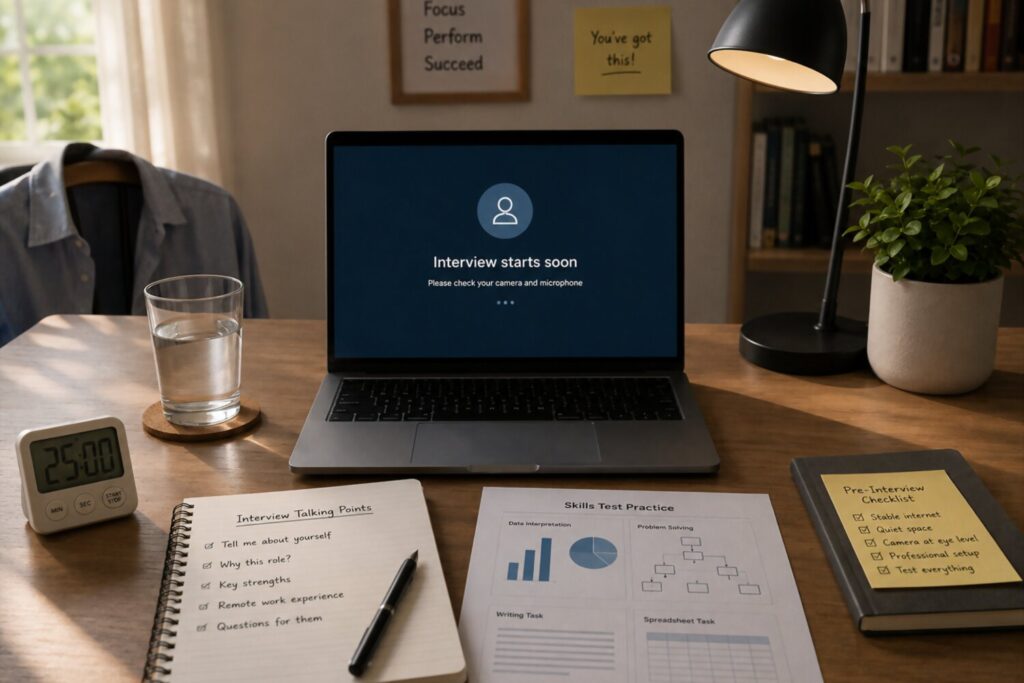
Remote interviews are not just a chance to explain your experience. They are also a chance to show how you communicate, prepare, solve problems, and handle professional conversations online. Since the employer may never meet you in person, every part of the process can shape their impression: your video setup, your answers, your follow-up, and the way you handle any skills test or assignment.
Start with the basics before the interview. Test your camera, microphone, internet connection, and video meeting link. Choose a quiet location, reduce distractions, and keep your resume, the job description, and a few notes nearby. You do not need a perfect home office, but you should show that you can create a professional environment for important conversations.
Prepare for questions that focus on remote work habits. Employers may ask how you organize your day, communicate progress, handle unclear instructions, or collaborate across time zones. Strong answers should include real examples. Instead of saying, “I’m a good communicator,” describe a situation where you kept a project moving by sending clear updates, documenting decisions, or coordinating with teammates who were not in the same location.
Common remote interview topics include:
- Time management: How do you prioritize tasks when no one is checking in constantly?
- Communication: How do you decide when to send a message, write documentation, or schedule a meeting?
- Accountability: How do you keep others informed about progress, delays, or blockers?
- Collaboration: How have you worked with teammates, clients, or managers in different locations?
- Problem-solving: What do you do when you are stuck and cannot get an immediate answer?
- Tools: Which platforms have you used for project management, messaging, video calls, file sharing, or customer support?
If the employer gives you a skills test or take-home assignment, read the instructions carefully before starting. Clarify the deadline, expected format, and estimated time commitment if those details are not clear. A good assignment response should be organized, easy to review, and connected to the role. For example, a writing task should show clear structure and audience awareness, while a project management task should show prioritization, trade-offs, and next steps.
Be honest about your tool experience. You do not need to claim expertise in every platform listed in the job description. It is often better to say, “I have used similar project management tools and can get up to speed quickly,” than to overstate your experience. Remote employers value reliability and judgment, and exaggeration can create problems later in the process.
Prepare a few thoughtful questions for the interviewer, too. Ask how the team communicates, how success is measured, what onboarding looks like, and how remote employees receive feedback. These questions help you evaluate the role while also showing that you understand what makes remote work effective.
A strong remote interview leaves the employer with confidence that you can do the job, communicate clearly, and work independently without disappearing. Your goal is to show not only that you have the right skills, but that you can use them consistently in a remote environment.
Follow Up, Improve, and Keep the Search Moving
After you start applying, your job search should not run on autopilot. Remote job searches often involve multiple applications, different hiring timelines, and long gaps between updates. A steady follow-up and review process helps you stay organized, learn from your results, and keep your search focused instead of reacting emotionally to every delay or rejection.
Start by following up at the right time. If you have applied but have not heard back, it is usually reasonable to send a brief, professional follow-up after about one to two weeks, unless the posting or recruiter gave a different timeline. Keep the message simple: restate your interest, mention the role, and ask whether there are any updates on the hiring process. Avoid sounding impatient or sending repeated messages too close together.
For interviews, send a thank-you note within a day if possible. Use it to thank the interviewer for their time, briefly reinforce your interest, and mention one specific detail from the conversation. This does not need to be long. A thoughtful, concise note can show professionalism and attention to detail, especially in a remote process where written communication matters.
As your search continues, review your job tracker each week. Look at more than the number of applications you submitted. Pay attention to what is working and where your search may need adjustment.
A simple weekly review can include:
- Applications sent: Are you applying consistently without rushing?
- Response rate: Which roles, industries, or resume versions are getting replies?
- Role fit: Are you applying to jobs that match your experience and remote-work needs?
- Search terms: Are your keywords bringing up relevant listings?
- Follow-ups due: Are there recruiters, contacts, or interviewers you should check in with?
- Skill gaps: Are the same tools, certifications, or responsibilities appearing in roles you want?
- Energy level: Is your search routine sustainable, or do you need to adjust your pace?
If you are not getting responses, do not immediately assume you are unqualified. First, review your targeting. You may be applying to roles that are too broad, too senior, too location-restricted, or not closely aligned with your background. Next, review your resume and LinkedIn profile. Make sure they clearly match the jobs you want and include specific evidence of your skills. Small improvements in targeting and presentation can make your search more effective over time.
It is also important to keep building momentum outside of applications. Continue networking, learning about target companies, updating your materials, and preparing for interviews before they are scheduled. Remote job searches can take time, so your process should help you stay steady and practical.
The goal is not to control every outcome. It is to control the parts of the search you can manage: the quality of your applications, the clarity of your follow-up, the accuracy of your tracking, and your willingness to adjust based on real feedback. A consistent, thoughtful process gives you the best chance of finding a remote role that fits both your skills and the way you want to work.
Common Mistakes To Avoid When Searching for a Remote Job

A remote job search works best when it is focused, organized, and realistic. Many candidates make the process harder by applying too broadly, overlooking important details in job postings, or failing to show that they can work effectively outside a traditional office. Avoiding these common mistakes can help you spend your time on stronger opportunities and present yourself more clearly to employers.
1. Applying to every job with “remote” in the title
Not every remote job is the right fit. Some roles are fully remote, while others require employees to live in a specific state, country, or time zone. Some may involve occasional office visits, travel, or fixed hours that do not match your availability. Before applying, read the full posting and confirm that the role fits your location, experience level, schedule, and work style.
2. Using the same resume for every application
A general resume may miss the details employers are looking for. Remote hiring managers often want to see evidence of clear communication, independence, organization, and comfort with digital tools. Tailor your resume to the role by highlighting relevant skills, outcomes, and work habits that match the job description. This does not mean rewriting your entire resume each time; it means adjusting the most important sections so they speak directly to the opportunity.
3. Ignoring location and time zone requirements
Remote does not always mean “work from anywhere.” Employers may limit hiring based on business hours, team collaboration needs, tax requirements, client coverage, or operational policies. If a posting says the role is remote but limited to certain locations, take that requirement seriously. Applying when you clearly do not meet the location criteria can waste time and reduce the quality of your search.
4. Failing to research the company
A remote role can look attractive because of the flexibility, but the company still matters. Before applying or interviewing, review the company’s website, career page, job description, and public information. Look for signs that the organization has a clear remote-work process, realistic expectations, and a professional hiring structure. If important details are missing, prepare thoughtful questions for the recruiter or hiring manager.
5. Overlooking scam warning signs
Remote job seekers should be especially careful with postings that ask for money upfront, request sensitive personal information too early, or offer a job without a real interview. Be cautious with vague job descriptions, pressure-based messages, personal email addresses, and promises that sound unrealistic. A legitimate employer should be able to explain the role, hiring process, company identity, and next steps clearly.
6. Treating remote interviews too casually
A remote interview is still a professional interview. Test your technology, choose a quiet space, review the job description, and prepare examples that show how you communicate and manage work independently. Employers are not only evaluating your qualifications; they are also noticing how prepared, responsive, and clear you are in a virtual setting.
7. Not tracking applications and follow-ups
Without a tracker, it is easy to forget where you applied, which resume you used, or when to follow up. Use a simple spreadsheet or job-search tool to record the company, role, posting link, application date, contact name, status, and follow-up date. This helps you stay organized and spot patterns in your search over time.
8. Waiting too long to improve your approach
If you are applying consistently but not getting responses, review your strategy instead of simply sending more applications. Check whether your target roles are realistic, whether your resume matches the postings, and whether your LinkedIn profile supports the same message. A remote job search should improve as you learn from the results.
The main mistake to avoid is treating a remote job search like a numbers game only. Quality matters. A focused target, tailored application materials, careful research, and professional follow-up can help you pursue remote roles with more confidence and better judgment.