
What Actually Makes a Remote FullStack Developer Stand Out
Standing out in remote hiring is less about claiming broad full stack capability and more about proving depth where it matters. Employers are not impressed by long lists of technologies. They look for signal, not noise.
A strong candidate shows clear ownership of outcomes. This means you can point to features or systems you designed, built, and maintained across the stack. It also means you understand how frontend, backend, and infrastructure decisions connect. Remote teams especially value developers who can move work forward without constant oversight.
Generalists who try to do everything often dilute their perceived value. Focused generalists who demonstrate depth in key areas tend to outperform them.
Focus on Impact Over Activity
Many developers describe what they worked on. Fewer explain what changed because of their work. The distinction is critical.
Instead of listing tasks, describe results. For example, improving API response time, reducing frontend bundle size, or increasing conversion rates. These outcomes show that you understand business impact, not just technical execution. Remote companies rely on this because visibility is lower than in office environments.
Show End to End Thinking
Remote full stack roles require more than switching between frontend and backend tasks. They require systems thinking.
A standout developer can explain how a feature moves from idea to deployment. This includes design decisions, data flow, edge cases, and monitoring after release. It also includes trade offs such as performance versus maintainability. When you communicate this clearly, you demonstrate maturity that hiring managers trust.
Communicate With Precision
Communication is not a soft skill in remote work. It is a core technical skill.
You need to write clearly and structure information so others can act on it without confusion. This includes pull request descriptions, technical proposals, and status updates. Good communication reduces friction and prevents costly misunderstandings. Poor communication creates hidden delays that remote teams cannot afford.
Operate Independently Without Isolation
Remote teams expect autonomy, but not silence. Strong developers balance independence with visibility.
They ask questions early when context is missing. They document decisions so others can follow. They update progress without being prompted. This creates trust, which is a primary currency in distributed teams.
What Hiring Managers Actually Notice
| Signal | Why It Matters |
|---|---|
| Clear project ownership | Shows accountability and reliability |
| Measurable outcomes | Proves real impact beyond tasks |
| Documented decisions | Reflects strong async communication |
| Clean, navigable code | Indicates professionalism and maintainability |
| Consistent delivery | Builds trust in remote environments |
Most candidates underestimate how quickly recruiters filter profiles. If your experience does not immediately communicate these signals, you are likely overlooked.
Standing out is not about being everywhere. It is about being precise, credible, and easy to trust in a low visibility environment.
Build a Portfolio That Signals Real World Value

Most portfolios fail because they look like collections of tutorials. Hiring managers recognize this immediately. A strong portfolio shows evidence of independent thinking and real problem solving.
Your goal is not to display everything you have built. It is to present a small number of projects that demonstrate depth, clarity, and impact. Three to five well executed projects are enough if they are credible. Each project should resemble something that could exist in production, not just a sandbox experiment.
What a Strong Portfolio Actually Includes
A compelling project does more than render a UI and connect to a database. It tells a story about decisions, constraints, and outcomes. This is where most candidates fall short.
- A clear problem statement that explains why the project exists
- A description of the architecture and key technical decisions
- Evidence of backend complexity such as authentication, APIs, or data modeling
- Consideration of performance, error handling, and edge cases
- A live demo that works reliably without setup friction
- Clean and readable code with meaningful structure and documentation
These elements signal that you understand how software behaves outside of controlled environments. That is what employers are evaluating.
Go Beyond Screenshots and Code Links
A portfolio without context forces reviewers to guess your thinking. That is inefficient and often leads to rejection.
Add short case studies for each project. Explain what problem you solved, what options you considered, and why you chose a specific approach. Include trade offs, especially when there was no perfect solution. This demonstrates judgment, which is more valuable than technical breadth alone.
Demonstrate Backend and System Depth
Full stack roles require more than connecting frontend components to simple endpoints. Employers expect to see meaningful backend work.
This includes designing APIs, handling authentication flows, managing data consistency, and structuring services in a way that scales. Even in smaller projects, you can simulate real world complexity. For example, implement rate limiting, caching strategies, or background processing. These details differentiate you from candidates who only focus on interface development.
Make It Easy to Evaluate Your Work
Reviewers spend limited time on each portfolio. If they cannot quickly understand your work, they move on.
Organize your repositories clearly. Use descriptive README files that explain how to run the project and what it demonstrates. Structure your code so that key components are easy to find. Avoid unnecessary complexity that obscures your intent.
A portfolio that signals real world value reduces uncertainty. That is ultimately what hiring decisions are about.
Optimize Your Resume and Online Presence for Remote Roles
Your resume and online presence function as a filtering system before any conversation begins. In remote hiring, this filtering is stricter because companies receive global applications. Small weaknesses compound quickly.
Most resumes fail because they describe responsibilities instead of outcomes. Hiring managers are not trying to understand what your job was. They are trying to understand what changed because you were there.
Write for Signal, Not Volume
A concise resume with strong signals consistently outperforms a long document filled with generic content. Each bullet point should communicate impact, ownership, and context.
Focus on measurable results whenever possible. If you improved performance, quantify it. If you shipped features, explain their effect on users or the business. If exact numbers are unavailable, use directional indicators such as increased, reduced, or optimized with clear context.
Avoid listing every technology you have touched. Prioritize tools that align with the roles you are targeting. Relevance matters more than completeness.
Align With How Recruiters Search
Recruiters rely heavily on keyword matching when scanning candidates across platforms. Your profile must align with how roles are described in job listings.
| Area | What to Optimize |
|---|---|
| Resume headline | Include clear role identity and core stack |
| Skills section | Match terminology used in job descriptions |
| Experience bullets | Reflect keywords tied to real outcomes |
| LinkedIn title | Mirror your resume positioning |
| Project descriptions | Reinforce relevant technologies and impact |
This alignment increases your visibility in search results without changing your actual experience.
Treat GitHub as Evidence, Not Storage
An active GitHub profile strengthens credibility when it reflects meaningful work. Empty repositories or unfinished experiments create the opposite effect.
Showcase projects that demonstrate depth and consistency. Ensure repositories have clear documentation and structured commits. Activity matters, but quality matters more. A few well maintained projects outperform dozens of incomplete ones.
Recruiters often check GitHub to validate claims made in your resume. If the signal does not match, trust decreases immediately.
Use LinkedIn as a Distribution Channel
LinkedIn is not just a static profile. It is a discovery platform.
Keep your profile complete and aligned with your resume. Then use it to share insights, project updates, or technical observations. This increases visibility and positions you as an engaged professional. Consistent, thoughtful activity attracts inbound opportunities over time.
Build a Simple Personal Website
A personal website acts as a central reference point. It should be minimal, fast, and easy to navigate.
Include links to your projects, a concise summary of your experience, and clear contact information. Avoid unnecessary design complexity that distracts from content. The goal is clarity and accessibility.
A well optimized presence reduces friction for reviewers. It allows them to quickly understand who you are, what you have done, and whether you are worth advancing in the process.
Master the Modern FullStack Tooling Employers Expect

Tooling expectations in full stack roles have become more standardized. Employers are not looking for familiarity alone. They expect working proficiency across a coherent stack that reflects current industry practices.
A common mistake is chasing every new framework. This leads to shallow knowledge and inconsistent understanding. A more effective approach is to build depth in a primary stack while maintaining awareness of adjacent tools. This allows you to reason about systems instead of memorizing APIs.
Frontend Expectations
Modern frontend development is centered around component based architectures and performance awareness. Frameworks such as React, Next.js, and Vue dominate job requirements because they support scalable interfaces and strong ecosystems.
You are expected to understand state management, routing, rendering strategies, and performance optimization. This includes concepts like server side rendering, static generation, and client side hydration. It also includes writing maintainable styles and ensuring accessibility. Employers often evaluate how well you structure applications rather than how quickly you build interfaces.
Backend and API Design
Backend expectations go beyond writing endpoints. Employers want developers who can design systems that are predictable, secure, and maintainable.
Key competencies include:
- Designing RESTful or GraphQL APIs with clear contracts
- Managing authentication and authorization flows
- Structuring applications using modular architecture principles
- Handling errors and edge cases systematically
- Writing tests that validate business logic
Languages such as JavaScript with Node.js, Python, and Go are widely used. The specific language matters less than your ability to design reliable systems.
Data and Storage
Understanding data is a core requirement. Full stack developers are expected to work with both relational and non relational databases.
| Category | What You Should Know |
|---|---|
| SQL databases | Schema design, indexing, query optimization |
| NoSQL databases | Data modeling for flexibility and scale |
| Transactions | Consistency and isolation principles |
| Migrations | Managing schema changes safely |
| Caching | Reducing load and improving performance |
These skills directly affect application performance and scalability.
Cloud and Deployment
Modern applications rarely run on local servers. Employers expect familiarity with cloud platforms such as AWS, Google Cloud, or Azure.
You should understand how applications are deployed, monitored, and scaled. This includes configuring environments, managing secrets, and setting up logging. Basic knowledge of infrastructure as code is increasingly valuable. Even if you are not a dedicated DevOps engineer, you are expected to navigate deployment pipelines with confidence.
Development Workflow and DevOps Basics
Full stack work is tightly connected to development workflows. This includes version control, collaboration practices, and automation.
You should be comfortable with Git based workflows, pull requests, and code reviews. Continuous integration and continuous delivery pipelines are standard in most teams. Containerization tools such as Docker are commonly used to ensure consistency across environments. Understanding these systems allows you to integrate smoothly into distributed teams.
Mastery of tooling is not about memorizing commands. It is about understanding how each layer of the stack interacts and where failures can occur.
Demonstrate Strong Remote Communication Skills
Remote engineering depends on written clarity. Communication is the mechanism that replaces proximity.
Many developers underestimate how technical this skill is. Clear communication requires structure, precision, and awareness of audience context.
Write for Asynchronous Work
Remote teams rely heavily on asynchronous workflows. This means your message must stand on its own without immediate clarification.
A strong update includes context, current status, blockers, and next steps. It should allow a teammate in another time zone to continue the work without delay. Ambiguity creates idle time, which compounds across distributed teams. Precision reduces that cost.
Good async communication minimizes the number of follow up questions required to act.
Structure Technical Information Clearly
Unstructured writing slows down decision making. Engineers are expected to present information in a way that is easy to scan and evaluate.
Use consistent patterns when writing technical content:
- Start with a short context statement
- Present the problem or change clearly
- List options when decisions are required
- Explain trade offs between options
- State a recommendation with reasoning
This structure allows others to engage quickly without decoding your intent.
Communicate Progress Without Prompting
Visibility is limited in remote environments. Teams rely on proactive updates to understand progress.
You should communicate milestones, delays, and risks before being asked. This builds trust because it reduces uncertainty. It also allows managers and teammates to adjust plans early instead of reacting late.
| Situation | What to Communicate |
|---|---|
| Starting work | Scope and expected outcome |
| Mid progress | Current status and any risks |
| Blocked | Clear description of blocker and needed input |
| Completed | Result and any follow up actions |
Consistent updates create a predictable workflow for the entire team.
Collaborate Through Written Discussions
Decisions in remote teams are often made in writing. This includes pull requests, issue threads, and design documents.
You need to explain your reasoning, respond to feedback, and adjust your approach when needed. Strong contributors engage constructively without creating unnecessary conflict. They focus on clarity and outcomes rather than personal preference.
Use Tools Effectively
Communication is mediated through tools. Knowing how to use them correctly improves both speed and clarity.
Familiarity with platforms such as Slack, Jira, Notion, and Git based workflows is expected. Each tool has a purpose, and misuse leads to confusion. For example, long form decisions belong in documented spaces, not in fragmented chat messages. Short updates belong in communication channels, not buried in task systems.
Effective tool usage reinforces clear communication rather than replacing it.
Prepare for Remote Technical Interviews
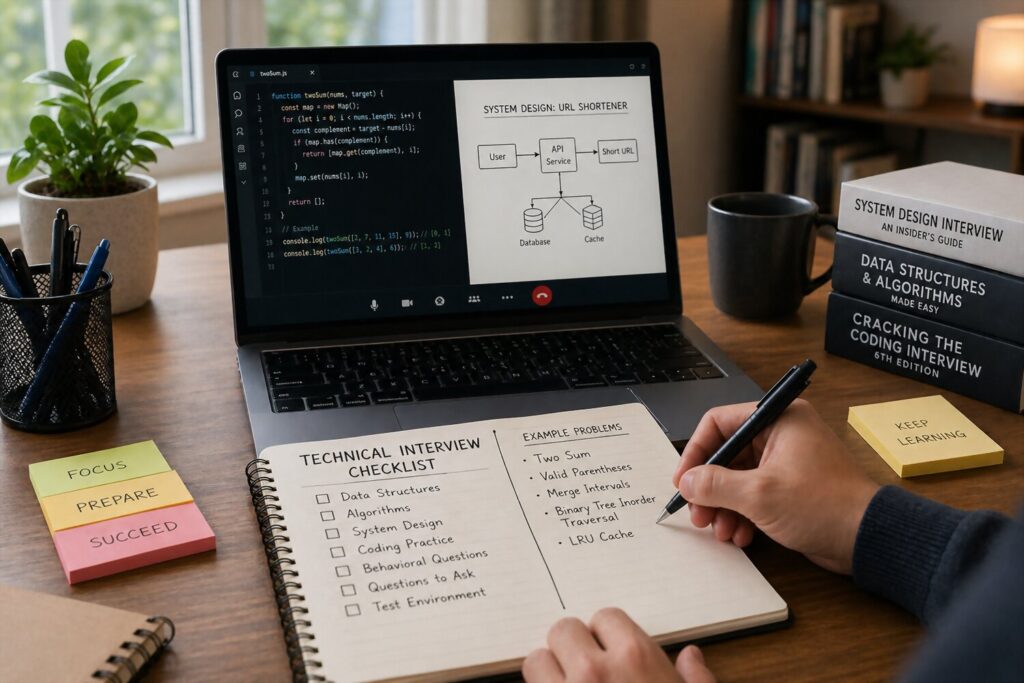
Remote technical interviews are designed to evaluate more than coding ability. They test how you think, how you communicate, and how you operate without in person cues.
The format often combines live coding, system design, and deep discussion of past work. Each part reflects real job expectations in a distributed environment.
Understand the Evaluation Model
Interviewers are not only checking correctness. They are assessing reasoning, clarity, and decision making under constraints.
A correct solution with weak explanation is often scored lower than a well reasoned approach with minor gaps. This is because remote work depends on transparent thinking. You need to make your process visible as you work.
Approach Coding Interviews as Communication Exercises
Live coding in remote settings introduces additional friction. You are working through a shared editor while explaining your thinking verbally.
Focus on clarity over speed. State your assumptions before writing code. Break the problem into steps and explain each one. When you encounter uncertainty, articulate it explicitly instead of guessing silently.
Interviewers evaluate how you handle ambiguity as much as how you solve the problem.
Prepare for System Design at Multiple Levels
System design is no longer limited to senior roles. Even mid level candidates are expected to reason about architecture.
You should be able to design systems that handle real world constraints such as scale, latency, and failure. This includes choosing appropriate data storage, defining APIs, and considering deployment environments. It also includes explaining trade offs between different approaches.
| Area | What You Should Demonstrate |
|---|---|
| Requirements | Ability to clarify scope and constraints |
| Architecture | Clear structure of components and interactions |
| Data design | Appropriate choice of storage and schema |
| Scalability | Handling growth and increased load |
| Reliability | Managing failures and recovery strategies |
These dimensions reflect how systems behave beyond simple examples.
Use Past Projects as Evidence
Your previous work is one of the strongest signals you can provide. Interviewers often ask you to walk through a project in detail.
Prepare structured explanations that cover problem definition, design decisions, implementation challenges, and outcomes. Be ready to discuss what you would change if you built it again. This shows reflection and growth.
Avoid vague descriptions. Specific details demonstrate ownership and credibility.
Simulate Real Interview Conditions
Preparation should mirror the actual environment. Practice coding while speaking your thoughts out loud. Use timed sessions to build pacing awareness.
Conduct mock interviews with peers or use platforms that replicate real scenarios. Record yourself if possible and review clarity and structure. This helps identify gaps that are not obvious during silent practice.
Handle Remote Specific Constraints
Technical issues can affect performance. You need to control what you can.
Ensure your environment is stable. Test your microphone, camera, and development setup in advance. Keep notes or a simple framework nearby to organize your thoughts during complex discussions.
Small operational details can influence the overall impression.
Position Yourself in High Demand Niches
General full stack capability is no longer sufficient to differentiate candidates. The market has matured, and employers increasingly prioritize developers who combine breadth with targeted expertise.
Positioning yourself in a high demand niche does not mean abandoning full stack identity. It means anchoring your skill set in a domain where complexity, scarcity, and business value intersect. This creates a stronger narrative and reduces competition.
Identify Where Demand Is Concentrated
Certain domains consistently attract hiring demand because they solve high value problems or require specialized knowledge. These areas evolve, but patterns remain stable.
- SaaS platforms that require scalable multi tenant architectures
- AI enabled applications that integrate machine learning models into products
- Fintech systems that demand strong data integrity and regulatory awareness
- Developer tools and APIs that prioritize performance and usability
- Real time systems such as collaboration tools or streaming platforms
These niches are not defined only by technology. They are defined by the problems they solve and the constraints they operate under.
Develop Depth Through Practical Exposure
You cannot credibly claim a niche without hands on experience. Reading about a domain is not enough.
Build or contribute to projects that reflect real use cases. For example, in SaaS, implement role based access control and billing logic. In AI integration, work with model inference pipelines and data preprocessing. In fintech, simulate transaction handling with consistency guarantees. These experiences create concrete understanding that transfers directly to job requirements.
Depth is demonstrated through decisions made under constraints, not through surface level familiarity.
Understand Domain Specific Constraints
Each niche introduces its own set of technical and operational constraints. Employers expect awareness of these constraints even at intermediate levels.
For example, fintech systems require strong consistency and auditability. AI systems require data quality management and performance considerations for inference. SaaS platforms require tenant isolation and scalability. Understanding these factors allows you to design systems that align with real world expectations.
Ignoring domain constraints leads to designs that look correct but fail under practical conditions.
Align Your Stack With Your Niche
Technology choices should support your positioning. Random stacks weaken your narrative.
If you focus on SaaS, emphasize frameworks and tools that support scalable web applications and cloud deployment. If you focus on AI integration, highlight experience with data pipelines and model serving. If you focus on developer tools, demonstrate strong API design and performance optimization.
Consistency across your projects, resume, and discussions reinforces credibility.
Communicate Your Positioning Clearly
Your niche must be visible to others. This includes recruiters, hiring managers, and peers.
Use precise language when describing your experience. Avoid generic labels and instead highlight the type of systems you build and the problems you solve. Your portfolio, resume, and online presence should all reflect the same direction.
A clear position reduces ambiguity. It helps others quickly understand where you fit and why you are valuable.
References
- Remote work overview – Explains the nature of remote work, its reliance on digital tools, and challenges such as reduced face to face interaction and communication barriers.
- Virtual team – Describes how distributed teams collaborate across locations using communication technologies, highlighting the importance of structured communication in remote environments.
- Communication in distributed software development – Covers how communication and coordination directly impact software development quality in remote and distributed teams.
- Collaborative software – Defines tools that support teamwork and shared goals, reinforcing the role of structured communication and coordination in remote work settings.