
Why Freelancers Struggle to Deliver Work on Time
Delivering work on time is one of the biggest challenges freelancers face—not because they lack discipline, but because freelance projects often have more moving parts than they appear to have at the start. A “simple” website update, article draft, logo package, consulting report, or video edit can quickly become delayed when the scope is unclear, client feedback arrives late, or the freelancer underestimates how much coordination the project requires.
One common issue is unclear expectations at the beginning of the project. If the deliverables are loosely defined, both the freelancer and the client may have different ideas of what “done” means. For example, a client may expect multiple design concepts, extra revision rounds, or same-day changes, while the freelancer may have planned for a smaller scope. Without a shared understanding of responsibilities, timelines, and approval steps, even a well-managed project can slip behind schedule.
Another major cause of delays is poor time estimation. Freelancers often estimate the creative or technical work itself but forget to account for the surrounding tasks: onboarding, research, file organization, client communication, revisions, invoicing, and unexpected troubleshooting. A project that requires ten hours of focused work may realistically need several additional hours for planning and communication. When those hidden tasks are not included in the schedule, deadlines become harder to meet.
Client-side delays can also disrupt the timeline. Freelancers often depend on clients to provide brand assets, background information, feedback, approvals, or access to tools. If those inputs arrive late, the freelancer may lose valuable production time. The challenge is that many freelancers still feel responsible for the final deadline, even when the delay was caused by missing information or slow approvals. That is why strong project management includes clear client responsibilities from day one.
Overbooking is another frequent problem. Because freelance income can be unpredictable, many freelancers say yes to too many projects at once. This may feel practical in the short term, but it creates a fragile schedule. One delayed client, one urgent revision, or one personal interruption can create a chain reaction across multiple projects. Sustainable delivery requires more than motivation; it requires a realistic workload and enough buffer time to absorb normal project friction.
Freelancers also struggle when they rely only on memory instead of a repeatable system. Without a task list, calendar, project board, or documented workflow, important details can fall through the cracks. Missed messages, forgotten revision notes, unclear file versions, and vague next steps all add unnecessary delay. A simple system is often enough: one place to track deadlines, one place to store project details, and one routine for checking progress.
In our team’s view, late delivery is rarely caused by one dramatic mistake. More often, it is the result of several small gaps: a vague scope, an optimistic estimate, a missing approval, an overpacked calendar, or a lack of communication. The good news is that each of these problems can be managed with better planning.
To understand where your own projects tend to slow down, ask:
- Was the scope clear before the work began?
- Did the estimate include revisions, communication, and admin time?
- Did the client know exactly what they needed to provide and when?
- Was there buffer time for delays or unexpected changes?
- Was progress tracked in a reliable system?
Once freelancers identify the real source of delays, they can stop treating on-time delivery as a matter of luck or personal willpower. Instead, they can build a project management process that makes deadlines easier to plan, communicate, and meet.
Start Every Project With a Clear Scope and Timeline
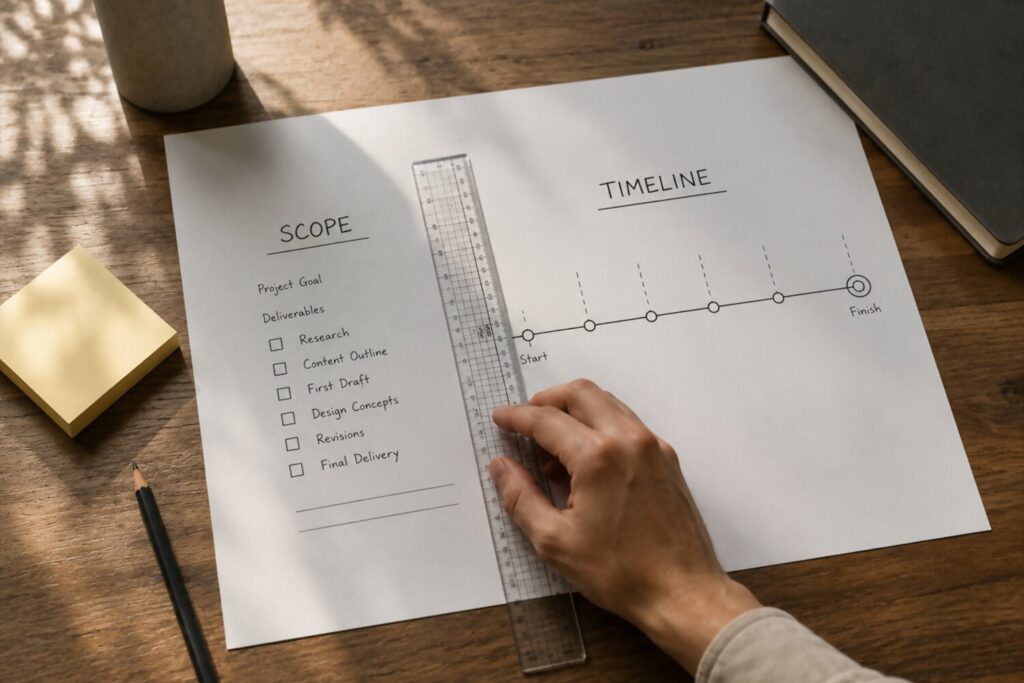
A reliable delivery process begins before the actual work starts. For freelancers, the first step is to make sure everyone understands what will be delivered, when it will be delivered, and what is needed from the client along the way. When those details are vague, even a small project can become difficult to manage.
A clear project scope defines the boundaries of the work. It explains what is included, what is not included, and how the final result will be reviewed. For example, “write website copy” is too broad. A stronger scope would specify the number of pages, approximate word count, tone, number of revision rounds, deadline for client feedback, and final file format. The more specific the scope is, the easier it becomes to plan the work and avoid last-minute confusion.
A timeline should also include more than the final due date. Freelancers often benefit from mapping out the full path from kickoff to delivery, including research, drafts, reviews, revisions, and final approval. This helps both sides see where time is being spent and where client input is required.
| Project Detail | What to Clarify Before Starting |
|---|---|
| Deliverables | What exactly will be created or completed? |
| Deadline | When is the final delivery due? |
| Milestones | What smaller checkpoints will happen before the deadline? |
| Revisions | How many rounds are included, and what counts as a revision? |
| Client responsibilities | What materials, feedback, approvals, or access does the client need to provide? |
| Communication | Where will updates, files, and decisions be shared? |
One of the most useful habits freelancers can build is creating a short kickoff summary after the project is approved. This does not need to be complicated. It can be a simple email, shared document, proposal section, or project brief that confirms the agreed details in one place. The goal is to reduce assumptions and give both the freelancer and client a shared reference point.
A strong kickoff summary might include:
- Project goal: What the client wants to accomplish.
- Main deliverables: The specific work the freelancer will provide.
- Timeline: Key dates for drafts, feedback, revisions, and final delivery.
- Client inputs: Assets, information, access, or approvals needed.
- Review process: How feedback will be collected and when it is due.
- Out-of-scope items: Work that would require a separate discussion or updated timeline.
This step is especially important when a project involves multiple stakeholders. If one person approves the project but another person reviews the work, expectations can shift halfway through. Asking who will provide final feedback and approval helps prevent conflicting notes and delayed decisions.
In our team’s view, the best project timelines are not just schedules; they are communication tools. They show the client how the work will move forward and help the freelancer protect enough time for focused production. A clear timeline also makes it easier to identify delays early. If feedback is due on Wednesday but arrives Friday, both sides can see how that may affect the final delivery date.
Freelancers do not need a complex system to start projects well. They need a clear scope, realistic dates, and a written record of key decisions. When those pieces are in place, deadlines become easier to manage because the project has structure from the beginning.
Break Projects Into Milestones Instead of One Final Deadline
One of the most effective ways freelancers can deliver work on time is to stop treating the final deadline as the only deadline. A project becomes much easier to manage when it is broken into smaller milestones, each with a clear purpose and due date. Instead of waiting until the end to find out whether the project is on track, milestones create natural checkpoints where progress can be reviewed, adjusted, and approved.
A milestone is a meaningful step in the project, not just a random task on a to-do list. For example, “send first draft,” “receive client feedback,” “complete revisions,” and “deliver final files” are milestones because they move the project from one phase to the next. They also make the timeline more visible for both the freelancer and the client.
For a freelance writing project, the milestones might look like this:
- Kickoff and brief review: Confirm the topic, audience, goals, and requirements.
- Outline approval: Share the structure before writing the full draft.
- First draft delivery: Submit the complete draft for review.
- Client feedback: Collect comments by an agreed date.
- Revision round: Apply approved changes and polish the work.
- Final delivery: Send the finished version in the required format.
This approach works for many types of freelance projects. A designer might use milestones for mood boards, initial concepts, revisions, and final assets. A developer might use milestones for discovery, wireframes, staging, testing, and launch. A consultant might use milestones for research, findings, draft recommendations, and final presentation.
Milestones help reduce risk because they make problems easier to spot early. If a client does not approve the outline on time, the freelancer can address the delay before writing begins. If a technical issue appears during testing, it can be handled before the launch date. Without milestones, these problems often stay hidden until the final deadline is already too close.
In our team’s view, milestones also improve client communication. Clients often feel more confident when they can see where the project stands and what comes next. Instead of asking, “Is this almost done?” they can follow a clear sequence of steps. This reduces uncertainty and gives the freelancer a practical reason to send updates without sounding defensive or rushed.
A useful milestone should answer three questions:
- What will be completed at this stage?
- Who needs to review or approve it?
- What happens next after approval?
Freelancers should also be careful not to create too many milestones. If every small task becomes a formal checkpoint, the process can feel slow and overcomplicated. The goal is to create enough structure to keep the project moving, while still leaving room for focused work.
For most freelance projects, a simple milestone plan is enough: start, draft or build, review, revise, and deliver. When each stage has a clear date and owner, the final deadline becomes less stressful because progress is being managed throughout the entire project—not just at the end.
Estimate Time More Accurately With Buffer Built In

Accurate time estimation is one of the most valuable project management skills a freelancer can develop. It affects nearly every part of the client experience: the project timeline, the delivery date, the freelancer’s workload, and the client’s confidence in the process. When estimates are too optimistic, even a well-planned project can become stressful. When estimates are realistic, the freelancer has a better chance of delivering quality work without rushing.
A common mistake is estimating only the “main work” and forgetting everything around it. For example, a freelance writer may estimate the time needed to draft an article but overlook research, outlining, editing, formatting, client emails, and revisions. A designer may estimate the time needed to create a concept but not the time required to prepare files, respond to feedback, or adjust designs for different formats. These supporting tasks may seem small, but they can add up quickly.
A stronger estimate includes the full project workflow:
- Preparation time: reviewing the brief, asking questions, gathering assets, and setting up files.
- Production time: writing, designing, developing, editing, consulting, or creating the main deliverable.
- Review time: checking accuracy, quality, formatting, links, file names, or technical details.
- Communication time: sending updates, answering questions, and documenting decisions.
- Revision time: applying client feedback and preparing updated versions.
- Admin time: organizing files, creating invoices, updating task boards, or closing out the project.
Freelancers should also consider the project’s risk level. A repeat project for a familiar client may be easier to estimate because the process is already known. A first-time client, unclear brief, new tool, complex topic, or project with several decision-makers may require more buffer. Buffer time is not about working slowly; it is about protecting the schedule from normal project friction.
For example, if a task usually takes six hours of focused work, it may not be wise to promise delivery in one business day. The work itself may fit into the day, but the project could still require clarification, file setup, review, and communication. A more realistic timeline gives space for both the task and the process around it.
In our team’s view, freelancers should track estimated time versus actual time whenever possible. This simple habit builds better judgment over time. After each project, ask: Did this take longer than expected? If so, why? The answer may reveal patterns, such as underestimating research, accepting too many revision requests, or waiting on client materials.
Useful questions to ask before giving a timeline include:
- Have I done this type of project before?
- What information or assets do I need from the client?
- How many review or revision rounds are included?
- Could another project or commitment compete for the same time?
- What part of this project is most likely to take longer than expected?
The goal is not to create a perfect estimate every time. Freelance work often includes variables that cannot be fully predicted. The goal is to create an informed estimate based on real tasks, past experience, and reasonable buffer. When freelancers estimate with the full workflow in mind, they are more likely to set timelines they can actually meet—and clients are more likely to understand what the work truly involves.
Use Simple Project Management Tools and Systems
Freelancers do not need a complicated project management setup to deliver work on time. In many cases, the best system is the one that is easy to update, easy to understand, and easy to use consistently. A tool should reduce confusion—not create another layer of work.
The goal is to have a reliable place to track tasks, deadlines, files, client communication, and project status. When those details are scattered across email threads, chat messages, notes apps, and memory, it becomes easier to miss something important. A simple system helps freelancers see what needs attention today, what is waiting on the client, and what is coming next.
Start With a Task List
A task list is the foundation of most freelance workflows. It turns a project from a vague obligation into specific actions. Instead of writing “finish client project,” break the work into smaller tasks such as “review brief,” “draft outline,” “send first version,” “apply feedback,” and “prepare final files.”
A useful task list should include:
- The next action needed to move the project forward.
- A due date for time-sensitive work.
- The project or client name so tasks are easy to sort.
- Status notes such as “waiting for feedback” or “ready for review.”
This keeps the freelancer focused on what can actually be done, instead of constantly rethinking the whole project.
Use a Calendar for Deadlines and Work Blocks
A calendar is helpful for more than final deadlines. Freelancers can use it to schedule milestone dates, client check-ins, review windows, and focused work sessions. This makes workload planning more realistic because it shows how much time is actually available.
For example, if a project is due Friday, the calendar might include research on Monday, drafting on Tuesday, revisions on Wednesday, internal review on Thursday, and final delivery on Friday morning. Seeing the work spread across the week helps prevent the common mistake of assuming everything can be completed at the last minute.
Choose a Project Board for Multi-Step Work
For projects with several moving parts, a basic project board can be useful. Many freelancers use columns such as:
- To Do
- In Progress
- Waiting on Client
- In Review
- Completed
This format makes project status visible at a glance. It is especially helpful when managing multiple clients because it separates active work from items that are paused while waiting for feedback, files, approvals, or access.
Keep Files and Decisions Organized
Timely delivery is not only about completing the work; it is also about finding the right information quickly. Freelancers should have a clear naming system for files, drafts, notes, and final versions. For example, using dates or version numbers can help prevent confusion when several drafts exist.
It is also useful to keep important decisions in writing. If a client approves a direction, changes a deadline, or requests a revision, that decision should be documented in a place both sides can reference. This reduces the risk of repeating conversations or working from outdated instructions.
Avoid Overbuilding the System
In our team’s view, freelancers should be careful not to spend more time managing the system than doing the work. A project management setup should be simple enough to maintain during a busy week. If a tool requires too many fields, too many updates, or too much manual organization, it may become a burden instead of a benefit.
A practical starting system might include:
- One task list for daily and weekly actions.
- One calendar for deadlines and work sessions.
- One project board for tracking client projects.
- One shared folder or workspace for files and key notes.
- One communication routine for updates and approvals.
The best system is not necessarily the most advanced. It is the one that helps the freelancer stay organized, protect their time, and give clients a clear view of progress. When tools support the workflow instead of distracting from it, they become an important part of delivering work on time.
Communicate Progress Before Problems Become Delays
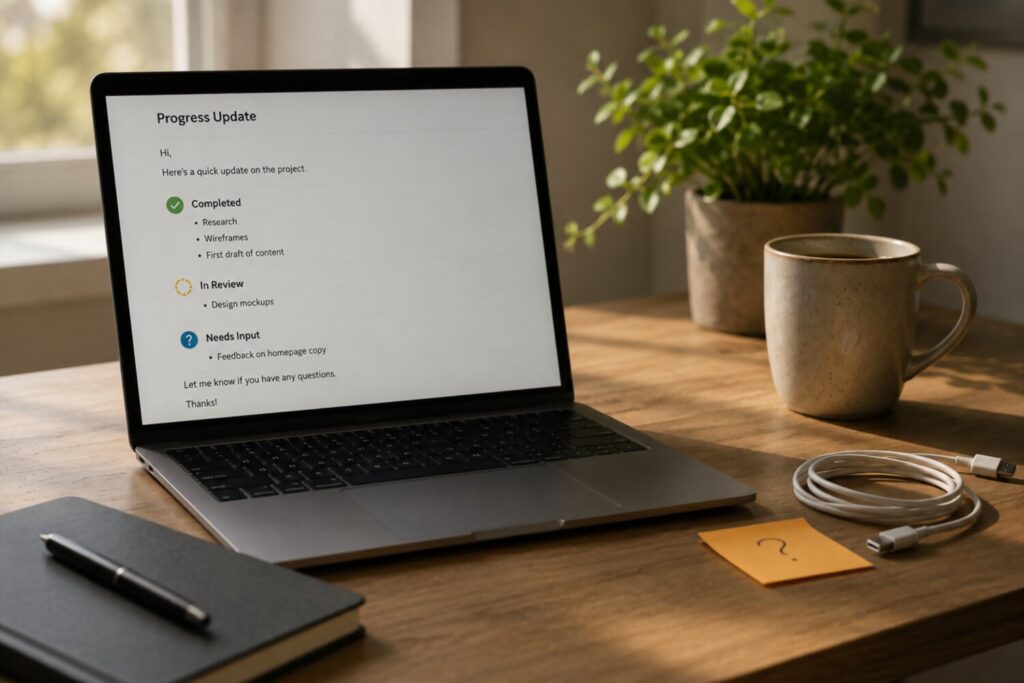
Strong communication is one of the simplest ways freelancers can keep projects on schedule. Clients should not have to wonder whether work is moving forward, what stage the project is in, or what they need to do next. When communication is clear and proactive, small questions are resolved sooner, feedback arrives with more context, and potential delays are easier to manage before they affect the final deadline.
A good progress update does not need to be long. It should tell the client what has been completed, what is currently happening, and what is needed next. This keeps the project visible without overwhelming the client with unnecessary detail. For example, a freelancer might send a short message after completing research, starting a draft, submitting a first version, or waiting on feedback.
A useful update might include:
- Current status: What stage the project is in.
- Recent progress: What has been completed since the last update.
- Next step: What will happen next and when.
- Client action: Any feedback, files, approvals, or decisions needed.
- Timeline note: Whether the project is still on track or needs adjustment.
This habit is especially important when a project depends on client input. If the client needs to send brand assets, review a draft, approve a design direction, or provide access to a platform, those responsibilities should be stated clearly and early. A vague reminder such as “Let me know what you think” is less helpful than “Please send feedback by Thursday at 3 p.m. so I can complete revisions by Friday.”
Freelancers should also flag blockers as soon as they appear. A blocker is anything that prevents the work from moving forward, such as missing information, unclear feedback, delayed approvals, technical access issues, or a change in direction. Waiting too long to mention a blocker can make the freelancer look unprepared, even when the delay is outside their control.
In our team’s view, the best communication style is calm, specific, and solution-focused. Instead of writing, “This is going to be late because I still do not have what I need,” a more professional message would be: “I’m ready to move into revisions, but I still need feedback on the first draft. If I receive comments by Wednesday, I can keep the Friday delivery date. If feedback comes later, I’ll send an updated timeline.”
That kind of message does three important things: it identifies the issue, explains the impact, and gives the client a clear path forward. It avoids blame while still protecting the project schedule.
Freelancers can also reduce confusion by documenting important decisions in writing. If a client approves a concept during a call, changes a deadline, or asks to prioritize one deliverable over another, it is helpful to send a quick recap afterward. Written confirmation gives both sides a shared record and helps prevent misunderstandings later.
A simple communication rhythm might include:
- Kickoff confirmation after the project begins.
- Milestone updates when major stages are completed.
- Feedback reminders before client review deadlines.
- Blocker alerts when something prevents progress.
- Final delivery notes explaining what was completed and where files can be found.
Clear communication does not mean sending constant messages. It means sending the right information at the right time. When freelancers communicate before problems become urgent, they create a smoother project experience and give themselves a better chance of delivering work on time.
Create a Repeatable Delivery Process for Future Projects
Delivering work on time becomes easier when freelancers stop rebuilding their process from scratch for every client. While each project may have different goals, most freelance work follows a familiar pattern: gather information, plan the work, create the deliverable, collect feedback, revise, and deliver the final version. Turning that pattern into a repeatable process helps reduce mistakes and makes timelines more predictable.
A repeatable delivery process does not have to be complicated. It can start with a simple checklist that guides each project from beginning to end. For example, a freelancer might create one checklist for onboarding, one for production, one for revisions, and one for final delivery. These checklists help ensure important steps are not missed, especially during busy periods.
A practical freelance delivery process might include:
- Project intake: Collect goals, requirements, files, access details, deadlines, and stakeholder information.
- Scope confirmation: Confirm deliverables, milestones, revision limits, and client responsibilities.
- Production plan: Break the project into tasks and schedule focused work time.
- Progress updates: Send status notes at key milestones or agreed intervals.
- Review and revision: Collect feedback in one place and apply approved changes.
- Final delivery: Send completed files, links, notes, or documentation in the agreed format.
- Project review: Compare the estimate to the actual time spent and note improvements for next time.
The final step is especially valuable. After a project ends, freelancers should take a few minutes to review what happened. Did the timeline work? Was the scope clear? Did feedback arrive on time? Were there avoidable delays? These questions help turn each project into useful experience rather than just another completed assignment.
Templates can also make the process faster and more consistent. Freelancers can create reusable templates for project briefs, kickoff emails, status updates, feedback requests, file delivery messages, and post-project reviews. Instead of writing everything from scratch, they can adapt a proven format to each client.
In our team’s view, a strong process protects both the freelancer and the client. It gives the freelancer a reliable way to manage details, and it gives the client a clearer view of what to expect. This does not mean every project will be perfect or completely predictable. It means the freelancer has a structured way to handle common situations, such as missing assets, delayed feedback, or extra revision requests.
A repeatable process also makes improvement easier. When freelancers track what they estimated, what actually happened, and where delays occurred, they can refine future timelines with better information. Over time, this can lead to more realistic scheduling, clearer communication, and fewer last-minute surprises.
The most useful process is one that is simple enough to follow consistently. Start with the basics: a checklist, a timeline, a communication routine, and a habit of reviewing each project after delivery. With those pieces in place, on-time delivery becomes less dependent on memory or pressure and more supported by a system that can improve with every project.
Common Mistakes To Avoid
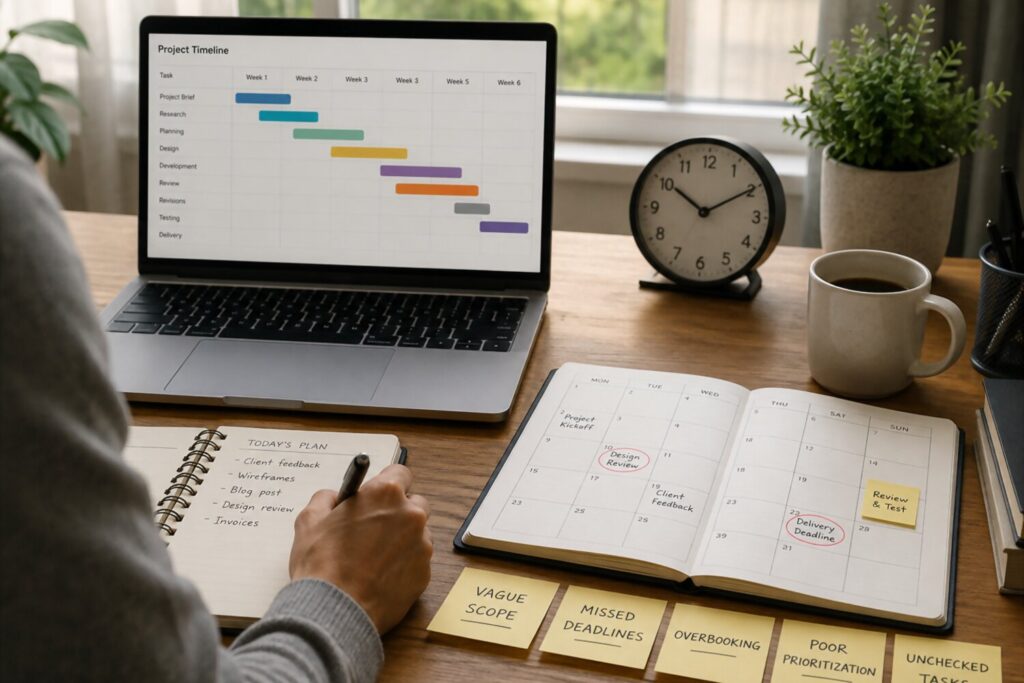
Even freelancers with strong skills can miss deadlines when their project management habits are too informal. Delivering work on time is not only about working faster; it is about removing the small risks that quietly build up during a project. Since project management often involves balancing scope, time, resources, and documentation, freelancers need a process that makes those limits visible from the beginning. For helpful background, see Wikipedia’s overview of project management.
1. Starting before the scope is clear
One of the most common mistakes is beginning the work before the deliverables, deadlines, and review process are fully understood. This can lead to rework, unclear priorities, and difficult conversations later. Before starting, freelancers should confirm what is included, what is not included, how feedback will be handled, and what the client must provide.
2. Treating the final deadline as the only deadline
A single final due date does not give enough visibility into the project. Without smaller checkpoints, a freelancer may not realize the project is behind until there is little time left to fix it. Milestones make progress easier to track and give clients structured opportunities to review the work before final delivery.
3. Forgetting to schedule admin and communication time
Many freelancers estimate only the creative or technical work. They forget about emails, file setup, research, meetings, revisions, formatting, invoicing, and final delivery notes. These tasks are part of the project, even if they are not the main deliverable. Time management is closely connected to planning and controlling how time is spent on specific activities, which makes it useful to review basic time management principles when building a freelance workflow.
4. Waiting too long to flag a problem
Delays are easier to manage when they are communicated early. If a client has not sent feedback, a tool is not working, or the project needs more clarification, the freelancer should explain the issue before it becomes urgent. A calm update with the blocker, the impact, and the next step is usually more helpful than a last-minute apology.
5. Accepting every request without checking the timeline
Small changes can add up. A quick revision, an extra format, or a new stakeholder review may seem manageable on its own, but several small additions can affect delivery. Freelancers should pause before agreeing to extra work and consider whether the timeline, scope, or milestone plan needs to be adjusted.
6. Relying on memory instead of a system
A freelancer may remember most details when managing one project, but memory becomes less reliable when several clients, deadlines, and revision rounds are active at once. A simple task list, calendar, project board, or shared document can prevent missed steps and reduce mental clutter.
7. Skipping the post-project review
Once a project is delivered, it is tempting to move straight to the next one. However, a short review can reveal useful patterns. Freelancers should ask: What took longer than expected? Where did the client need more guidance? Which step caused the most delay? What should be added to the checklist next time? These answers help improve future estimates and make the delivery process more reliable.
Avoiding these mistakes helps freelancers build a more predictable workflow. The goal is not to control every possible variable, but to create enough structure that deadlines are easier to plan, communicate, and meet.