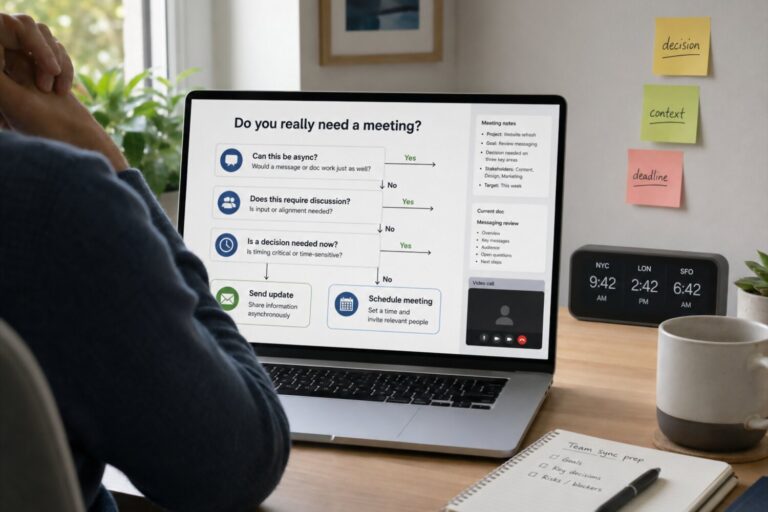
Why Hybrid Work Fails Even When Employees Want Flexibility
Hybrid work is a flexible work arrangement in which employees split their working time between remote and on-site locations. It differs from fully remote work, where employees normally work outside a traditional office, and office-first work, where most work is expected to happen on-site. Gallup uses this basic distinction in its research on remote-capable U.S. employees and reports that hybrid work remains the preferred arrangement for many workers whose jobs can be done remotely. Gallup’s Hybrid Work Indicator provides ongoing data on how remote-capable employees work and what arrangements they prefer.
Hybrid work can look simple on paper: employees spend part of the week at home and part in the office. In practice, however, a hybrid schedule is not the same thing as a well-designed hybrid operating model.
Many organizations run into problems because they change where people work without sufficiently changing how work gets done. Teams may still depend on spontaneous office conversations, in-person meetings, or managers being able to see who is at a desk. When some employees are remote and others are on-site, those habits can create gaps in communication, coordination, and decision-making.
That does not mean work location is irrelevant. Some roles, activities, and teams depend more heavily on physical equipment, face-to-face interaction, or rapid in-person coordination than others. The point is that organizations should diagnose the specific source of a problem rather than assuming that either remote work or office attendance is automatically the solution.
For example, imagine that a project decision is made during an informal office conversation. The people who were present understand the change immediately, while remote colleagues learn about it later—or not at all. In this situation, the main problem is not simply that someone worked remotely. The team lacks a reliable process for documenting and sharing important decisions.
A struggling hybrid workplace may show several recognizable signs:
- Employees attend more meetings because teams use calls to compensate for limited visibility.
- Important information is spread across email, chat, meetings, and informal conversations.
- People are unsure when coworkers are available or when office attendance is actually necessary.
- Managers focus heavily on presence instead of project progress and measurable outcomes.
- Remote participants have difficulty contributing equally during meetings.
- Employees come to the office only to spend most of the day on video calls with colleagues elsewhere.
These issues can indicate a work-design problem rather than a location problem alone. Hybrid teams generally need clear expectations about communication, documentation, availability, meetings, decision-making, and performance.
Research also suggests that hybrid work should not automatically be treated as a productivity problem. A randomized controlled trial highlighted by Stanford examined employees who worked from home two days per week and found no measurable negative effect on productivity or career advancement while employee attrition declined. The finding does not prove that every hybrid arrangement will produce the same outcome, but it reinforces an important point: the design and management of the arrangement matter. Stanford’s summary of the hybrid-work study explains the findings in more detail.
One useful test is to ask: Would this process still work if every team member were working from a different location today? If the answer is no, the workflow may depend heavily on physical proximity.
That does not mean every activity should become remote. Certain conversations, workshops, training sessions, and collaborative activities may benefit from being done in person. The goal is to make those choices intentionally. Employees should understand why they are being asked to work together in a particular place or format, rather than following a schedule that has little connection to the work itself.
Before changing the number of required office days, organizations should first identify where friction is occurring. Is information getting lost? Are decisions slow? Are meetings ineffective? Are responsibilities unclear? Diagnosing the actual problem makes it much easier to determine whether the solution involves better processes, stronger management practices, improved technology, more purposeful in-person collaboration—or a combination of these.
For specific ways to address these workflow issues, see How to Fix Communication, Meetings, and Collaboration later in this article.
In other words, hybrid work can struggle when flexibility is treated mainly as a scheduling policy rather than as an operating model for the team. A more reliable approach is to build clear workflows and shared expectations that allow employees to contribute effectively across locations.
The Most Common Hybrid Work Problems

Hybrid work problems rarely come from a single source. More often, they develop when communication habits, meeting practices, management expectations, and workplace technology are not designed for a team that is split across locations.
The first step toward improving a hybrid model is recognizing where the friction actually occurs. Several issues tend to appear repeatedly.
Communication breakdowns
In a hybrid workplace, information can easily become fragmented. One update may be shared in a meeting, another in a private chat, and a third during an informal office conversation. Employees who were not present may receive incomplete information or spend additional time trying to reconstruct what happened.
A practical solution is to create a shared source of truth for important decisions, project updates, deadlines, and responsibilities. Teams should not have to attend every conversation to stay informed.
Collaboration becomes uneven
Hybrid collaboration can become difficult when some employees are physically together while others join remotely. In meetings, for example, people in the room may naturally talk to one another, read body language, or continue discussions after the call ends. Remote participants may have fewer opportunities to contribute unless the meeting is deliberately structured to include them.
Microsoft Research has examined this problem in its work on hybrid meetings, noting that hybrid formats can create participation disadvantages for people joining remotely. Its guidance emphasizes intentionally designing meetings around both remote and in-room participants rather than treating the remote audience as an add-on.
Teams can reduce this imbalance by using shared digital documents, structured agendas, clear facilitation, and written follow-ups. The goal is not to make every interaction identical, but to make it possible for employees in different locations to participate meaningfully.
Too many meetings
Some organizations respond to distributed work by adding more video calls. While meetings can be useful for discussion and decision-making, using them as the default communication method can reduce time available for focused work.
A better approach is to decide what actually requires real-time discussion. Status updates, routine announcements, and straightforward project information can often be handled asynchronously. Meetings are generally more useful when teams need to solve a complex problem, make a decision, resolve ambiguity, or work through an issue together.
Unclear schedules and availability
Hybrid work becomes harder when employees do not know who will be available, where colleagues will be working, or whether a particular day is intended for collaboration.
Clear team norms can help. For example, a team might establish expectations for core collaboration hours, calendar updates, response times, or shared in-office days. These expectations should support the work rather than create unnecessary rigidity.
Proximity can affect visibility
Employees who spend more time in the office may naturally have more informal contact with managers or senior colleagues. That can create an uneven employee experience if important conversations, recognition, feedback, or opportunities depend heavily on physical presence.
This possibility deserves attention, but managers should avoid assuming that every difference in employee experience is caused by proximity. Instead, they can make communication and performance processes more deliberate. Regular one-on-one conversations, documented goals, transparent project assignments, and consistent evaluation criteria can help keep attention focused on relevant work and results.
For a deeper look at management practices that can address these issues, see How Managers Can Build a Fair and Effective Hybrid Work Model.
Technology creates unnecessary friction
Hybrid work depends heavily on reliable technology. Poor audio, inconsistent conferencing tools, weak room setups, or confusing software processes can turn routine collaboration into a frustrating experience.
Technology does not need to be complex, but it does need to be dependable. Teams should have clear standards for video meetings, document sharing, messaging, project tracking, and access to information. Meeting rooms should also be designed so remote participants can hear, see, and contribute without unnecessary difficulty.
Social connection can weaken
Not every hybrid-work challenge is operational. Employees may also have fewer informal interactions with coworkers, particularly when schedules rarely overlap. This can make relationship-building and informal knowledge-sharing more difficult for some teams.
Organizations do not need to force constant social activity to address the issue. More purposeful approaches—such as team working sessions, mentoring, occasional in-person gatherings, or informal virtual conversations—can create opportunities for connection without adding excessive meetings.
The key is to avoid treating all of these problems as evidence that hybrid work itself has failed. Different problems have different causes and require different responses. Communication gaps may require better documentation, meeting overload may require stronger asynchronous practices, and uneven participation may require changes to meeting design.
Before changing a hybrid policy, leaders should identify which specific problems employees are experiencing and address those directly. This provides a more useful basis for decision-making than applying a single solution to every team.
Why Hybrid Teams Struggle With Productivity and Accountability
When productivity drops in a hybrid environment, it is tempting to blame the location of work. But performance problems can also be connected to unclear priorities, weak processes, fragmented communication, or poorly defined responsibilities.
Hybrid work can make these weaknesses easier to notice because managers and employees have fewer opportunities to resolve confusion through spontaneous, in-person conversations. A task with an unclear owner may sit unfinished. A decision buried in a chat thread may delay a project. An employee may spend hours in status meetings because there is no reliable system for tracking progress.
At the same time, research does not support a simple assumption that hybrid work inherently reduces productivity. In Stanford’s randomized study of Trip.com employees, participants who worked from home two days per week were as productive as their office-based peers according to the measures examined, while attrition fell by about one-third. The results came from a specific company and workforce, so they should not be generalized to every job or organization. They do show why managers should evaluate actual outcomes instead of assuming that location determines performance. Read Stanford’s overview of the study.
The solution to a productivity problem, therefore, is not necessarily more supervision. In many cases, managers should first examine how the work is structured.
Measure outcomes, not visibility
In a traditional office, managers can easily see when employees arrive, attend meetings, or sit at their desks. Those observations provide information about presence, but they do not necessarily show whether meaningful work is being completed.
A stronger hybrid management approach focuses on observable outcomes. Employees should understand:
- What they are responsible for
- What a successful result looks like
- Which deadlines or milestones matter
- Who has authority to make key decisions
- How progress will be communicated
- When they should ask for help or escalate a blocker
For example, instead of expecting an employee to remain visibly active throughout the day, a manager can define a specific deliverable, quality standard, due date, and review process. This gives both sides a clearer way to evaluate progress.
A useful diagnostic question is: Can the manager explain who owns the work, what success looks like, and when the result is expected? If not, the accountability problem may begin with unclear expectations rather than employee location.
Fragmented communication creates hidden work
Hybrid teams often use several communication channels at once: email, messaging platforms, video meetings, shared documents, and project-management systems. Each tool can be useful, but problems arise when employees do not know where authoritative information belongs.
Consider a simple project update:
| Weak hybrid workflow | Stronger hybrid workflow |
|---|---|
| Deadline changes during a video call | Deadline is updated in the shared project system |
| Responsibilities are assigned through private messages | Owners are documented where the team can see them |
| Employees attend meetings to learn project status | Routine status updates are available asynchronously |
| Decisions remain in chat history | Important decisions are recorded in a shared document |
| Managers repeatedly ask for progress updates | Employees update agreed-upon milestones |
The goal is not to document every conversation. It is to make important information easy to find without requiring employees to reconstruct it from multiple channels.
Too much coordination can reduce productive time
Hybrid teams sometimes respond to uncertainty by increasing communication. More check-ins, status meetings, notifications, and progress requests may seem like ways to improve accountability, but they can also interrupt focused work.
Managers should distinguish between communication that moves work forward and communication that mainly demonstrates activity.
A routine project update, for example, may not require a 30-minute meeting if employees can provide the necessary information in a shared project tracker. Real-time meetings are more useful when participants need to debate options, resolve a complicated issue, make a decision, or coordinate work that requires immediate interaction.
Protecting periods of uninterrupted work can be especially valuable for tasks that require sustained concentration, such as analysis, writing, design, coding, or strategic planning.
Clear ownership prevents work from falling between locations
Accountability becomes difficult when responsibilities belong vaguely to “the team.” Hybrid environments benefit from explicit ownership because employees cannot always rely on informal office interactions to determine who is handling the next step.
For important work, teams should identify both an owner and a next action. Instead of writing, “We need to update the presentation,” a clearer project note might say, “Jordan will update the customer analysis and share the revised slides by Thursday afternoon.”
That level of clarity reduces unnecessary follow-up and makes delays easier to diagnose.
Productivity should be evaluated in context
No single metric can accurately represent productivity across every role. The right indicators depend on the work being performed. A customer support team might examine resolution quality and response times, while a product team might focus on milestones, defects, customer outcomes, or delivery reliability.
Managers should therefore select a small number of measures that reflect meaningful results rather than relying primarily on easily observed activity such as messages sent, hours online, or meetings attended.
When performance problems appear, it helps to investigate the underlying process before changing the entire hybrid policy. Ask whether priorities are clear, employees have the information and tools they need, dependencies are being managed, and unnecessary meetings or interruptions are slowing execution.
For a broader approach to diagnosing and measuring hybrid performance, see A Practical Framework for Making Hybrid Work Successful.
Effective accountability in hybrid work depends heavily on clarity rather than visibility alone. When people know what they own, how their work contributes to team goals, and how success will be evaluated, managers have a stronger foundation for identifying genuine performance problems and removing obstacles.
How to Fix Communication, Meetings, and Collaboration
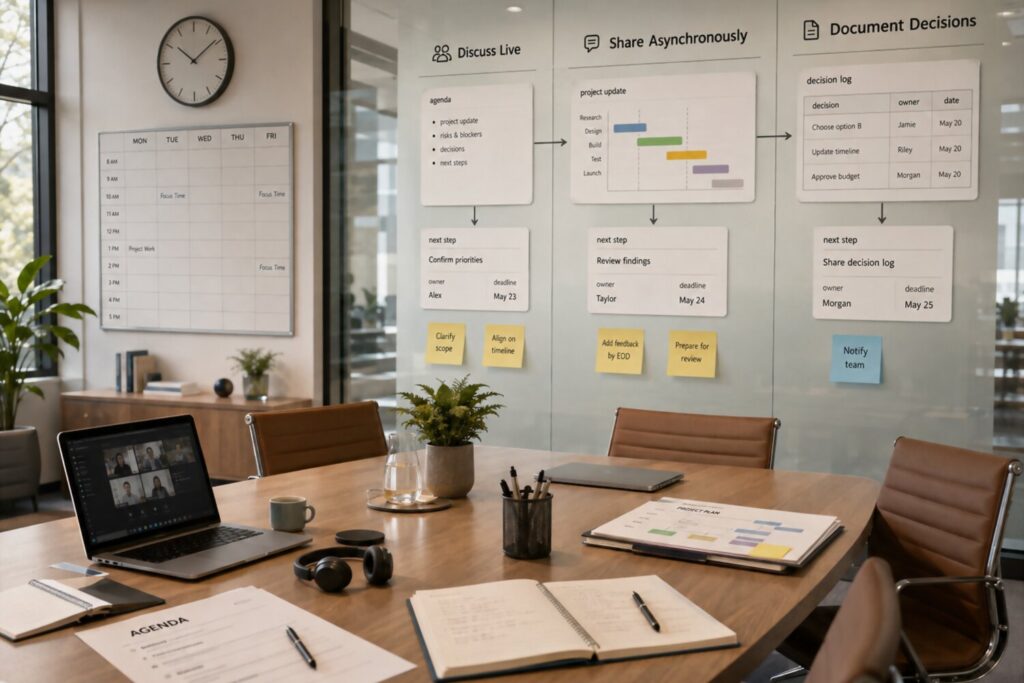
Hybrid teams work more reliably when communication does not depend on everyone being in the same place at the same time. That requires more than adding video calls or messaging tools. Teams need clear rules for where information lives, which conversations require real-time discussion, and how decisions are documented.
The goal is not necessarily to communicate more. It is to communicate with less friction.
Create a documentation-first habit
Important information should be accessible after a conversation ends. When decisions exist only in meetings, private messages, or office discussions, employees who were not present may lack the context they need to move forward.
Teams can reduce this problem by documenting a few essential items consistently:
- Key decisions and the reasoning behind them
- Project owners and responsibilities
- Important deadlines and milestones
- Changes to scope or priorities
- Action items that come out of meetings
Documentation does not need to become a lengthy administrative task. A short written summary with the decision, owner, and next step is often enough.
For example, instead of relying on everyone to remember a meeting discussion, a team might record: “The product launch will move to October 15. Maya owns the revised timeline and will publish it in the project tracker by Friday.”
That creates a reference point employees can find later.
Match the communication method to the task
Not every issue deserves a meeting. Hybrid teams can save time by deciding which work should happen asynchronously and which situations benefit from live discussion.
| Better handled asynchronously | Better handled synchronously |
|---|---|
| Routine status updates | Complex problem-solving |
| Project documentation | Sensitive or nuanced discussions |
| Simple approvals | Decisions requiring debate |
| Sharing background information | Collaborative brainstorming |
| Nonurgent questions | Urgent coordination |
| Progress reporting | Resolving significant ambiguity |
These categories are not absolute. A written discussion can become a meeting when an issue grows complicated, while a recurring meeting can become an asynchronous update when participants rarely need to discuss anything.
A useful rule is to ask: Does this conversation require people to react, discuss, or decide together right now? If not, an asynchronous format may be more efficient.
Give each communication channel a clear purpose
Hybrid collaboration becomes confusing when the same type of information appears across email, chat, shared documents, and project tools.
Teams can establish simple conventions. For example:
- Chat: quick questions and short coordination
- Email: external communication or formal updates
- Project management system: owners, deadlines, and task status
- Shared documents: plans, decisions, and detailed working information
- Video or in-person meetings: discussion, problem-solving, and decisions that benefit from interaction
The exact tools matter less than consistency. Employees should know where to look for the latest version of important information.
Design meetings for everyone, not just the room
A hybrid meeting can become uneven when several people are together in a conference room and others join remotely. Side conversations, poor audio, or discussions directed primarily toward people in the room can make remote participation difficult.
This is a documented challenge in hybrid meeting research. Microsoft’s research-based Hybrid Meetings Guide discusses the trade-offs among in-person, remote, and hybrid formats and recommends deliberately designing hybrid meetings so remote attendees can participate effectively.
Good meeting design can reduce these problems.
Start with an agenda that explains the purpose of the meeting and what decision or outcome is expected. Share relevant documents in advance when possible so participants do not spend the first part of the meeting catching up.
During the conversation, facilitators should make space for remote participants rather than assuming they will interrupt when they want to speak. Shared digital documents can also help because everyone can contribute notes, questions, or ideas through the same interface.
After the meeting, record decisions, owners, and next steps in a place the entire team can access.
Reduce meetings that exist only for visibility
Recurring meetings often continue because they are familiar, not because they remain useful. Hybrid teams should periodically review their calendars and ask whether each meeting still serves a clear purpose.
A meeting may be a candidate for removal or redesign if:
- Participants mostly provide updates without discussion
- The same information already exists in another system
- Few attendees actively contribute
- Decisions are rarely made
- Employees routinely multitask because the content is not relevant to them
Replacing a weekly status call with a structured written update can free time while still giving managers visibility into progress.
However, reducing meetings should not mean eliminating meaningful interaction. Live conversations remain valuable when teams need to build shared understanding, resolve disagreement, or work through complicated decisions.
Make office time purposeful
Hybrid collaboration can work better when employees understand why being together physically is useful. Requiring office attendance without connecting it to specific activities can result in employees commuting to the office only to spend the day on individual work or video calls.
Teams can instead coordinate in-person time around activities that are likely to benefit from richer interaction, such as planning sessions, workshops, onboarding, collaborative problem-solving, or relationship-building.
Individual concentration work may often be completed effectively in other environments, depending on the role, task, available workspace, and employee circumstances.
Protect time for focused work
Collaboration is important, but employees also need uninterrupted time to complete tasks. A calendar filled with short meetings can fragment the workday and make sustained concentration difficult.
Teams can experiment with practical boundaries such as meeting-free periods, fewer recurring check-ins, or agreed blocks for focused work. Managers can also avoid treating immediate responses as the default expectation when a message is not actually urgent.
Ultimately, strong hybrid communication is based on intentional choices rather than constant availability. Teams should know when to write, when to meet, where to record decisions, and how to make collaboration accessible regardless of location.
When those practices are consistent, employees can spend less time searching for information or attending unnecessary meetings and more time completing the work those communication systems are intended to support.
How Managers Can Build a Fair and Effective Hybrid Work Model
Managers play a major role in whether hybrid work feels organized or frustrating. Policies may define how many days employees spend in the office, but day-to-day management determines how work is assigned, how information is shared, and how performance is evaluated.
A strong hybrid model should make expectations clear while giving employees enough structure to coordinate effectively. The goal is not to manage every hour of the workday. It is to create conditions in which people understand what is expected and can contribute consistently from different locations.
Set clear team expectations
Hybrid teams need shared norms around availability, communication, meetings, and office attendance. Without them, employees may create their own assumptions, which can lead to missed messages, scheduling conflicts, or uneven workloads.
Managers should clarify practical questions such as:
- When are team members generally expected to be available?
- Which meetings require attendance?
- How quickly should employees respond to routine messages?
- When should urgent issues be escalated?
- Which activities are best handled in the office?
- Where should project updates and decisions be recorded?
These expectations should be specific enough to reduce confusion without creating unnecessary rules for every situation.
Evaluate performance based on meaningful outcomes
One risk in hybrid management is treating visibility as a substitute for performance. Employees who spend more time in the office may naturally have more informal contact with managers, but that does not automatically mean they are producing stronger results.
A better approach is to evaluate employees using criteria connected to their actual responsibilities.
For example, managers might look at:
- Quality and completeness of work
- Progress toward agreed goals
- Reliability in meeting deadlines
- Contribution to team projects
- Customer or stakeholder outcomes
- Ability to communicate and resolve issues
The exact measures should vary by role. What matters is that employees understand how their work will be assessed and that managers use relevant criteria consistently.
The Stanford hybrid-work trial provides useful context here: researchers found no negative effect on performance ratings or promotion outcomes for the hybrid group in the population studied. While one study cannot establish what will happen in every workplace, the result provides another reason not to use physical presence as a stand-alone proxy for performance.
Reduce the risk of proximity bias
Proximity bias describes the risk that people who are physically closer to decision-makers may receive more attention, information, or opportunities because they have more frequent informal contact.
Managers can reduce this risk by making important processes more deliberate. Project assignments, feedback, recognition, and development conversations should be based on relevant work considerations rather than depending mainly on who happens to be in the office.
For example, instead of choosing a project lead during an informal hallway conversation, a manager can review relevant skills, workload, and development goals before making the assignment. Important opportunities can also be shared through channels that everyone can access.
Use one-on-ones for support, not surveillance
Regular one-on-one meetings can be especially useful in hybrid teams because managers may have fewer informal opportunities to understand how employees are doing.
These conversations are most valuable when they focus on priorities, obstacles, feedback, development, and support.
Useful questions include:
- What is getting in the way of your work?
- Which priorities feel unclear?
- Where do you need a decision or additional context?
- Is the current meeting schedule helping or slowing you down?
- Are there collaboration issues we should address?
This approach gives managers useful information without turning one-on-ones into activity checks.
Train managers to lead distributed teams
Managing a hybrid team can require different habits from managing a group that works together in one location every day. Managers may need to become more deliberate about documentation, communication, delegation, and performance expectations.
For example, a manager who relies heavily on spontaneous conversations may need to shift toward written follow-ups. A manager who once judged progress partly by seeing employees at their desks may need to define clearer deliverables and milestones.
These are management skills, not just technology skills. New collaboration tools cannot compensate for unclear expectations or inconsistent leadership.
Gather feedback and adjust the model
Hybrid policies should not be treated as permanent simply because they have been announced. Teams, projects, and business needs change.
Managers can periodically review whether the model is supporting the work by asking employees about specific operational issues. Instead of asking only, “Do you like hybrid work?” it is more useful to ask questions such as:
- Are you able to get the information you need?
- Are office days useful for collaboration?
- Which meetings could be improved or removed?
- Are responsibilities and deadlines clear?
- Do remote and in-office participants have similar access to discussions and decisions?
The answers can reveal practical problems that may not be visible from a policy document.
Use in-person time where it adds value
A fair hybrid model does not require every task to be treated the same way. Some activities may benefit from being done in person, while others may be better suited to focused remote work.
Stanford research on hybrid work has similarly emphasized that hybrid arrangements can combine some benefits of office-based interaction with the benefits employees may receive from working at home. The appropriate balance, however, depends on the organization and the work being performed.
For example, teams may choose in-person time for planning sessions, onboarding, workshops, or complex collaboration. Individual writing, analysis, or routine project work may not require everyone to be physically together.
The key is to connect location decisions to the work itself rather than using attendance as a general indicator of commitment or performance.
Ultimately, effective hybrid management depends on clarity, consistency, and intentional leadership. When employees know what is expected, how performance is measured, and how decisions are made, managers have a stronger foundation for making hybrid work predictable and effective.
A Practical Framework for Making Hybrid Work Successful
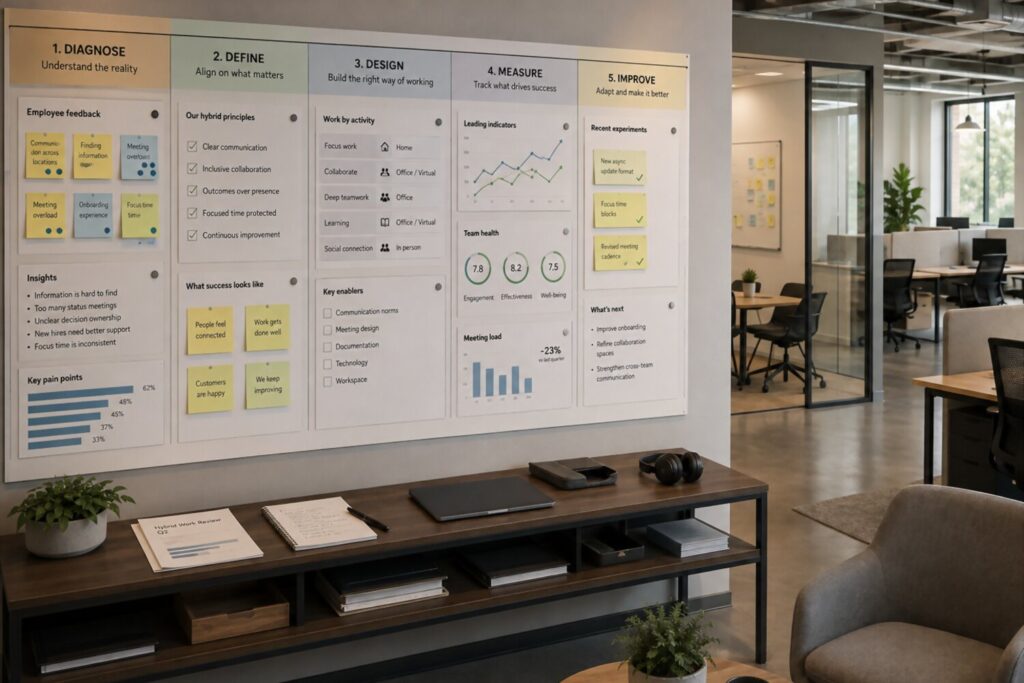
A successful hybrid model is not built simply by choosing an office schedule and leaving everything else unchanged. It requires a repeatable way to identify problems, set expectations, design workflows, measure results, and adjust when something is not working.
A useful approach is to treat hybrid work as an operating model that can be tested and improved, rather than a fixed policy.
1. Diagnose the real problem
Before changing office requirements or adding new tools, identify where employees are experiencing friction.
Look for specific issues such as:
- Important information is difficult to find
- Projects are delayed because ownership is unclear
- Employees spend too much time in meetings
- Remote participants struggle to contribute
- Office days lack a clear purpose
- Managers have limited visibility into project progress
- Employees use different systems for the same type of information
Avoid starting with a broad conclusion such as “hybrid work is reducing productivity.” Instead, define the observable problem. For example, “project approvals are taking longer because decision-makers are not clearly identified” gives the team something concrete to investigate and fix.
2. Define how the team will work
Once the problem is clear, establish practical expectations.
A hybrid team should understand when synchronous collaboration is necessary, where information should be stored, how quickly different types of messages should be answered, and how office time will be used.
These expectations do not need to cover every possible situation. A small number of clear working agreements may be easier to follow than a long policy document.
For example:
Availability: Team members maintain agreed collaboration hours for meetings and time-sensitive work.
Communication: Routine updates go into the project system rather than private messages.
Decisions: Significant project decisions are documented in a shared location.
Office time: In-person days are primarily used for activities that benefit from being together.
Performance: Employees are evaluated using role-relevant goals and outcomes rather than physical presence alone.
3. Design workflows for more than one location
A good test of a hybrid process is whether it still works when team members are in different places.
Suppose a manager assigns a project during an office conversation. If that assignment is never recorded, the process depends on physical proximity. A stronger workflow would document the project owner, deadline, requirements, and next step in a system available to everyone involved.
This does not mean every interaction needs formal documentation. Teams should focus on information that others may need later, especially decisions, responsibilities, deadlines, and changes in direction.
The objective is to make location less relevant to someone’s ability to understand what is happening.
4. Measure outcomes that matter
Hybrid work should be evaluated using relevant business and team outcomes rather than a single measure such as office attendance.
The right metrics will vary by organization and role, but useful examples may include:
- Project completion and delivery reliability
- Quality or error rates
- Customer or stakeholder outcomes
- Time required to make or implement decisions
- Employee turnover or retention trends
- Meeting volume and time spent in meetings
- Progress toward team or organizational goals
Metrics also need context. A missed deadline, for example, does not automatically indicate an individual productivity problem. The delay may come from changing priorities, unclear requirements, technical dependencies, or slow approvals.
The Stanford randomized trial demonstrates why this distinction matters: in the workforce studied, hybrid employees did not experience the productivity decline that some managers initially expected. Measurement can therefore help leaders test assumptions rather than relying on perceptions about where work happens.
Managers should use measurement to identify patterns and ask better questions—not simply to create more employee monitoring.
5. Review and improve the model
No hybrid system should be assumed to work equally well in every context or indefinitely. Teams change, new employees join, projects become more complex, and tools or business priorities evolve.
A periodic review can help identify whether established practices still make sense.
Teams might ask:
- Which parts of our hybrid model are helping us work effectively?
- Where are employees still losing time?
- Which meetings no longer provide enough value?
- Are important decisions easy to find?
- Do employees understand when they should work together in person?
- Are remote and in-office employees able to participate effectively?
- Are performance expectations still clear?
Changes should address identifiable problems. If collaboration is weak, for example, the answer may be better meeting design or more coordinated working sessions—not necessarily additional mandatory office days.
A simple hybrid-work health check
Leaders can also use a short checklist to spot weaknesses before they become larger operational problems:
- Information: Can employees find important decisions and project updates without attending every meeting?
- Ownership: Does important work have a clearly identified owner?
- Expectations: Do employees understand what results they are responsible for?
- Collaboration: Can remote participants contribute meaningfully to discussions and decisions?
- Meetings: Does each recurring meeting have a clear purpose?
- Office time: Is there a practical reason for employees to be together?
- Technology: Can employees access the tools and information required to do their jobs?
- Management: Are managers evaluating relevant outcomes consistently rather than relying mainly on visibility?
- Improvement: Is the organization willing to change practices that are not working?
If several answers are “no,” the organization has a useful starting point for further investigation and improvement.
There is no single number of office days that will make every hybrid team successful. Roles, organizations, employees, customers, and operational requirements differ. What leaders can control is the quality of the system around the schedule: clear expectations, reliable workflows, purposeful collaboration, appropriate performance measures, and a willingness to change practices when evidence shows they are not working.
Hybrid work becomes easier to evaluate when leaders stop asking only, “Where should people work?” and also ask the more useful question: “What conditions do people need to do good work together?”
Conclusion
Hybrid work does not succeed or fail simply because employees split their time between home and the office. Results depend largely on how well the organization designs communication, collaboration, accountability, and day-to-day workflows around that arrangement.
Instead of focusing only on how many days people should be in the office, leaders should identify the specific problems affecting their teams. Clear responsibilities, accessible information, purposeful meetings, consistent performance expectations, and well-planned in-person collaboration can address many of the common challenges discussed in this article.
The most useful approach is to treat hybrid work as a system that should be reviewed and adjusted over time. Measure relevant outcomes, gather practical feedback, and change processes when evidence shows they are creating unnecessary friction. A hybrid model that supports the actual work—not just the schedule—has a much stronger foundation for long-term effectiveness.