What Is a Freelance Proposal—and When Do You Need One?
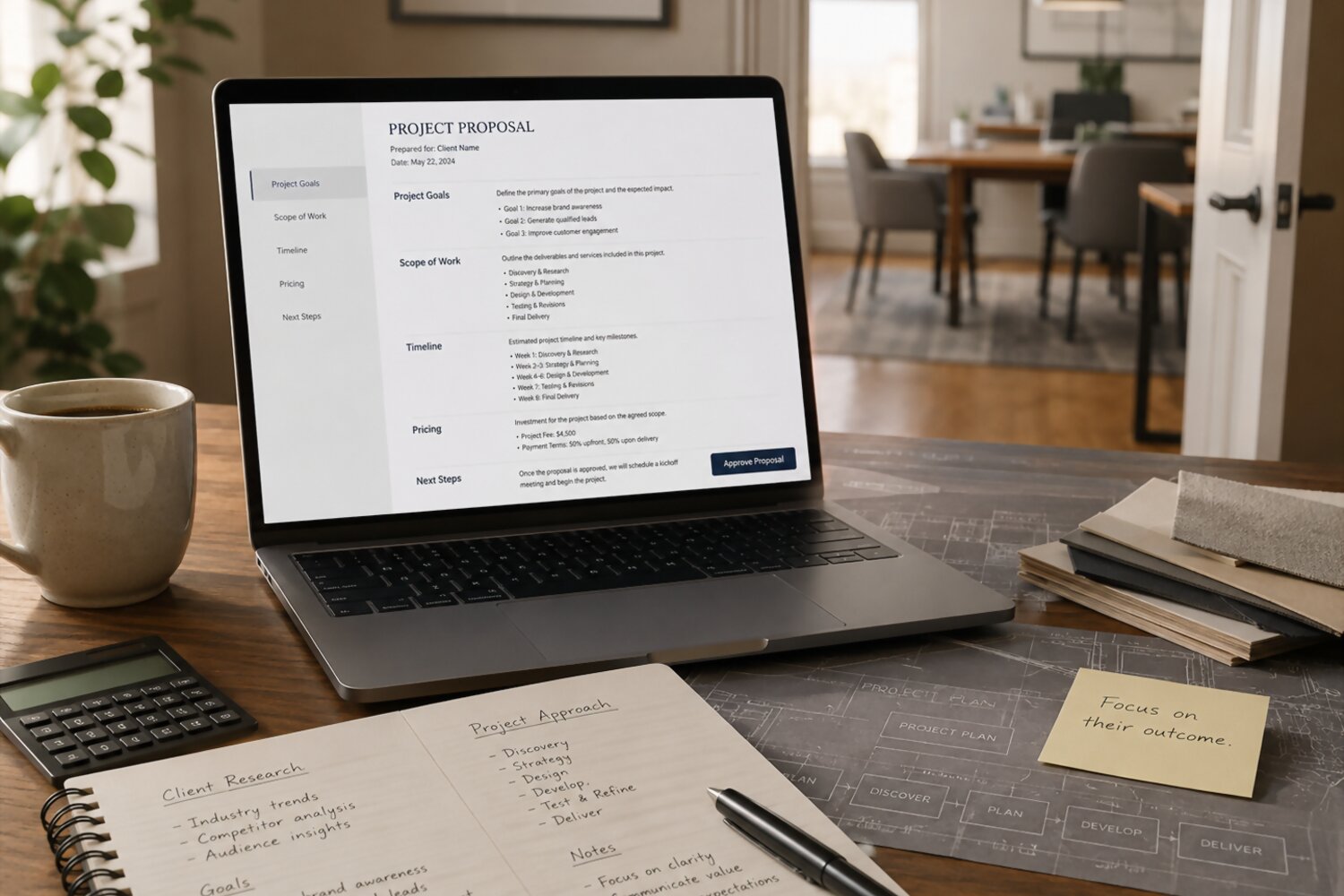
A freelance proposal is a document or message that explains how you plan to help a potential client complete a project or achieve a specific goal. It usually outlines your understanding of the work, the services you will provide, the expected timeline, the price, and the next steps.
A strong proposal does more than introduce you. It helps the client evaluate whether you understand their needs, whether your approach is realistic, and whether working with you feels clear and low-risk. Instead of focusing only on your skills, it connects your experience to the client’s situation.
For example, a weak opening might say:
“I am an experienced freelance writer with five years of experience.”
A more useful proposal would connect that experience to the project:
“You need a series of beginner-friendly articles that explain technical topics without losing accuracy. I would begin by reviewing your existing content and audience guidelines, then create a consistent outline and approval process for the full series.”
The second version gives the client more decision-making information. It shows that the freelancer understands the assignment and has already started thinking about a practical approach.
Freelance Proposal vs. Cover Letter, Quote, and Contract
These terms are sometimes used interchangeably, but they serve different purposes.
| Document | Primary purpose | Common contents |
|---|---|---|
| Cover letter or pitch | Introduces your qualifications and interest | Short overview, relevant experience, portfolio links |
| Proposal | Explains how you would complete the project | Client goals, approach, deliverables, timeline, pricing |
| Quote or estimate | Provides an expected price | Services, quantities, rates, total cost |
| Contract | Records the agreed working terms | Scope, responsibilities, payment terms, ownership, cancellation terms |
A proposal may include a quote, but it usually provides more context than a price alone. It explains what the client will receive and why your recommended approach fits the project.
A proposal is also different from a contract. A client may approve your proposal as the basis for moving forward, but freelancers often use a separate written agreement to document the final scope and working terms. The exact process can vary by client, platform, and project type.
When Should You Send a Freelance Proposal?
You do not need a detailed proposal for every conversation. The right format depends on the project’s complexity, value, and level of uncertainty.
A full proposal is especially useful when:
- The client has requested multiple deliverables.
- The work will take place over several weeks or phases.
- The scope needs to be clarified before work begins.
- You are offering a customized solution rather than a standard service.
- The project involves milestones, revisions, or multiple stakeholders.
- The client needs to compare several freelancers or service options.
- You have completed a discovery call and want to summarize the recommended plan.
A shorter pitch may be enough for a small, clearly defined task. For example, if a client needs one existing document proofread and has already provided the word count, deadline, and file, you may only need a brief message confirming your approach, availability, and fee.
By contrast, a website redesign may require a more detailed proposal covering page types, design stages, client responsibilities, revision rounds, launch support, and timing. Without that information, both sides may leave the conversation with different expectations.
What a Freelance Proposal Should Accomplish
Before sending a proposal, check whether it answers the client’s most important questions:
- Do you understand what I need?
- What exactly will you deliver?
- How will you approach the work?
- How long is the project expected to take?
- What will it cost?
- Why are you a credible fit?
- What should I do next?
The goal is not to make the proposal as long as possible. It is to remove avoidable uncertainty. A client should be able to scan the document and understand the project structure without searching through unrelated background information. You can see how these elements fit together in the fill-in-the-blank freelance proposal template.
The best time to write a proposal is after you have enough information to recommend a realistic path forward. When important details are still missing, ask focused questions first. A clear proposal begins with a clear understanding of the work.
What to Learn About the Client Before Writing
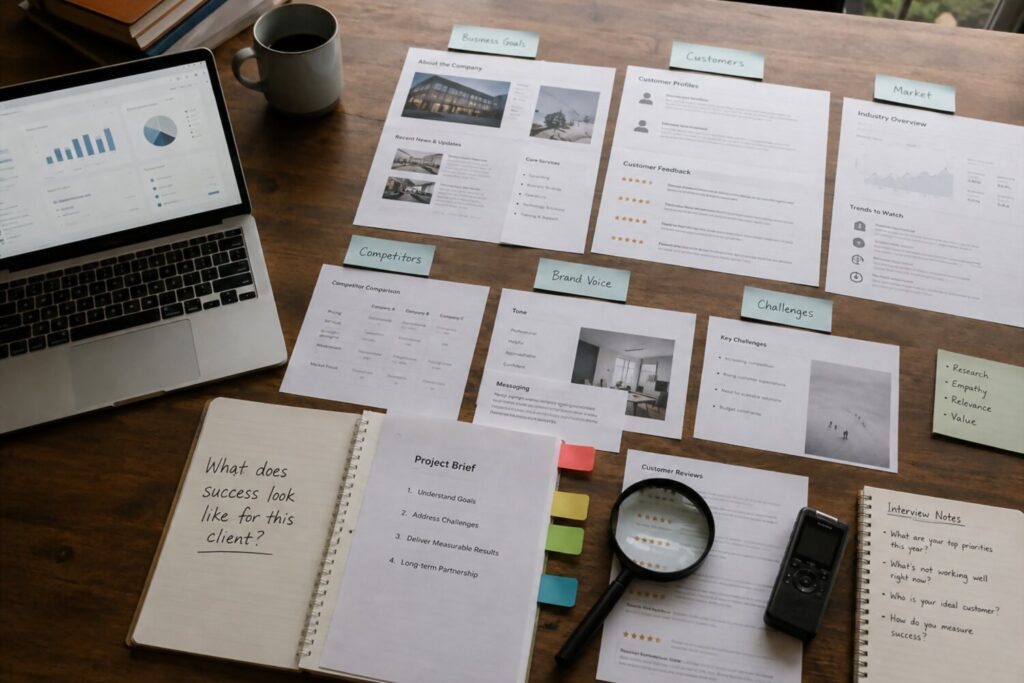
A persuasive freelance proposal starts before you write the opening sentence. To recommend the right approach, you first need to understand what the client is trying to accomplish, what constraints may affect the project, and how success will be evaluated.
This does not require hours of research. In many cases, a careful review of the client’s website, project brief, job post, and previous messages will give you enough context to ask better questions and avoid a generic response.
Identify the Goal Behind the Task
Clients often describe what they want produced without fully explaining why they need it.
For example:
- “Write four blog posts” is a deliverable.
- “Help new customers understand our software” is a goal.
- “Create a landing page” is a task.
- “Increase demo requests from qualified visitors” is a desired outcome.
Your proposal should acknowledge the requested work, but it should also show that you understand the business or practical purpose behind it. This helps you explain your approach in terms that matter to the client.
Avoid assuming the goal when it has not been stated. Instead, ask a focused question such as:
“What should readers understand or do after viewing the finished page?”
The answer may affect the structure, scope, timeline, and type of expertise the project requires.
Review the Available Context
Before contacting the client with questions, look at the information already available. Repeating questions that the client has answered can make your proposal feel rushed or impersonal.
Depending on the project, review:
- The original inquiry or job description
- The client’s website and public-facing materials
- Brand, style, or technical guidelines
- Examples the client has shared
- Existing content, designs, or systems related to the project
- Mentioned deadlines, budgets, and approval processes
- Required tools, platforms, file formats, or integrations
Look for patterns as well as gaps. A client may say they need “website copy,” but the site could contain ten pages with different audiences and goals. That difference matters when estimating the workload.
The information you collect here will also help you personalize the template for different clients instead of relying on language that could apply to almost any project.
Clarify the Scope and Deliverables
A clear proposal depends on a clear definition of what you are expected to provide. Before pricing the project, confirm the quantity, format, level of complexity, and review process for each deliverable.
For a freelance writer, this might include:
- Number and approximate length of articles
- Research expectations
- SEO requirements
- Interview or source needs
- Image or upload responsibilities
- Number of revision rounds
For a designer, developer, consultant, or virtual assistant, the details will be different, but the principle is the same: define the work in specific, observable terms.
Compare these two descriptions:
Vague: “I will help improve your website.”
Specific: “I will review the five primary service pages, recommend structural changes, rewrite the page copy, and provide one consolidated revision round.”
The second version gives both parties a clearer basis for discussing price, timing, and completion.
Understand the Timeline and Decision Process
Ask when the work needs to be completed and whether that date depends on another event, such as a product launch, campaign, conference, or internal review.
You should also find out:
- When project materials will be available
- Who will provide feedback
- How many people must approve the work
- Whether milestones are required
- How quickly the client can respond to questions
- Whether other freelancers or teams are involved
A deadline is not the same as a workable schedule. If the client needs a final deliverable in three weeks but cannot provide source materials for two weeks, the proposal should account for that dependency.
Learn How Success Will Be Evaluated
Not every project can be measured with a single number. Still, you should understand what the client will consider a successful result.
Possible success criteria include:
- Completing the agreed deliverables by the target date
- Meeting brand or technical requirements
- Improving clarity, usability, or consistency
- Supporting a campaign or launch
- Reducing the client’s internal workload
- Producing assets that are ready for publication or implementation
Be careful not to promise results that depend on factors outside your control. A freelancer may be able to improve a landing page’s message, for example, but cannot responsibly guarantee a specific number of sales without knowing the traffic quality, offer, pricing, and other variables.
Ask Focused Discovery Questions
Good discovery questions are specific enough to produce useful answers. Instead of asking, “Can you tell me more about the project?” guide the client toward the information you need.
Consider asking:
- What result should this project support?
- Who is the primary audience or end user?
- Which deliverables are required, and which are optional?
- Are there examples you want me to follow or avoid?
- What deadline or launch date is driving the schedule?
- Who will review and approve the work?
- Are there technical, brand, or platform requirements I should know about?
You do not need to ask every question on every project. Choose the ones that resolve real uncertainty and help you prepare an accurate proposal.
The purpose of client research is not to collect unnecessary information. It is to understand the project well enough to recommend a realistic solution. Once you know the client’s goal, audience, deliverables, constraints, and decision process, you can write a proposal that feels specific rather than interchangeable.
How to Write a Freelance Proposal, Step by Step
Once you understand the client’s goal, scope, and constraints, you can turn that information into a proposal that is easy to evaluate. The strongest proposals are usually not the ones with the most elaborate language. They are the ones that clearly explain the problem, the recommended solution, the work involved, and the next step.
Use the following process to build a proposal that is specific without becoming unnecessarily long.
1. Begin With the Client’s Situation
Open by showing that you understand why the client is considering the project. This is more useful than beginning with a lengthy introduction about your background.
A clear opening might summarize:
- What the client wants to accomplish
- Who the project is intended to serve
- What challenge or gap needs to be addressed
- Why the timing or outcome matters
For example:
“Your current website explains the product’s features, but new visitors may have difficulty understanding which plan fits their needs. This project will focus on reorganizing and rewriting the five primary product pages so users can compare options more easily.”
This opening demonstrates understanding without claiming to know more than the client has shared. If an important detail is uncertain, state it as an assumption or identify it as something to confirm.
2. Define the Desired Outcome
After describing the situation, explain what the project is intended to achieve. The outcome should be realistic and connected to the work you will actually perform.
For example, a freelance editor might write:
“The goal is to produce a clear, consistent manuscript that follows the publisher’s style requirements and is ready for the next stage of review.”
That is more precise than promising that the manuscript will become a bestseller. Freelancers can commit to their process and deliverables, but they should avoid guaranteeing results that also depend on advertising, market conditions, customer behavior, or decisions outside their control.
When possible, use the client’s own language to describe the goal. This creates continuity between the initial conversation and the proposal.
3. Present Your Recommended Approach
Explain how you plan to complete the project. Clients usually do not need every internal detail of your workflow, but they should understand the major phases and why they are necessary.
A website copy project, for example, might include:
- Reviewing the existing site, audience information, and brand guidelines
- Confirming the purpose and key message of each page
- Preparing page outlines for approval
- Drafting the copy
- Incorporating the agreed revision round
- Delivering final copy in the requested format
This structure helps the client see that your fee covers a defined process rather than only the final file.
Keep the approach proportional to the project. A one-hour consultation may need only a few sentences, while a multi-stage project may benefit from a timeline or milestone table.
4. List the Deliverables Clearly
Deliverables should be specific enough that both you and the client can recognize when the work has been completed.
Instead of writing:
“Social media support for one month,”
write something more concrete:
“Twelve original social media posts, including captions, recommended posting dates, and one platform-ready graphic for each post.”
Depending on your service, clarify details such as:
- Quantity and approximate length
- File type or delivery format
- Platforms, pages, or channels included
- Research or preparation work
- Meetings or consultation time
- Revision rounds
- Final handoff materials
It can also be helpful to state what is not included when the boundary may otherwise be unclear. For example, a proposal for website design might include page layouts and responsive mockups but exclude development, hosting setup, and ongoing maintenance.
Exclusions should be written neutrally. The purpose is to prevent confusion, not to make the proposal feel restrictive.
5. Establish Responsibilities and Dependencies
Projects often require information, access, or feedback from the client. Mention these dependencies so the proposed schedule is based on realistic conditions.
Client responsibilities might include:
- Providing brand guidelines, source files, or account access
- Confirming the main point of contact
- Reviewing work within an agreed period
- Consolidating feedback from multiple stakeholders
- Approving milestones before the next phase begins
For example:
“The schedule assumes that background materials are provided before the project start date and that milestone feedback is returned within three business days.”
This makes the timeline more useful because it shows what must happen for the dates to remain achievable.
6. Include Relevant Evidence
A proposal should explain why you are a credible fit, but that does not require a complete career history. Choose evidence that is closely connected to the client’s project.
Useful forms of evidence include:
- A similar project from your portfolio
- A relevant professional qualification
- Experience with the client’s industry, audience, or platform
- A brief testimonial that addresses a comparable need
- A measurable result you can verify and explain accurately
Add context to each example. Instead of linking to several unrelated samples, explain why one or two examples matter:
“The attached case study shows a similar onboarding project for a subscription-based software company. My role included restructuring the content, writing the interface copy, and coordinating revisions with the product team.”
New freelancers can use relevant personal projects, volunteer work, training assignments, or transferable experience. Label the work accurately rather than presenting practice projects as paid client engagements.
7. Provide a Realistic Timeline
A useful timeline explains more than the final completion date. It shows when major stages will occur and where the client’s input is required.
For example:
- Week 1: Research, kickoff, and content planning
- Week 2: First-draft development
- Week 3: Client review and revisions
- Week 4: Final delivery and handoff
Avoid promising a schedule before confirming your availability and the full scope. If the start date is not yet known, use relative timing:
“Final delivery is expected within 15 business days of the project start date, provided that required materials and feedback are received on schedule.”
Build in reasonable time for communication, quality checks, and revisions. An aggressive deadline may look attractive in a proposal, but it is not helpful if it cannot be met consistently.
8. Explain Pricing in a Simple Format
Present pricing where the client can find and understand it easily. State what the price covers and whether the project will be billed as a fixed fee, an hourly engagement, a retainer, or another clearly defined arrangement.
A simple pricing section might look like this:
Project fee: $2,400
This includes:
- Discovery and content review
- Five website pages
- One revision round
- Final delivery in Google Docs
For projects with several possible scopes, you may offer a small number of clearly differentiated options. Each option should help the client make a practical decision rather than creating unnecessary complexity.
For example:
- Essential: Core deliverables only
- Expanded: Core deliverables plus additional research or assets
- Ongoing: Initial project plus scheduled support after delivery
Make sure the proposal explains how additional work will be handled if the client later requests deliverables outside the stated scope. Avoid hidden fees, vague totals, or pricing language designed to pressure the client into an immediate decision.
9. End With a Clear Next Step
Do not leave the client wondering how to respond. Close with one direct action that moves the conversation forward.
Possible next steps include:
- Approving the proposal
- Choosing a service option
- Scheduling a final call
- Confirming a start date
- Answering an unresolved project question
- Providing the materials needed to begin
For example:
“To move forward, please confirm the proposed scope and preferred start week. I will then provide the final project agreement and kickoff details.”
A clear close is more effective than a vague statement such as “Let me know what you think.” It tells the client what information or decision is needed while leaving room for questions.
Review the Proposal From the Client’s Perspective
Before sending, read the proposal as if you were evaluating several freelancers. Confirm that a client can quickly identify:
- The problem or goal
- Your recommended solution
- The specific deliverables
- The project schedule
- The total price or billing method
- Your relevant experience
- The next action
Remove background information that does not help the client make a decision. Check every name, date, price, link, and project detail for accuracy. A proposal should feel customized because it reflects the actual project—not because it uses elaborate language.
The final document should give the client a clear picture of what working together would involve. When the scope, process, evidence, timeline, and price support one another, the proposal becomes easier to understand and easier to discuss.
Fill-in-the-Blank Freelance Proposal Template
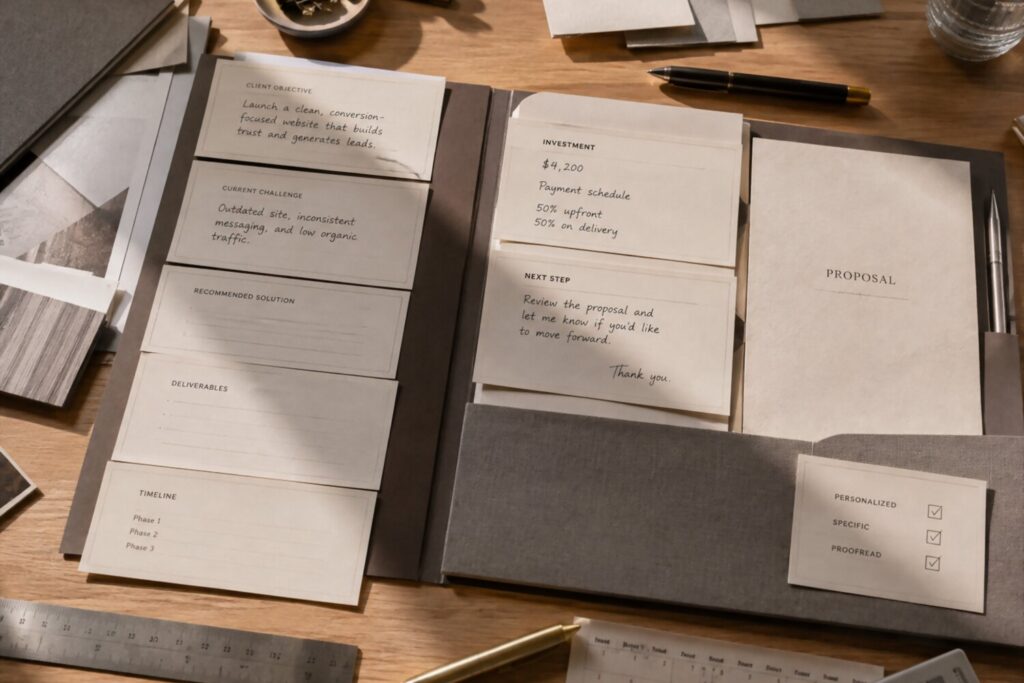
A reusable proposal template can save time and help you present projects consistently. The key is to treat it as a framework—not a message you send unchanged to every client. The client’s goals, deliverables, proof, timeline, and pricing should be customized for each opportunity.
Use the template below as a starting point.
Freelance Proposal Template
Proposal title:
[Project name or service]
Prepared for:
[Client name or company]
Prepared by:
[Your name or business name]
Date:
[Date]
Project Overview
Based on our [conversation, discovery call, project brief, or job post], you are looking for help with [brief description of the project].
The primary goal is to [describe the desired outcome]. The project will support [audience, business objective, campaign, launch, workflow, or other relevant purpose].
Recommended Approach
I recommend completing the project in the following stages:
- [Stage one]: [Brief explanation]
- [Stage two]: [Brief explanation]
- [Stage three]: [Brief explanation]
- [Final stage]: [Brief explanation]
This approach is designed to [explain why the process fits the client’s needs].
Scope and Deliverables
The project includes:
- [Deliverable, quantity, and format]
- [Deliverable, quantity, and format]
- [Deliverable, quantity, and format]
- [Number] round(s) of revisions
- Final files delivered in [format or platform]
The project does not include [related work that may reasonably be confused with the stated scope]. Additional requests can be reviewed and priced separately before work begins.
Project Timeline
The estimated project schedule is:
- Start date: [Date or timing]
- First milestone: [Date or number of business days]
- Client review: [Expected review period]
- Final delivery: [Date or number of business days]
This schedule assumes that required materials, access, and feedback are provided within the agreed timeframes.
Pricing
Total project fee: [$X]
The fee includes:
- [Service or deliverable]
- [Service or deliverable]
- [Revision allowance]
- [Final handoff or support]
Suggested payment schedule:
- [$X or X%] to begin the project
- [$X or X%] after [milestone]
- [$X or X%] upon final delivery
Adjust the payment structure to match the size and duration of the project. A small assignment may require only one payment, while a longer engagement may be easier to manage through milestones.
Relevant Experience
I am a strong fit for this project because [brief explanation of relevant experience, skills, or subject knowledge].
A related example is [project or sample], where I [describe your role and the work completed]. You can review it here: [portfolio link].
Include only evidence that is accurate and relevant. New freelancers can reference personal projects, volunteer work, coursework, or transferable professional experience, provided each example is labeled clearly.
Next Steps
To move forward, please:
- Confirm the proposed scope and timeline.
- Share any remaining materials or access requirements.
- Approve the proposal or request revisions.
- Confirm the preferred start date.
Once these details are finalized, I will provide the kickoff information and begin according to the agreed schedule.
How to Customize the Template
The bracketed placeholders are only the beginning. A proposal should reflect the client’s actual language and priorities.
Before sending it, customize at least these five areas:
- The opening: Mention the client’s specific project and intended result.
- The approach: Explain the process you would genuinely use.
- The scope: Replace broad service descriptions with precise deliverables.
- The evidence: Select examples that closely match the assignment.
- The next step: Ask for one clear decision or action.
For example, avoid a generic statement such as:
“I can provide high-quality content for your business.”
Replace it with something specific:
“I will write four 1,200-word educational articles for first-time homebuyers, following your brand guidelines and approved keyword briefs.”
The revised version gives the client useful information about the audience, quantity, length, purpose, and working requirements.
Keep the Template Easy to Scan
Even a detailed proposal should be easy to review. Use descriptive headings, short paragraphs, bullet points, and simple pricing language. Important information—especially deliverables, timing, and cost—should not be buried in long blocks of text.
Before sending, remove every unused placeholder and verify all names, dates, amounts, and links. A template improves efficiency only when the final proposal still feels accurate, thoughtful, and specific to the client.
How to Personalize the Template for Different Clients
A freelance proposal template gives you a reliable structure, but the final proposal should reflect the specific client, project, and decision-making process. Personalization does not mean rewriting every sentence from scratch. It means adjusting the parts that help the client understand why your approach fits their situation.
The most important areas to customize are the opening, scope, process, proof, and next step.
Match the Proposal to the Type of Opportunity
Different client situations call for different levels of detail. A short application on a freelance marketplace may need only a focused pitch, while a proposal sent after a discovery call may require a complete breakdown of deliverables, milestones, and pricing.
Direct Client Inquiries
When a client contacts you directly, they have usually shown some level of interest in your services. Your proposal should build on the information they have already provided.
Include:
- A brief summary of the client’s goal
- Your recommended approach
- Clearly defined deliverables
- A realistic timeline
- Pricing and payment stages
- The information or approval needed to begin
Refer to details from your conversation so the proposal feels connected to the client’s priorities.
For example:
“During our call, you explained that the new resource center needs to serve both first-time customers and experienced users. I recommend organizing the content into two learning paths so each audience can find relevant guidance quickly.”
This is more useful than a generic statement about providing “high-quality content.”
Freelance Marketplace Applications
Marketplace proposals are often reviewed alongside many other applications, so relevance and clarity matter. Begin by responding directly to the job post rather than using a broad introduction about yourself.
A concise marketplace proposal might include:
- A sentence showing that you understand the assignment
- A brief explanation of your approach
- One relevant example or qualification
- A practical question about the project
- A clear next step
Avoid copying large portions of the job description. Instead, identify one or two details that affect how you would complete the work.
For example:
“Because the articles are intended for first-time investors, I would focus on plain-language explanations, define technical terms, and use examples that do not assume previous financial knowledge.”
That sentence demonstrates a project-specific decision rather than simply repeating that the audience is made up of beginners.
Adjust the Proposal to the Service
The structure of a proposal can remain consistent, but the details should reflect the type of freelance work being offered.
A writer may need to define word counts, research expectations, interviews, SEO requirements, and revision rounds.
A designer may need to clarify concepts, file formats, responsive versions, source files, and feedback stages.
A developer may need to specify features, supported platforms, testing, deployment responsibilities, and required access.
A consultant may need to outline meetings, analysis, recommendations, presentation materials, and implementation support.
A virtual assistant may need to describe weekly hours, communication channels, recurring tasks, response expectations, and reporting methods.
Do not rely on broad labels such as “full-service support.” Describe the work in terms the client can observe and evaluate.
Choose Proof That Matches the Project
Relevant evidence is more persuasive than a large collection of unrelated samples. Select one or two examples that resemble the client’s project in a meaningful way.
The connection might involve:
- The same type of deliverable
- A similar audience
- The same platform or tool
- A comparable business challenge
- A related subject area
- A similar project size or workflow
Explain the connection rather than expecting the client to identify it.
For example:
“This case study is relevant because the client also needed to simplify a technical service for a nontechnical audience. My role included audience research, content structure, and final copywriting.”
Only include results you can support accurately. If a result depended on a larger team or campaign, describe your specific contribution rather than taking credit for the entire outcome.
Personalize Proposals When You Have Limited Experience
You do not need to invent experience to make a proposal credible. New freelancers can demonstrate readiness through relevant sample work, training, previous employment, volunteer projects, or transferable skills.
For example, someone moving from customer support into freelance content writing might highlight experience explaining products, identifying recurring customer questions, and adapting information for different audiences.
A proposal could say:
“Although I am building my freelance writing portfolio, I have three years of experience creating customer-facing help content and explaining software features in clear, practical language. I have included a sample article written for a similar audience.”
This is specific and transparent. It gives the client evidence to review without overstating the freelancer’s background.
Adapt the Proposal for Returning Clients
A returning client does not usually need a full introduction to your experience or working style. Keep the proposal focused on what is changing in the new engagement.
Clarify:
- The new project goal
- How the scope differs from previous work
- Updated deliverables or responsibilities
- Changes to timing or pricing
- Any new stakeholders, tools, or approval steps
You can also refer to what worked well previously:
“We will use the same two-stage review process as the previous campaign, with one change: product stakeholders will review the outlines before drafting begins.”
This demonstrates continuity while making the updated process clear.
Use AI-Assisted Drafting Carefully
AI tools can help organize notes, create an initial outline, or improve readability, but the final proposal still requires human judgment. Generic AI-generated language can make proposals sound interchangeable, especially when it relies on vague claims such as “I am uniquely positioned to deliver exceptional results.”
When using AI assistance:
- Remove statements that are not supported by your real experience
- Verify client names, project details, prices, and dates
- Replace generic language with specific decisions
- Do not enter confidential client information into tools without appropriate permission and safeguards
- Check whether the client or platform has stated expectations about AI use
- Read the entire proposal for accuracy, tone, and consistency
AI can help with presentation, but it should not invent qualifications, testimonials, portfolio examples, or project outcomes. Refer back to the step-by-step proposal process to confirm that the draft still contains a clear goal, defined scope, realistic timeline, relevant evidence, and a specific next step.
Use a Final Personalization Check
Before sending the proposal, ask:
- Does the opening describe this client’s actual situation?
- Are the deliverables specific to this project?
- Does the proposed process address the client’s constraints?
- Is the evidence closely related to the assignment?
- Have I removed irrelevant template language?
- Is the next step appropriate for the current stage of the conversation?
A simple test is to replace the client’s name with another company’s name. If the proposal still works without significant changes, it may not be personalized enough.
The purpose of customization is not to flatter the client or add superficial details. It is to show that you have considered the work carefully and developed a proposal that responds to the project in front of you.
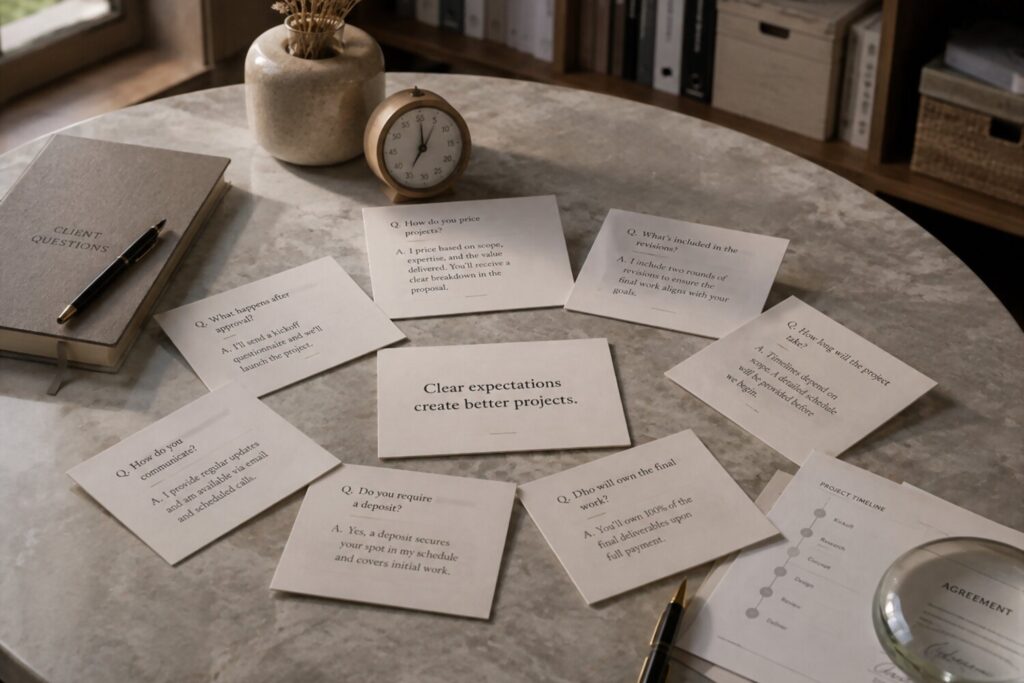
Frequently Asked Questions
How long should a freelance proposal be?
A proposal should be long enough to explain the project clearly, but not so long that the client has difficulty finding the scope, timeline, price, and next step.
A brief, well-defined assignment may require only a few paragraphs. A larger project involving several deliverables, stakeholders, or milestones may need multiple pages. Let the complexity of the work determine the length rather than aiming for an arbitrary word count.
Before sending, check whether every section helps the client evaluate the project. Remove unrelated background information, repeated claims, and process details that do not affect the client’s decision.
Should every freelance proposal include pricing?
Include pricing when you understand the scope well enough to provide a responsible estimate. The proposal should explain both the amount and what it covers.
When important details remain unclear, you can:
- Ask additional discovery questions before submitting the proposal
- Present a preliminary price range and identify the assumptions behind it
- Break the work into an initial paid discovery phase and a later implementation phase
- Offer clearly differentiated options for different scopes
Avoid presenting a firm project fee when the number of deliverables, technical requirements, or review process is still unknown. A price is most useful when the client can connect it to a specific set of services.
Can I use the same proposal template for every client?
You can use the same underlying structure, but you should not send the same completed proposal to every client.
Reusable sections may include:
- Proposal title and contact information
- Scope and deliverables
- Timeline
- Pricing
- Relevant experience
- Next steps
However, the client’s goal, your recommended approach, supporting examples, and project details should be customized. Review the earlier guidance on personalizing the proposal for different clients before sending a template-based draft.
A useful test is to remove the client’s name. If the proposal could be sent to several unrelated companies without meaningful changes, it probably needs more specific information.
What should I include if I have limited freelance experience?
Focus on relevant evidence rather than the total number of freelance projects you have completed.
Depending on the assignment, you may be able to reference:
- Sample or portfolio projects
- Relevant responsibilities from previous employment
- Volunteer or community work
- Coursework or professional training
- Experience with the required software, platform, or subject
- A personal project that demonstrates the necessary skill
Describe each example accurately. Do not present an unpaid sample as client work or claim responsibility for results produced by an entire team.
You can also strengthen the proposal by explaining your process clearly. A realistic plan, precise scope, and thoughtful project questions can help the client evaluate how you would approach the work.
Should I send a proposal in an email, document, or PDF?
Choose the format that fits the client’s process and the complexity of the project.
A short proposal may work well in an email or marketplace message. A structured document or PDF may be easier to review when the proposal contains several deliverables, pricing options, milestones, or portfolio examples.
Consider the following:
- Email or direct message: Appropriate for short, straightforward assignments
- Shared document: Useful when the client may need to comment or collaborate
- PDF: Helpful when you want to preserve a polished, consistent layout
- Platform form: Necessary when a freelance marketplace requires a specific submission process
Make sure the proposal is readable on both desktop and mobile devices. Use descriptive headings and avoid relying on visual design to communicate essential information.
What is the difference between a freelance proposal and an RFP response?
A freelance proposal is the response you prepare to explain how you would handle a client’s project. A request for proposal, or RFP, is a document an organization may issue to invite potential providers to submit competing proposals.
An RFP often includes formal requirements, evaluation criteria, deadlines, and submission instructions. A regular client inquiry may be much less structured.
When responding to an RFP, follow the requested format carefully and address every required item. The general concept is explained in this overview of requests for proposals.
How many portfolio examples should I include?
A small number of closely related examples is usually more useful than a long list of unrelated links. Select work that helps the client evaluate your ability to complete this particular assignment.
For each example, briefly explain:
- What the project involved
- What your role was
- Which part is relevant to the proposed work
- What result or deliverable you can verify
One strong example with clear context may provide more decision-making value than several samples that require the client to determine their relevance.
When should I follow up after sending a proposal?
Your follow-up timing should reflect the client’s stated decision process. If the client provided a review date, wait until that date has passed. If no timing was discussed, a brief follow-up after several business days may be appropriate for many ordinary projects.
Keep the message focused. Confirm that the proposal was received, ask whether the client has questions, and restate the next action. Avoid sending repeated daily messages or creating artificial urgency.
For a formal RFP or platform application, follow any stated communication rules. Some processes limit when or how applicants may contact the buyer.
Can I use AI to write my freelance proposal?
AI can help you organize discovery notes, create a preliminary structure, or identify unclear sentences. It should not replace your judgment or knowledge of the project.
Before sending AI-assisted content:
- Verify every name, date, amount, and project detail
- Remove generic claims that could apply to any freelancer
- Confirm that all qualifications and examples are real
- Check the client’s or platform’s AI-use expectations
- Protect confidential or sensitive client information
- Rewrite the proposal so it reflects your actual process and voice
Google’s guidance on AI-generated material emphasizes the value of original, helpful, people-first content rather than content created primarily to influence rankings. The same principle is useful when drafting proposals: technology may assist the process, but the final document should provide accurate, relevant information that serves the reader. See Google Search Central’s guidance on AI-generated content and helpful, reliable, people-first content.
What should I do if the client does not respond?
A lack of response does not necessarily explain why the proposal was not accepted. The project may have been delayed, priorities may have changed, or the client may still be reviewing options.
Send one concise follow-up based on the expected decision timeline. If you receive no response, close the conversation professionally and keep your records for future reference. Avoid assuming that repeated contact will change the outcome.
You can also review the proposal for useful lessons:
- Was the client’s goal clearly stated?
- Were the deliverables specific?
- Did the evidence match the assignment?
- Was the pricing easy to understand?
- Did the proposal identify one clear next step?
- Were any important questions left unanswered?
Use that review to improve future proposals without drawing unsupported conclusions from a single outcome.
Online freelancing includes a wide range of working arrangements, industries, and platform-based opportunities. OECD research on self-employed online freelancers in the platform economy offers broader context on the opportunities and working conditions associated with this type of work.
Key Takeaways and Conclusion
A freelance proposal is not simply a biography, portfolio list, or price quote. It is a practical explanation of how you would approach a particular client’s project.
Keep these principles in mind:
- Research before writing. Understand the goal, audience, deliverables, constraints, and approval process.
- Lead with the client’s situation. Connect your skills to the work instead of opening with a lengthy personal introduction.
- Define the scope precisely. State what you will deliver, in what format, and with how many review or revision stages.
- Recommend a realistic process. Show the major phases without overwhelming the client with unnecessary operational detail.
- Use relevant evidence. Choose portfolio examples, experience, or qualifications that directly support your ability to perform the proposed work.
- Make pricing understandable. Explain what the fee covers and identify any assumptions that could affect it.
- Set a workable timeline. Account for client materials, feedback, approvals, and other dependencies.
- End with one next step. Tell the client what decision, information, or action is needed to move forward.
- Personalize the final draft. A template should improve consistency without making every proposal sound the same.
- Verify every detail. Check names, links, dates, deliverables, pricing, and claims before sending.
The purpose of a proposal is not to pressure a client or promise an outcome you cannot control. Its purpose is to make the proposed working relationship understandable. The client should be able to see what you recommend, why you recommend it, what they will receive, what the project is expected to cost, and what happens next.
Start with the fill-in-the-blank freelance proposal template, then adapt it using the information you gathered during discovery. The more closely the final proposal reflects the actual project, the more useful it becomes as a basis for an informed conversation.
No template can guarantee that a client will choose you. A clear, accurate, and relevant proposal can, however, help the client evaluate your offer without having to guess how the project would work. That is the standard to aim for: not the longest proposal or the most persuasive-sounding language, but a credible plan presented with clarity.