Why Tech Recruiters Notice Some Candidates First
Tech recruiters rarely begin with a blank search. Most of the time, they are trying to fill a specific role with a specific mix of skills, experience level, location, salary range, and availability. That means the candidates who get noticed first are not always the “best” developers, engineers, or analysts. They are often the people whose profiles make it easiest for recruiters to understand what they do and why they match the role.
Recruiters typically scan for signals such as:
- Clear job titles that match the role they are hiring for, such as Frontend Developer, Cloud Engineer, Data Analyst, or Cybersecurity Specialist.
- Relevant keywords from the job description, including tools, programming languages, frameworks, and platforms.
- Recent hands-on experience that proves the candidate has worked with those technologies in real projects.
- Measurable impact, such as performance improvements, cost savings, automation, revenue growth, or user growth.
- Proof of credibility, including GitHub projects, certifications, portfolio work, open-source contributions, or strong recommendations.
The biggest mistake many candidates make is describing themselves too broadly. A phrase like “passionate tech professional looking for new opportunities” does not tell a recruiter much. A stronger version would be: “Backend Developer with 3 years of experience building Python APIs, working with PostgreSQL, Docker, and AWS.” The second version gives recruiters searchable keywords and a clear reason to keep reading.
Recruiters also move quickly. They may review dozens or hundreds of profiles in one hiring cycle, so clarity matters. Your profile should answer three questions within a few seconds: What do you do? What technologies do you use? What value have you created?
Getting noticed is not about trying to appeal to everyone. It is about making your professional identity specific, searchable, and easy to trust. The more clearly you position yourself for the roles you want, the easier it becomes for recruiters to find you, understand your value, and decide that you are worth contacting.
Build a Recruiter-Friendly Tech Profile
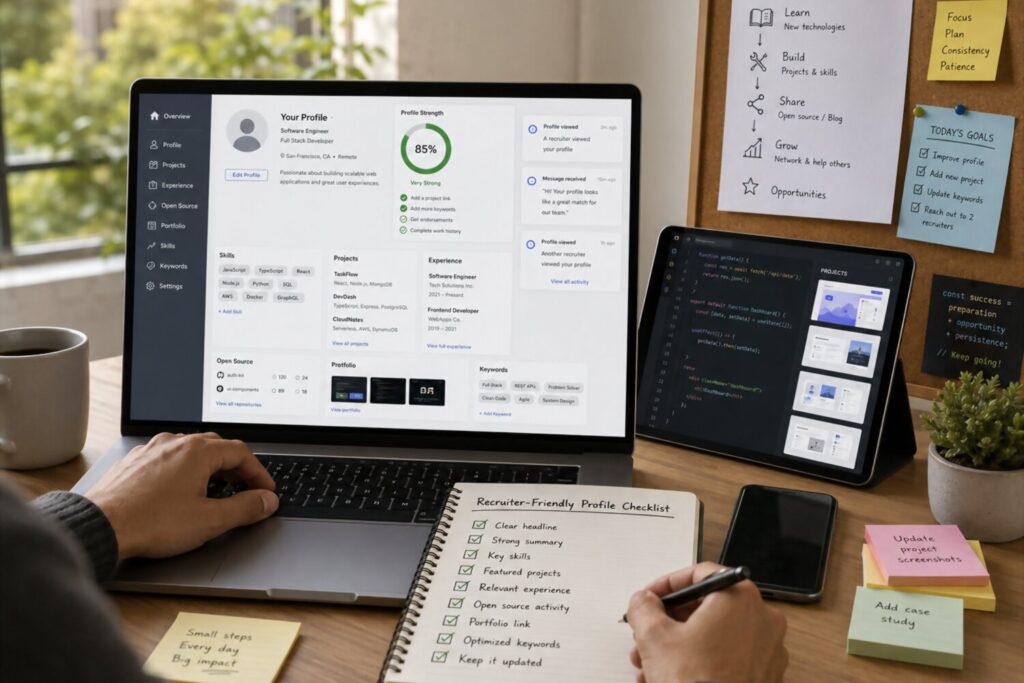
A recruiter-friendly tech profile is not just a list of tools you know. It is a clear, searchable, and convincing snapshot of your professional value. When a recruiter lands on your LinkedIn, resume, GitHub, or portfolio, they should quickly understand what role you fit, what technologies you use, and what kind of problems you can solve.
Start with your headline or summary. Avoid vague descriptions like “tech enthusiast” or “motivated problem solver.” Instead, use language that connects directly to real hiring searches.
| Weak Profile Message | Stronger Profile Message |
|---|---|
| Passionate developer looking for opportunities | Frontend Developer skilled in React, TypeScript, and performance optimization |
| Data professional interested in analytics | Data Analyst with SQL, Python, Power BI, and dashboard automation experience |
| Cloud learner seeking a role | Junior Cloud Engineer with AWS, Terraform, Linux, and CI/CD project experience |
Your profile should also include the keywords recruiters are likely to search for. These usually include programming languages, frameworks, cloud platforms, databases, methodologies, and job titles. However, keywords should feel natural. A profile packed with random technologies can look unfocused. It is better to show a strong connection between your skills and your target role.
A strong tech profile usually includes:
- A specific headline that matches your desired role.
- A short summary explaining your experience, strengths, and technical focus.
- A skills section organized around your main specialization.
- Project links that show real work, not just claims.
- Clear work achievements with numbers, outcomes, or technical context.
- Consistent branding across LinkedIn, resume, GitHub, and portfolio.
For example, a backend developer’s profile should not simply say they “worked with APIs.” A stronger description would explain the stack, scale, and result: “Built REST APIs with Node.js, PostgreSQL, and Docker to support internal reporting workflows and reduce manual data processing.” This gives recruiters both technical keywords and business context.
Your GitHub and portfolio matter as well, especially if you are early in your career or changing roles. Pin projects that reflect the type of work you want to do next. Add clear README files, screenshots, setup instructions, and short explanations of your decisions. A messy repository with no context can weaken your profile, while a simple but well-documented project can make you look thoughtful and professional.
The goal is to remove friction. Recruiters should not have to guess what you do, search for your best work, or decode your experience. A well-built profile acts like a landing page for your career: focused, credible, and easy to understand.
Highlight High-Demand Skills Recruiters Are Searching For
Recruiters often search for candidates using skill-based keywords before they ever read a full resume. That means your profile should clearly reflect the technologies, tools, and problem areas that are currently valuable in the market. The goal is not to list every tool you have ever touched, but to show a focused skill set that matches the roles you want.
Some of the most recruiter-friendly skill areas in tech include:
- Artificial intelligence and machine learning — Python, machine learning models, prompt engineering, LLMs, model evaluation, automation, and AI product integration.
- Cybersecurity — threat detection, vulnerability management, incident response, SIEM tools, cloud security, identity management, and risk assessment.
- Cloud engineering — AWS, Azure, Google Cloud, Terraform, Kubernetes, Docker, serverless architecture, and infrastructure automation.
- Data and analytics — SQL, Python, data pipelines, dashboards, ETL, Power BI, Tableau, Snowflake, dbt, and data storytelling.
- Software development — JavaScript, TypeScript, React, Node.js, Java, Python, APIs, testing, system design, and performance optimization.
- DevOps and platform engineering — CI/CD, monitoring, reliability, containerization, infrastructure as code, and developer experience.
A common mistake is adding these skills as a simple keyword dump. Recruiters may find your profile, but they still need evidence that you can actually use those skills. Instead of writing “Python, AWS, Docker, Kubernetes” with no context, connect each skill to a real project, task, or result.
For example:
“Built a Python data pipeline that processed sales data automatically, stored results in PostgreSQL, and generated weekly dashboards for the operations team.”
This sentence is much stronger than a plain skill list because it shows tools, purpose, and outcome. It also gives recruiters multiple searchable keywords without sounding forced.
You should also separate your core skills from your supporting skills. Core skills are the technologies you want to be hired for. Supporting skills are useful extras that strengthen your profile but should not distract from your main direction. For instance, if you want to become a cloud engineer, AWS, Linux, Terraform, Docker, and networking should appear more prominently than occasional experience with design tools or basic HTML.
Think of your skills section as a recruiter search map. It should guide the right people toward your profile and quickly show them that you match the role. The more clearly your high-demand skills are tied to practical experience, the more likely recruiters are to see you as a serious candidate rather than just another profile in the results.
Show Proof, Not Just Skills

Anyone can write “experienced with React”, “good at Python” or “familiar with AWS” on a resume. What gets a recruiter’s attention is proof. Recruiters and hiring managers want to see that you have used your skills to build, improve, fix, automate, analyze, or secure something real.
Proof does not always mean years of professional experience. It can come from many places:
- Work achievements that show measurable business or technical impact.
- Portfolio projects that demonstrate how you solve problems.
- GitHub repositories with clean code, documentation, and clear commit history.
- Open-source contributions that show collaboration and code quality.
- Case studies explaining your process, decisions, and results.
- Certifications or labs that support your knowledge in cloud, security, or data.
- Technical writing that shows you can explain complex ideas clearly.
The key is to connect your skills to outcomes. Instead of saying, “Built dashboards in Power BI”, explain what those dashboards helped people do. For example: “Created Power BI dashboards that helped the sales team track weekly pipeline changes and identify underperforming regions faster.” This turns a tool into a result.
For software engineers, proof might be a deployed app, a performance improvement, a test suite, or a well-structured API. For data professionals, it could be a dashboard, automated report, predictive model, or cleaned dataset. For cybersecurity candidates, proof might include home labs, write-ups, vulnerability reports, incident response exercises, or security monitoring projects.
A strong proof-of-work project usually answers four questions:
- What problem did you solve?
- What technologies did you use?
- What decisions did you make?
- What changed because of your work?
This is especially important for junior candidates, career changers, and self-taught professionals. When you lack a long work history, practical evidence can help reduce doubt. A small but polished project with a clear explanation is often more convincing than a long list of disconnected skills.
Your proof should also be easy to review. Add links to your best projects, write clear README files, include screenshots where useful, and explain the business or user problem behind the work. Recruiters may not inspect every line of code, but they will notice whether your work looks organized, intentional, and relevant.
In tech hiring, skills tell recruiters what you claim to know. Proof shows them why they should believe you.
Make Your Resume Recruiter-Ready
Before your resume reaches a hiring manager, it usually gets a quick first review by a recruiter. Recruiters often scan resumes fast, looking for signs that your experience matches the role. Your goal is to make your resume clear, relevant, and easy to understand within a few seconds.
Start by tailoring your resume to the position. This does not mean rewriting everything from scratch for every application. It means adjusting your headline, skills, project order, and achievement bullets so they reflect the job description. If a company is hiring a backend developer with Python, PostgreSQL, and AWS experience, those skills should be visible in the top half of your resume if you genuinely have them.
A strong tech resume usually includes:
- A clear target title, such as Frontend Developer, Data Engineer, or Cybersecurity Analyst.
- A focused skills section grouped by category: languages, frameworks, cloud, databases, tools.
- Achievement-based experience bullets that show impact, not just responsibilities.
- Relevant projects with technologies, links, and short explanations.
- Simple formatting that helps recruiters quickly find important details.
The biggest improvement you can make is turning vague responsibilities into specific results. For example, instead of writing “worked on website performance”, write “improved page load speed by optimizing React components and reducing unnecessary API calls.” Even without a number, the second version is stronger because it explains what you did and how.
Use this simple formula for resume bullets:
Action + Technology + Task + Result
Examples:
- Built REST APIs with Node.js and PostgreSQL to support customer account management.
- Automated weekly reporting with Python, reducing manual spreadsheet work for the operations team.
- Deployed Dockerized applications to AWS using CI/CD pipelines.
- Analyzed product usage data with SQL to identify user drop-off points.
- Improved test coverage by adding unit and integration tests for critical backend services.
Avoid overly designed templates with too many icons, graphics, unusual columns, or decorative elements. They may look attractive, but they can make your experience harder to scan. A clean, structured resume with strong content usually performs better than a visually complex one.
Your resume should not read like a generic job description. It should read like evidence. Every bullet should help answer the recruiter’s main question: “Can this person do the work we need?” When your resume clearly connects your skills, experience, and results to the target role, you make it much easier for recruiters to move you forward.
Use LinkedIn Strategically Without Sounding Desperate
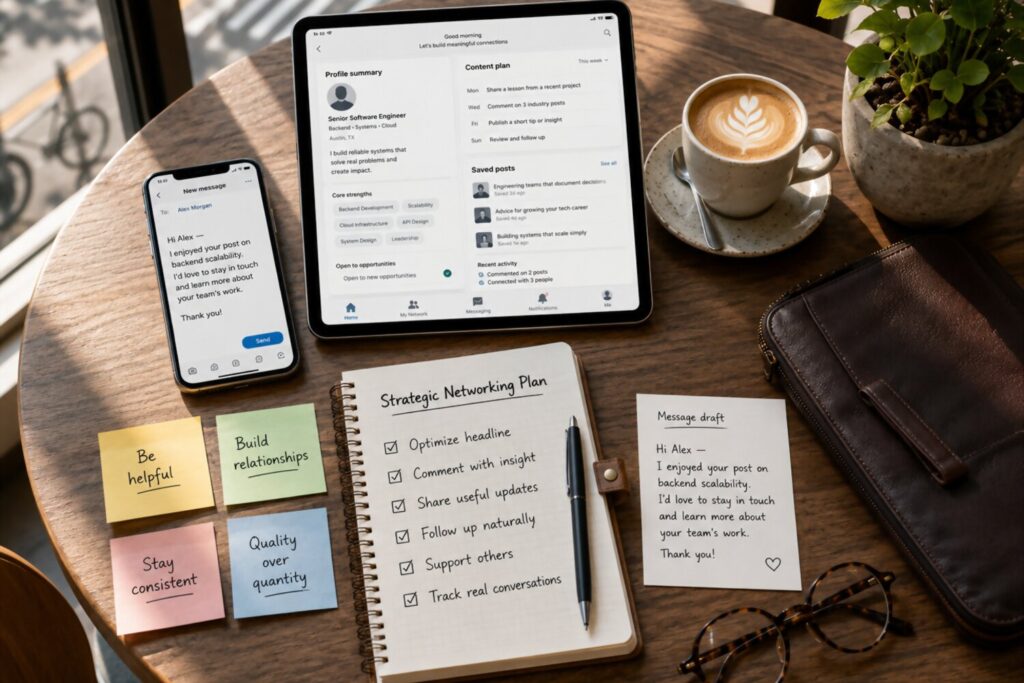
LinkedIn can be one of the most effective places to get noticed by tech recruiters, but only if you use it with intention. Many candidates make the mistake of appearing only when they need a job, posting generic “open to work” messages, or sending the same connection request to dozens of people. A better approach is to build visibility gradually by showing your expertise, curiosity, and professional direction.
Start by making your profile active and specific. Recruiters are more likely to trust a profile that looks current: recent role details, updated skills, a clear headline, and visible activity related to your field. You do not need to become a daily content creator. Even small, thoughtful actions can make your profile easier to discover.
Useful LinkedIn activities include:
- Commenting on posts from recruiters, engineers, founders, and hiring managers in your target field.
- Sharing short lessons from projects, courses, interviews, or technical challenges.
- Posting project updates with screenshots, GitHub links, or brief explanations of what you built.
- Following companies you want to work for and engaging with their hiring announcements.
- Joining niche communities around cloud, cybersecurity, data, AI, frontend, backend, or DevOps.
- Connecting with people thoughtfully instead of sending empty requests.
The key is to sound professional, not needy. Instead of writing, “Please help me find a job”, focus on what you are building, learning, or contributing. For example: “I recently finished a small project using React and TypeScript to improve my understanding of component design. The biggest lesson was how much cleaner state management becomes when components have clear responsibilities.” This kind of post shows growth and technical thinking without begging for attention.
When messaging recruiters, keep it short and relevant. Mention the role or area you are interested in, include your strongest matching skills, and make it easy for them to respond.
Example message:
Hi [Name], I saw that you recruit for cloud engineering roles. I’m a junior cloud engineer focused on AWS, Terraform, Linux, and CI/CD projects. I’d be happy to connect and would appreciate being considered for relevant openings.
LinkedIn works best when it feels like a professional presence, not a last-minute job search tool. If your profile clearly communicates your skills and your activity shows consistent interest in your field, recruiters have more reasons to notice you, remember you, and reach out when a relevant role appears.
Target Roles Where Recruiter Demand Is Strongest
Getting noticed by tech recruiters becomes easier when your profile points toward roles companies are actively trying to fill. This does not mean chasing every trend or pretending to be an expert in a field you barely know. It means understanding where demand is strong and positioning your experience around a clear direction.
Recruiters are often looking for candidates who can solve urgent business problems: building better products, protecting systems, automating infrastructure, managing data, or helping companies use AI effectively. If your profile speaks directly to one of these needs, you become easier to match with open roles.
Some high-demand tech paths include:
- AI and machine learning roles
These roles focus on building, integrating, or improving intelligent systems. Recruiters may look for Python, machine learning fundamentals, LLMs, prompt engineering, model evaluation, data processing, and practical AI product experience. - Cybersecurity roles
Security remains a priority because companies need to protect data, users, systems, and cloud environments. Useful skills include threat detection, vulnerability management, incident response, identity access management, SIEM tools, and cloud security. - Cloud engineering roles
Cloud engineers help companies build scalable and reliable infrastructure. Recruiters often search for AWS, Azure, Google Cloud, Terraform, Docker, Kubernetes, Linux, networking, and automation experience. - Data roles
Data analysts, data engineers, and analytics engineers help organizations turn raw information into decisions. Important skills include SQL, Python, ETL pipelines, dashboards, data modeling, dbt, Snowflake, Power BI, Tableau, and communication with business teams. - Software development roles
Developers remain central to tech hiring, especially when they can show strong fundamentals and practical product experience. Recruiters often look for JavaScript, TypeScript, React, Node.js, Java, Python, APIs, testing, databases, and system design. - DevOps and platform engineering roles
These roles support faster, safer, and more reliable software delivery. Useful skills include CI/CD, infrastructure as code, monitoring, observability, containerization, deployment automation, and developer tooling.
The best strategy is to choose one primary direction and make your profile reflect it. A candidate who says “I’m interested in software, cloud, data, AI, and cybersecurity” may seem unfocused. A candidate who says “I’m a backend developer building Python APIs and learning cloud deployment with AWS and Docker” gives recruiters a much clearer reason to reach out.
You can still have supporting skills, but your main role target should be obvious. Recruiters do not have time to solve your career puzzle for you. When your headline, resume, projects, and LinkedIn activity all point toward the same type of role, you make it easier for recruiters to understand where you fit — and easier for them to introduce you to the right opportunity.
Turn Recruiter Attention Into Interviews

Getting noticed by a recruiter is only the first step. The real goal is to turn that attention into a meaningful conversation, and eventually, an interview. Once a recruiter reaches out, your response should make it easy for them to understand your fit, availability, and interest.
Speed matters, but quality matters too. A rushed reply that simply says “I’m interested” does not give the recruiter much to work with. A stronger response briefly confirms your interest, highlights your most relevant experience, and asks for the next step.
For example:
Hi [Name], thanks for reaching out. This role sounds interesting, especially because it involves backend development with Python and cloud services. I have experience building APIs, working with PostgreSQL, and deploying applications with Docker. I’d be happy to learn more about the team and interview process.
Before speaking with a recruiter, prepare a short career story. This should not be a long autobiography. It should be a focused explanation of who you are professionally, what kind of work you do, and what role you are targeting next.
A simple structure works well:
- Your current role or background: what you do now or what you have recently studied or built.
- Your strongest skills: the technologies and problem areas most relevant to the role.
- Your proof: one or two achievements, projects, or examples.
- Your direction: the type of opportunity you want next.
Recruiter calls are often short, so clarity is important. Be ready to discuss your salary expectations, location preferences, work authorization, notice period, remote or hybrid preferences, and why the role interests you. These details help recruiters decide whether it makes sense to move forward.
You should also ask thoughtful questions. For example:
- What skills are most important for success in this role?
- What does the interview process look like?
- Is this a new role or a replacement?
- What kind of projects would this person work on first?
- What are the biggest challenges the team is trying to solve?
After the conversation, send a brief follow-up. Thank the recruiter, restate your interest, and mention one detail from the call. This shows professionalism and helps keep you memorable.
Recruiter attention can disappear quickly if you are unclear, slow to respond, or unprepared. But when you communicate confidently, connect your experience to the role, and make next steps easy, you increase your chances of turning a simple message into a real interview opportunity.
Common Mistakes To Avoid
Many candidates struggle to get noticed not because they lack talent, but because they present themselves in ways that make recruiters work too hard. A recruiter should be able to understand your value quickly. If your profile, resume, or outreach message feels unclear, generic, or disconnected from the role, you may be skipped even if you have the right skills.
One of the biggest mistakes is trying to look suitable for every tech role at once. Writing that you are interested in frontend, backend, cloud, data, AI, cybersecurity, and product management can make you seem flexible, but it often creates confusion. Recruiters are usually hiring for a specific need. A focused profile is stronger than a broad one.
Avoid these common errors:
- Using vague headlines like “Tech enthusiast” or “Open to new opportunities” instead of a clear role-based title.
- Listing too many unrelated skills without showing which ones are your strongest.
- Describing responsibilities instead of results, such as saying what you were assigned rather than what you improved, built, or solved.
- Sending generic recruiter messages that do not mention the role, company, or relevant skills.
- Ignoring your online presence, especially LinkedIn, GitHub, or portfolio links.
- Sharing unfinished or messy projects without documentation, screenshots, or explanations.
- Failing to respond professionally when a recruiter reaches out.
Another common mistake is relying only on applications. Applying to jobs is useful, but recruiter visibility often comes from a combination of signals: optimized profiles, networking, referrals, public projects, and thoughtful engagement. The more places recruiters can see evidence of your skills, the more credible you become.
Your goal is not to appear perfect. It is to appear clear, relevant, and prepared. When you remove confusion from your profile and show proof of your abilities, you make it easier for recruiters to understand where you fit and why they should contact you.