What Is Product Management?
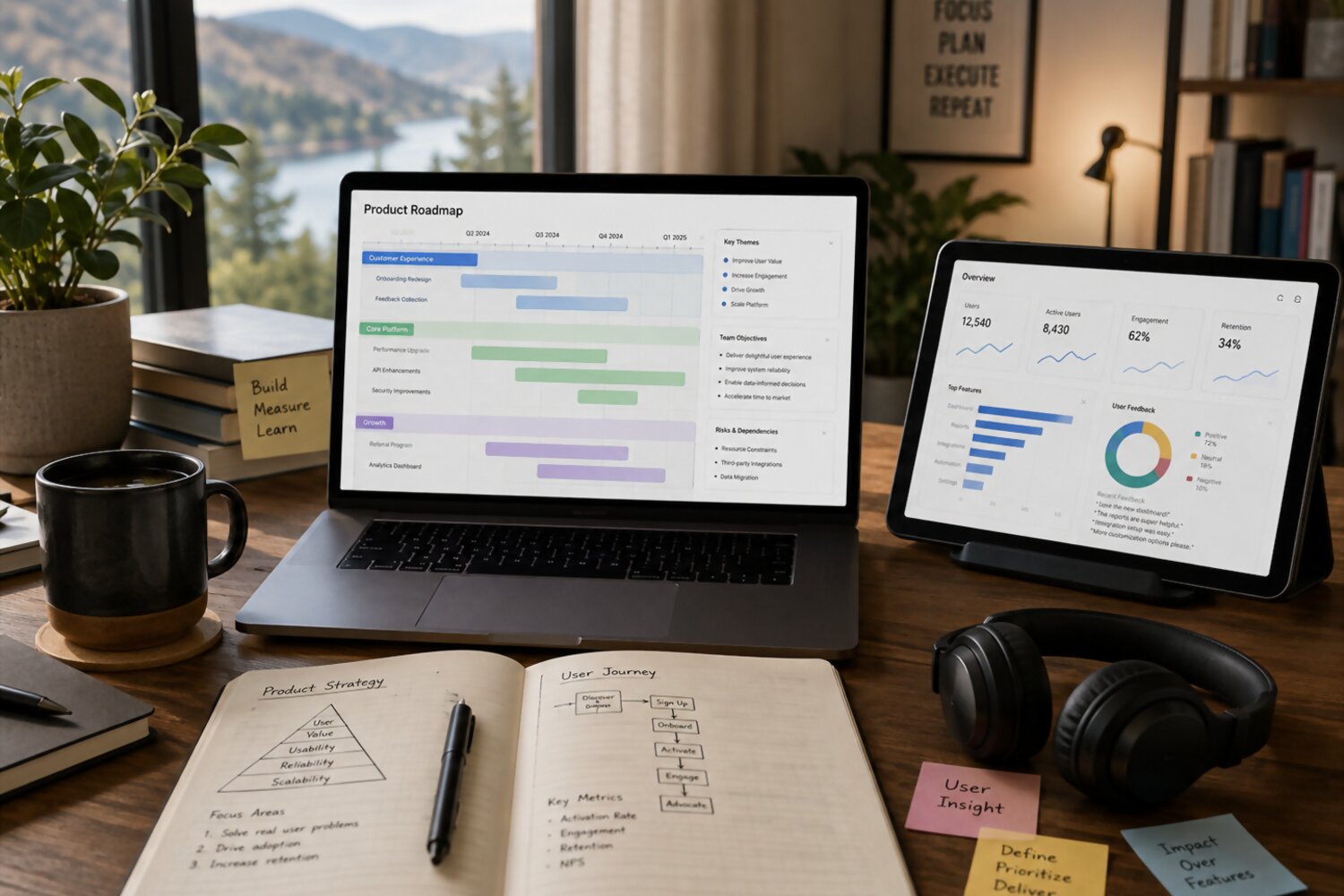
Product management is the practice of guiding a product from idea to launch and ongoing improvement. In simple terms, a product manager helps decide what should be built, why it matters, who it serves, and how success will be measured.
In tech companies, product management connects three important areas: customer needs, business goals, and technical execution. A product manager does not usually write the code or design every screen. Instead, they work with engineers, designers, marketers, sales teams, data analysts, and company leaders to make sure the product solves a valuable problem.
The role of a product manager
A product manager is often responsible for understanding users, defining product strategy, prioritizing features, and helping teams make smart decisions. This can include customer interviews, market research, competitor analysis, product roadmaps, feature requirements, launch planning, and performance tracking.
For example, a product manager at a remote software company might notice that customers are leaving during onboarding. The PM would investigate the problem, study product data, talk to users, work with designers on a better experience, and partner with engineers to release improvements. After launch, they would check whether activation, retention, or revenue improved.
Product management versus project management
Product management and project management are related, but they are not the same. Product management focuses on what to build and why it should be built. Project management focuses more on timelines, tasks, resources, and delivery.
A product manager asks questions such as: What customer problem are we solving? Which feature creates the most value? How will this product help the business grow?
A project manager asks questions such as: Who owns each task? What is the deadline? Are there blockers? Is the team on schedule?
Many remote tech teams need both roles, especially as companies scale.
Why product management matters in remote tech jobs
Product management is especially important in remote tech companies because distributed teams need clear priorities, strong communication, and well documented decisions. A remote product manager helps keep everyone aligned even when designers, engineers, executives, and customers are in different locations.
Good product management prevents teams from building features that look useful but do not solve real problems. It also helps companies use limited time and budget wisely. For people interested in remote tech jobs, product management can be a strong career path because it combines strategy, communication, research, data, and collaboration across many parts of a business.
What Does a Product Manager Do Day to Day?

A product manager spends each day helping a team build the right product for the right users. The role combines research, strategy, communication, prioritization, and decision making. In remote tech jobs, product managers also spend a lot of time writing clear updates, documenting product decisions, and keeping distributed teams aligned.
Daily responsibilities of a product manager
A product manager may start the day by reviewing product metrics, customer feedback, support tickets, or usage data. These signals help them understand what users need, where the product is failing, and which opportunities deserve attention.
They often meet with designers to improve user experience, engineers to clarify requirements, and business leaders to discuss goals. A product manager also writes product requirement documents, updates the roadmap, defines success metrics, and decides which features should come first.
Product managers do not simply collect ideas and pass them to developers. They evaluate whether an idea solves a real problem, supports the company strategy, and can be built with available resources. This makes prioritization one of the most important parts of the job.
In a remote product management role, communication becomes even more important. A good remote PM shares context before meetings, writes decisions clearly, records next steps, and makes sure everyone understands the customer problem, not just the feature request.
A typical product manager may work on:
- Customer interviews and user research
- Product analytics and performance tracking
- Feature prioritization and roadmap planning
- Product requirements and user stories
- Collaboration with engineering, design, marketing, and sales
- Launch planning and post launch analysis
The daily work changes depending on the company, product, and seniority level. A junior product manager may focus more on research, documentation, and execution. A senior product manager may spend more time on strategy, market positioning, product vision, and business impact.
Is Product Management a Good Career for Remote Tech Jobs?
Product management can be a strong career choice for remote tech jobs because much of the work depends on clear communication, product thinking, research, documentation, and decision making. These skills translate well to distributed teams where people collaborate across time zones and rely on written updates as much as live meetings.
Remote product managers help companies decide what to build, why it matters, and how success should be measured. They work with engineers, designers, marketers, sales teams, customer support, and leadership to connect user needs with business goals. This makes the role valuable in software companies, SaaS startups, AI companies, fintech platforms, marketplaces, edtech, healthtech, and other digital businesses.
Why product management works well remotely
A remote product manager does not need to be in the same room as the team to create impact. What matters more is the ability to gather evidence, explain priorities, align people, and make tradeoffs visible. Strong remote PMs use product briefs, roadmaps, user research notes, analytics dashboards, and async updates to keep teams moving in the same direction.
| Remote PM advantage | Why it matters |
|---|---|
| Written communication | Helps distributed teams understand goals, decisions, and next steps |
| Async collaboration | Reduces meeting overload and supports teams in different time zones |
| Product documentation | Creates a shared source of truth for strategy, requirements, and launches |
| Data driven decisions | Helps teams prioritize based on evidence instead of opinions |
| Cross functional work | Connects engineering, design, marketing, sales, and customer support |
Product management is not an easy shortcut into tech. Remote PM jobs often require strong judgment, business awareness, user empathy, and the confidence to make decisions with incomplete information. Entry level roles can be competitive because many companies prefer candidates with product, startup, analytics, design, engineering, or customer facing experience.
For people who enjoy solving problems, working with different teams, studying user behavior, and turning ideas into useful products, product management can offer a flexible and high impact path into remote tech work.
Skills You Need to Become a Remote Product Manager
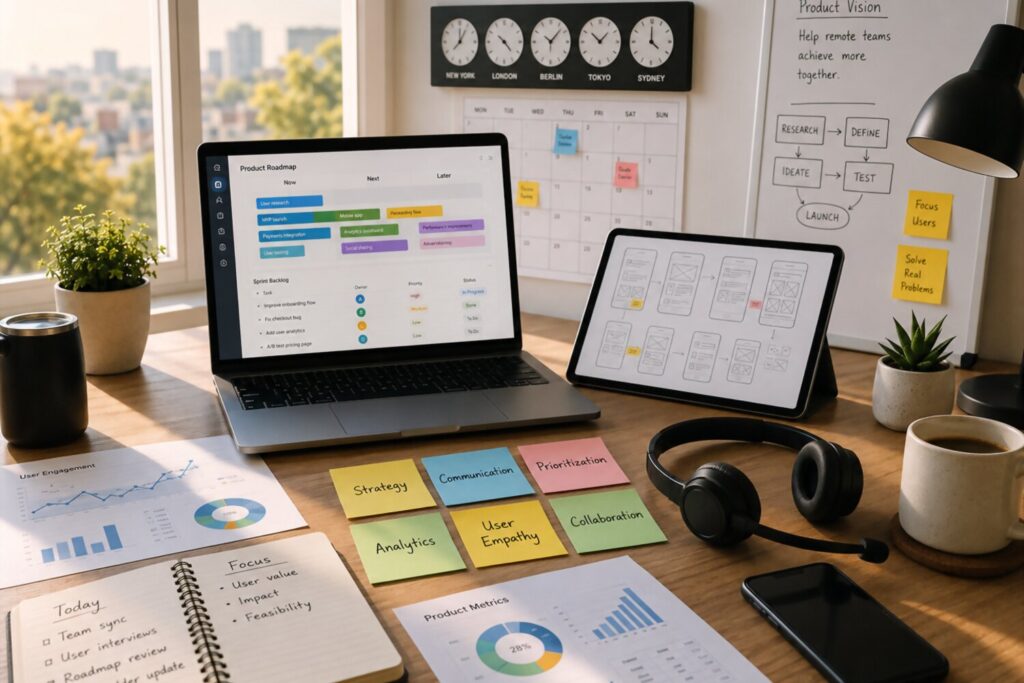
To become a remote product manager, you need a mix of business, technical, research, and communication skills. Product management is not only about having ideas. It is about understanding users, choosing the right problems, helping teams make decisions, and measuring whether the product creates real value.
Core skills for remote product management
Strong remote product managers are good at written communication because distributed teams depend on clear documents, product briefs, meeting notes, and async updates. A vague message can slow down engineers, confuse designers, or create the wrong expectations with leadership.
They also need product strategy skills. This means understanding the market, the customer, the company goals, and the reason a feature should exist. A product manager should be able to explain why one opportunity matters more than another.
User research is another important skill. Product managers often speak with customers, review feedback, study support tickets, and look for patterns in user behavior. This helps them avoid building features based only on assumptions.
Data analysis is also valuable. Remote product managers do not need to be data scientists, but they should understand metrics such as activation, retention, conversion, churn, revenue, engagement, and customer satisfaction. Basic SQL, analytics tools, and experimentation knowledge can make a PM much more effective.
A remote PM should build skills in:
- Product strategy and roadmap planning
- User research and customer discovery
- Product analytics and metric tracking
- Prioritization and tradeoff decisions
- UX thinking and usability basics
- Technical literacy for working with engineers
- Clear writing and async communication
- Stakeholder management across remote teams
- Launch planning and product marketing basics
- AI fluency for modern product workflows
Technical skills matter, but a product manager usually does not need to code professionally. What matters more is understanding how software is built, how APIs work, what technical constraints mean, and how to discuss tradeoffs with engineering teams.
AI skills are becoming more useful in product management. Remote PMs may use AI tools for research synthesis, competitive analysis, documentation, prototyping, and workflow automation. The best product managers use these tools carefully while still relying on evidence, customer insight, and sound judgment.
High Demand Product Management Specializations
Product management is a broad career path, and many remote tech jobs now focus on specialized product roles. Choosing a product management specialization can help candidates stand out, build relevant skills, and apply for roles that match growing business needs. If you are also exploring remote roles outside product management, this guide to digital marketing jobs that pay well can help you compare another flexible tech career path.
Popular product management specializations
- AI Product Manager
An AI product manager works on products that use artificial intelligence, machine learning, automation, or large language models. This role requires strong product judgment, user research, data awareness, and an understanding of AI limits, model behavior, privacy, and responsible product design. - Growth Product Manager
A growth product manager focuses on user acquisition, activation, retention, conversion, and revenue. This specialization is common in SaaS, marketplaces, mobile apps, and subscription businesses. Growth PMs often use experiments, funnel analysis, pricing tests, and onboarding improvements. - Technical Product Manager
A technical product manager works closely with engineering teams on complex products such as APIs, cloud platforms, developer tools, infrastructure, data systems, and security products. This role does not always require professional coding experience, but it does require technical literacy and the ability to discuss tradeoffs with engineers. - B2B SaaS Product Manager
A B2B SaaS product manager builds software for business customers. These products often involve workflows, integrations, permissions, dashboards, billing, compliance, and customer success needs. Remote tech companies frequently hire SaaS PMs because software subscriptions remain a major business model. - Data Product Manager
A data product manager focuses on analytics tools, reporting systems, data platforms, dashboards, and products that help teams make better decisions. This role is a strong fit for people who enjoy metrics, data quality, business intelligence, and user needs around information access. - Cybersecurity Product Manager
A cybersecurity product manager works on products that protect users, companies, systems, or data. This specialization can include identity management, fraud prevention, threat detection, privacy tools, compliance features, and secure product experiences. It is especially valuable for remote tech teams that serve enterprise customers.
How to Get a Remote Product Management Job
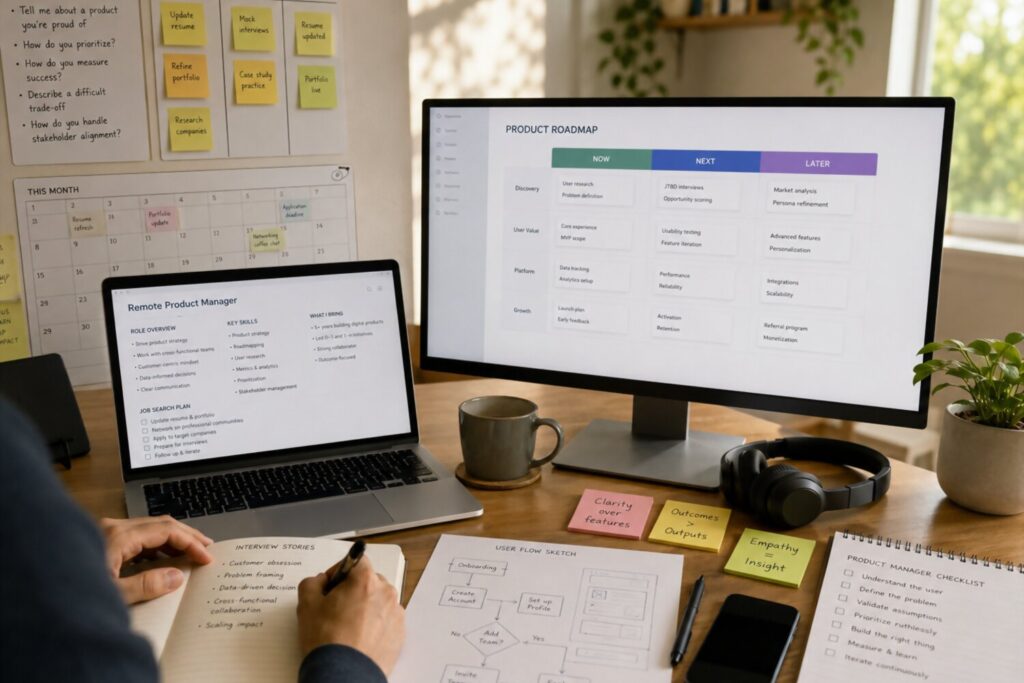
Getting a remote product management job usually requires more than reading about product strategy. Employers want proof that you can understand users, make product decisions, communicate clearly, and work with engineers, designers, and business teams. Since remote PM roles are competitive, your application should show practical thinking, not only interest in tech.
Build proof before you apply
A strong product management portfolio can help you stand out, especially if you do not already have a PM title. Create two or three product case studies that show how you think through problems. You can analyze an existing app, redesign an onboarding flow, research a customer pain point, or propose a feature based on user needs and business goals.
Your case study should explain the problem, target users, research method, product decision, tradeoffs, success metrics, and expected impact. Hiring managers want to see how you think, not just the final idea.
To prepare for remote product management jobs, focus on these steps:
- Learn the basics of product strategy, user research, analytics, UX, and software development
- Build a portfolio with practical product case studies
- Practice writing product requirement documents and product briefs
- Learn common tools such as Jira, Linear, Notion, Figma, Amplitude, Mixpanel, Google Analytics, and basic SQL
- Study remote collaboration habits, including async updates, clear documentation, and meeting discipline
- Apply for roles such as associate product manager, product owner, product analyst, growth PM, or junior technical PM
- Prepare for interviews that test product sense, prioritization, execution, data analysis, and communication
Remote companies often look for candidates who can work independently and communicate without constant supervision. This means your resume should highlight measurable outcomes, cross functional work, customer insight, and decisions you helped influence.
You can also enter product management from related roles such as customer success, marketing, business analysis, UX research, software engineering, data analysis, or operations. Many strong PMs begin by working close to users or internal teams, then move into product roles after proving they can identify problems and shape better solutions.
Common Mistakes To Avoid
Product management can be a rewarding path into remote tech jobs, but many beginners misunderstand what the role actually requires. A product manager is not hired only to share ideas. The job is about solving real customer problems, making evidence based decisions, and helping teams build products that support business goals.
Mistakes that can slow down your product management career
- Focusing only on ideas
Good product managers do not just suggest features. They validate problems, study users, review data, and explain why a solution is worth building. - Ignoring business goals
A product can be useful and still fail if it does not support revenue, retention, growth, efficiency, or customer satisfaction. Product decisions should connect user value with company value. - Skipping user research
Assumptions are risky in product management. Customer interviews, surveys, support tickets, analytics, and usability tests help product managers understand what users actually need. - Writing unclear requirements
Remote teams depend on clear documentation. Vague product briefs can create confusion for engineers, designers, marketers, and stakeholders. - Trying to please everyone
A product manager must make tradeoffs. Saying yes to every request can lead to bloated products, missed deadlines, and weak strategy. - Avoiding technical conversations
You do not need to be a software engineer to become a product manager, but you should understand technical constraints, APIs, data, integrations, and how software teams work. - Applying without proof of skill
Remote product management jobs are competitive. A resume is stronger when it includes case studies, measurable outcomes, product decisions, research examples, or cross functional experience.
Key Takeaways and Conclusion
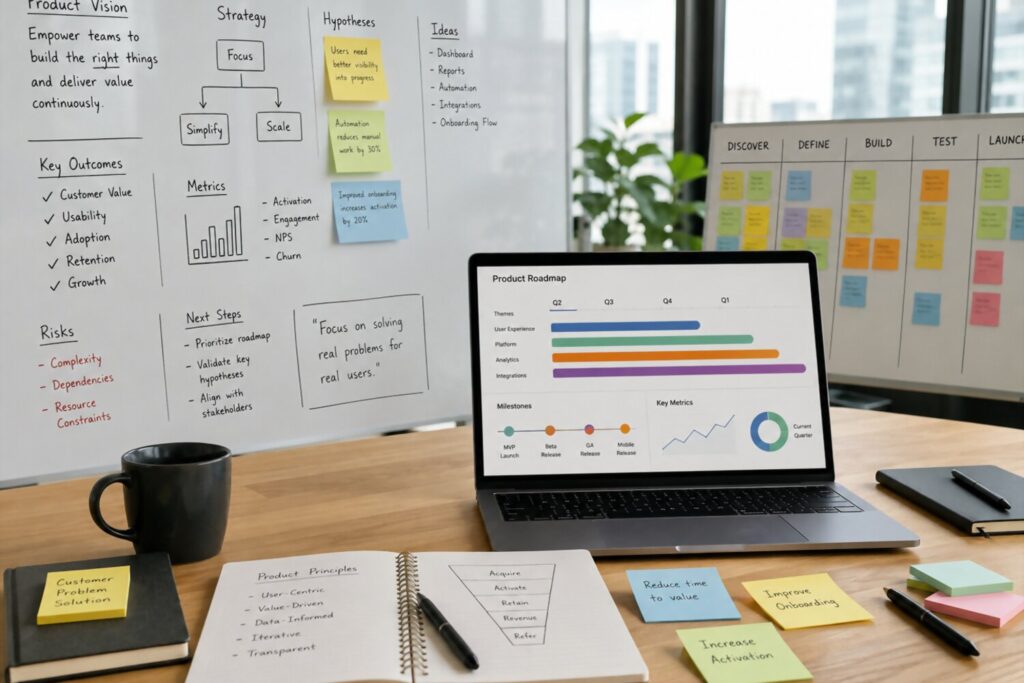
Product management is the practice of guiding a product from idea to launch and continuous improvement. It connects customer needs, business goals, and technical execution so teams can build products that solve real problems.
Key takeaways:
- Product managers help decide what to build, why it matters, and how success should be measured.
- Remote product management jobs require strong writing, clear documentation, async communication, and cross functional collaboration.
- Important PM skills include user research, product strategy, prioritization, analytics, UX thinking, technical literacy, and stakeholder management.
- High demand product management specializations include AI product management, growth product management, technical product management, B2B SaaS product management, data product management, and cybersecurity product management.
- To get a remote product management job, candidates should build practical case studies, learn common product tools, understand product metrics, and show evidence of clear decision making.
Product management can be a strong career path for people who enjoy solving problems, working with different teams, studying user behavior, and turning ideas into useful digital products. For remote tech jobs, the best product managers are not just creative thinkers. They are clear communicators, careful researchers, strategic decision makers, and trusted partners to engineering, design, marketing, sales, and leadership teams.