
A senior Python developer is not simply a programmer who has written Python code for many years. The role combines deep Python expertise, strong software engineering judgment, production ownership, system design ability, and leadership skills. Senior developers are expected to build reliable software, improve existing systems, guide technical decisions, mentor others, and understand how code affects users, business goals, security, cost, and long-term maintainability.
Python remains highly relevant across backend development, automation, data engineering, machine learning, infrastructure tooling, and internal platforms. Stack Overflow’s Developer Survey notes that Python adoption continued to accelerate, especially because of its use in AI, data science, and backend development. The U.S. Bureau of Labor Statistics also projects strong growth for software developers, quality assurance analysts, and testers from 2024 to 2034, reflecting continued demand for people who can design, build, test, and maintain software systems.
Becoming senior requires more than learning syntax. It means learning how to make good engineering decisions under real-world constraints.
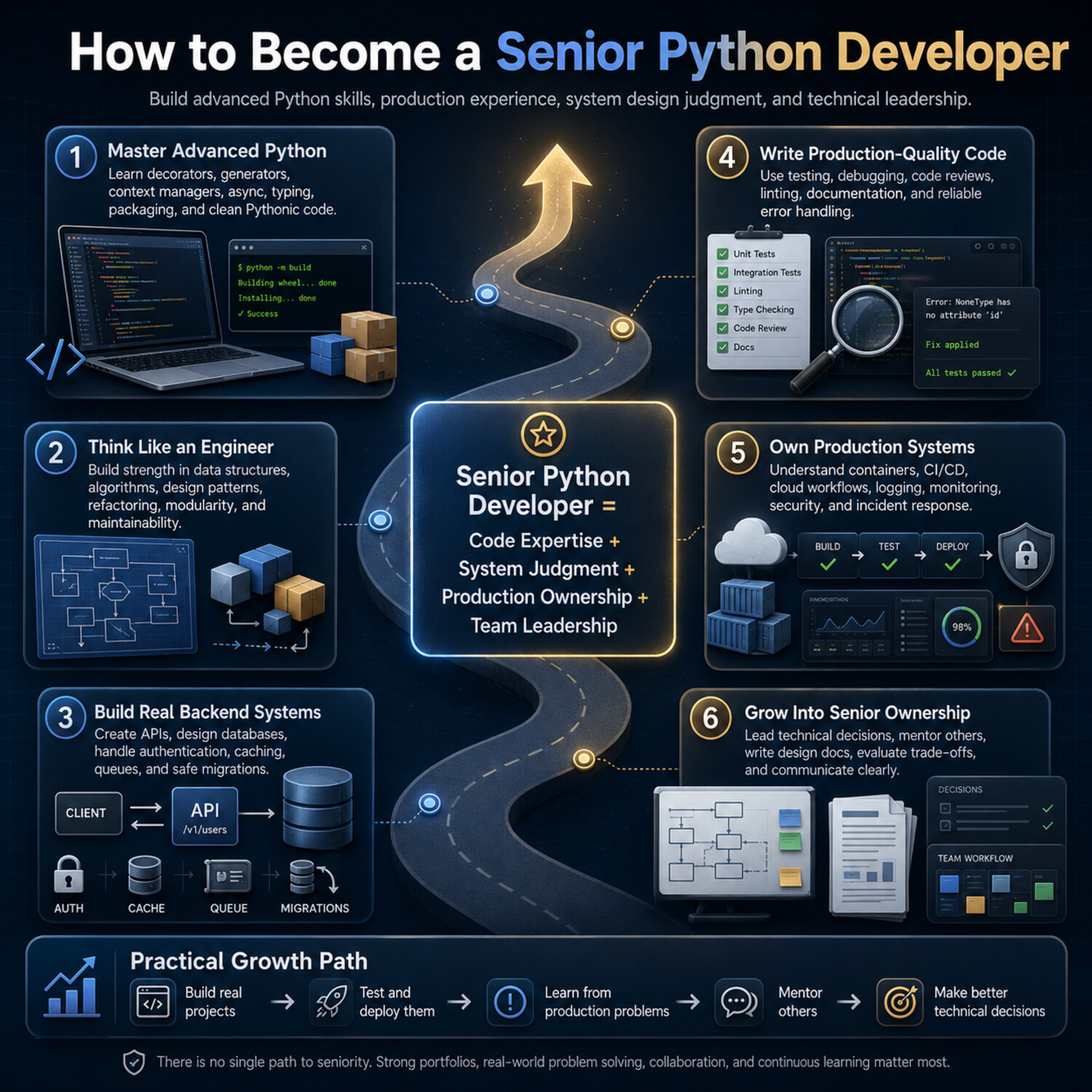
What Is a Senior Python Developer?
A Senior Python Developer designs, builds, maintains, and improves software systems where Python is a primary language. Depending on the company, this may involve backend APIs, automation tools, data pipelines, cloud services, platform tooling, internal applications, or AI-enabled systems.
At a junior level, success often means completing assigned tasks correctly. At a mid-level, success means delivering larger features with less supervision. At a senior level, success means owning outcomes. Senior developers clarify vague requirements, identify risks, choose appropriate architecture, review code, prevent avoidable failures, and help the team move faster without sacrificing quality.
O*NET describes software developers as professionals who research, design, and develop software; analyze user needs; apply computer science and engineering principles; improve existing systems; and define performance requirements. A senior Python developer performs these responsibilities with greater independence and broader technical judgment.
For example, a senior developer working on a payment API does not only write endpoint code. They ask questions such as:
- What happens if the payment provider times out?
- Is the operation idempotent?
- How are failed requests retried?
- What data should be logged, and what must never be logged?
- How will the team detect production failures?
- Can this design support future payment methods?
That mindset separates senior engineering from basic implementation.
What Skills Do Senior Python Developers Need?
Senior Python developers need a layered skill set. The foundation is Python fluency, but seniority depends on how well that knowledge is applied to real software systems.
The most important skill areas are:
- Advanced Python: data model, decorators, generators, context managers, typing, packaging, async programming, dependency management.
- Software design: modularity, clean architecture, design patterns, separation of concerns, domain modeling.
- Backend development: APIs, authentication, authorization, background jobs, caching, queues, framework knowledge.
- Databases: SQL, schema design, indexes, transactions, query optimization, migrations, data integrity.
- Testing and quality: unit tests, integration tests, fixtures, mocking, test strategy, code reviews.
- Production engineering: logging, monitoring, observability, deployment, rollback plans, incident response.
- Security: input validation, access control, secrets management, dependency vulnerabilities, secure defaults.
- Leadership: mentoring, design documents, communication, trade-off analysis, ownership.
These skills matter because senior developers are trusted with systems that other people depend on. A poorly designed feature can create bugs, outages, security issues, or expensive maintenance problems. A strong senior developer reduces that risk by making systems easier to understand, test, operate, and change.
A useful way to measure your progress is to ask: Can I explain not only what I built, but why this design is safer, simpler, faster, or more maintainable than the alternatives?
Learn Advanced Python Beyond the Basics
To become senior, you must move beyond writing simple scripts and become comfortable with Python’s deeper features and trade-offs.
Start with the Python data model. Learn how special methods such as __iter__, __enter__, __exit__, __call__, __eq__, and __repr__ shape object behavior. This helps you write classes that feel natural to use and integrate well with Python’s built-in tools.
Then learn:
- Decorators for cross-cutting behavior such as logging, caching, timing, retries, and authorization checks.
- Context managers for reliable resource handling, such as opening files, managing database transactions, or acquiring locks.
- Generators and iterators for memory-efficient data processing.
- Dataclasses and Pydantic-style models for structured data.
- Type hints for better readability, safer refactoring, and improved editor support.
Python’s official documentation explains that type annotations are not enforced by the runtime, but they can be used by type checkers, IDEs, and linters. This distinction is important. A senior developer understands that type hints are not a replacement for tests or validation, but they are valuable for documenting intent and catching many errors earlier.
You should also understand virtual environments and packaging. Python’s venv module creates isolated environments with their own installed packages, which helps prevent dependency conflicts between projects. The Python Packaging User Guide provides modern guidance for distributing and installing Python packages.
A practical learning path:
- Build a small package with
pyproject.toml. - Add type hints and run a type checker.
- Add formatting and linting.
- Write tests.
- Publish it privately or use it across two local projects.
- Refactor it after you discover a design weakness.
That process teaches you how reusable Python software is actually built.
Build Strong Computer Science and Software Design Foundations
A senior Python developer does not need to solve abstract algorithm puzzles every day, but they do need strong fundamentals. Computer science knowledge helps you choose efficient data structures, reason about complexity, and avoid designs that collapse under scale.
You should understand:
- Lists, tuples, dictionaries, sets, stacks, queues, heaps, and graphs.
- Time and space complexity.
- Sorting and searching.
- Hashing.
- Recursion and iteration.
- Concurrency and parallelism.
- Basic networking concepts.
- File systems and operating system processes.
For example, if an endpoint loops through 10,000 records and performs a database query for each one, the issue is not “Python is slow.” The issue is an inefficient design, often called the N+1 query problem. A senior developer identifies the pattern, explains the cause, and fixes it with better querying, batching, caching, or data modeling.
Software design is equally important. Learn concepts such as cohesion, coupling, dependency inversion, composition, interfaces, and separation of concerns. These ideas help you build systems where each component has a clear responsibility.
For example, avoid placing validation, database access, business rules, and HTTP response formatting in one large function. A stronger design might separate:
- Request parsing.
- Input validation.
- Business logic.
- Database persistence.
- Response serialization.
- Error handling.
This structure makes code easier to test and change. Senior developers are often valued not because they write more code, but because they write code that future teams can safely maintain.
Master Backend Development With Python
Many senior Python roles focus on backend development. This means building services that power applications, process data, integrate with external systems, and expose APIs to clients.
You should become comfortable with at least one major Python web framework. Django is common for full-featured web applications with built-in admin, ORM, authentication, and strong conventions. FastAPI is popular for modern APIs, async support, automatic documentation, and type-driven request validation. Flask is lightweight and flexible, often used for smaller services or custom architectures.
The goal is not to memorize every framework feature. The goal is to understand backend concepts that transfer across frameworks:
- HTTP methods and status codes.
- REST API design.
- Authentication and authorization.
- Request validation.
- Error handling.
- Pagination and filtering.
- Rate limiting.
- Background jobs.
- Caching.
- File uploads.
- Webhooks.
- API versioning.
- Idempotency.
For example, a senior developer designing a webhook endpoint knows that external providers may retry requests. The endpoint should safely handle duplicate deliveries, verify signatures, return appropriate status codes, and record enough information for debugging.
You should also learn when not to use a framework feature. For instance, placing complex business logic directly inside Django views or FastAPI route handlers can make the system hard to test. A senior developer often moves core rules into service modules or domain objects so the logic can be tested without running a web server.
A good portfolio project is a production-style API with:
- Authentication.
- PostgreSQL persistence.
- Background task processing.
- Automated tests.
- API documentation.
- Docker setup.
- CI workflow.
- Clear README.
- Deployment instructions.
This shows practical backend maturity, not just tutorial-level coding.
Work Confidently With Databases and Data Modeling
Senior Python developers must understand databases deeply enough to protect data integrity and performance. Many production issues come from weak database design rather than weak application code.
Start with SQL. Learn how to write joins, aggregate queries, subqueries, transactions, and indexes. Then learn schema design: primary keys, foreign keys, constraints, normalization, denormalization, and migration strategy.
PostgreSQL’s documentation explains that indexes can make row retrieval much faster, but they also add overhead and should be used thoughtfully. This is exactly the kind of trade-off senior developers must understand. Adding indexes blindly may speed up reads but slow down writes or increase storage costs.
Important database skills include:
- Designing tables around business concepts.
- Choosing appropriate data types.
- Enforcing constraints at the database level.
- Understanding transactions and isolation.
- Avoiding race conditions.
- Reading query plans.
- Using migrations safely.
- Handling large data changes.
- Knowing when NoSQL may be appropriate.
For example, suppose you are building an order system. A weak design might store order status as arbitrary text and rely only on application code to keep it valid. A stronger design might use constraints, clear state transitions, timestamps, and audit records. This protects the system even if a future code path behaves unexpectedly.
You should also understand ORMs such as Django ORM or SQLAlchemy. ORMs are useful, but they can hide expensive queries. Senior developers know how to inspect generated SQL and optimize when needed.
Write Production-Quality Code
Production-quality code is code that other developers can understand, test, deploy, monitor, and modify safely. It is not just code that “works on my machine.”
To write senior-level Python, focus on:
- Clear names.
- Small functions with specific responsibilities.
- Predictable error handling.
- Consistent formatting.
- Type hints where they improve clarity.
- Useful comments, not obvious comments.
- Simple abstractions.
- Limited global state.
- Explicit dependencies.
- Well-structured modules.
- Stable public interfaces.
A senior developer avoids cleverness when clarity is better. For example, a dense one-line comprehension may look impressive but become difficult to debug. Readable code is usually more valuable than compact code.
You should also learn refactoring. Refactoring means improving the structure of code without changing its external behavior. Common refactoring moves include extracting functions, renaming variables, reducing duplication, splitting modules, introducing interfaces, and replacing condition-heavy logic with clearer models.
Code reviews are another major part of production quality. A senior developer reviews for more than style. They ask:
- Is the behavior correct?
- Are edge cases handled?
- Is the code testable?
- Is this abstraction necessary?
- Could this fail in production?
- Are errors observable?
- Are security assumptions valid?
- Will another developer understand this in six months?
The best senior engineers do not use code reviews to show superiority. They use them to improve the system and help the team learn.
Become Excellent at Testing and Debugging
Testing is one of the clearest signs of senior engineering maturity. A senior Python developer knows that tests are not bureaucracy; they are a safety system for changing code.
You should understand several levels of testing:
- Unit tests: verify small pieces of logic.
- Integration tests: verify that components work together.
- End-to-end tests: verify user flows or system behavior.
- Contract tests: verify expectations between services.
- Regression tests: prevent known bugs from returning.
The pytest documentation describes fixtures as explicit, modular, and scalable tools that provide reliable test context, such as configured databases or known datasets. Learning fixtures well helps you write tests that are cleaner and less repetitive.
Good tests have three qualities: they are trustworthy, fast enough, and easy to understand. A test that frequently fails for unrelated reasons will be ignored. A test that is too slow may not run often. A test that is hard to read will not help future maintainers.
Debugging is the companion skill. Senior developers debug systematically. They do not randomly change code until something works. They reproduce the issue, inspect logs, isolate variables, form a hypothesis, test it, and document the fix.
Useful debugging habits include:
- Reading tracebacks carefully.
- Using breakpoints.
- Adding structured logs.
- Checking assumptions with small experiments.
- Reproducing bugs with tests.
- Looking at recent changes.
- Comparing expected and actual data.
- Investigating environment differences.
For example, if a background job fails only in production, a senior developer checks configuration, credentials, dependency versions, data shape, queue behavior, retries, timeouts, and logs before assuming the code itself is wrong.
Learn System Design and Software Architecture
System design is the ability to plan how software components work together. At the senior level, you are expected to make decisions that balance reliability, cost, complexity, speed, maintainability, and future growth.
Important system design concepts include:
- Service boundaries.
- API contracts.
- Load balancing.
- Caching.
- Queues.
- Event-driven architecture.
- Distributed transactions.
- Consistency and availability.
- Rate limiting.
- Fault tolerance.
- Data replication.
- Horizontal and vertical scaling.
- Backward compatibility.
- Deployment strategy.
For Python developers, system design often appears in backend services, data pipelines, internal platforms, and automation systems. For example, a simple synchronous request may be fine for a small task. But if the task involves sending emails, generating reports, or processing large files, a queue-based design may be more reliable.
A senior developer knows how to choose the simplest design that meets the need. Overengineering is a common trap. A monolith with good module boundaries may be better than premature microservices. A scheduled batch job may be better than a complex event system. A database constraint may be better than hundreds of lines of validation logic.
To improve, practice writing design documents. A good design document includes:
- Problem statement.
- Goals and non-goals.
- Proposed architecture.
- Alternatives considered.
- Data model.
- API design.
- Failure modes.
- Security considerations.
- Rollout plan.
- Monitoring plan.
- Open questions.
This habit trains you to think like a senior engineer: not only about code, but about consequences.
Understand Cloud, DevOps, and Deployment Workflows
Senior Python developers do not need to be full-time DevOps engineers, but they should understand how software reaches production and how it behaves once it gets there.
Core areas to learn include:
- Linux basics.
- Shell scripting.
- Environment variables.
- Docker.
- CI/CD.
- Secrets management.
- Build pipelines.
- Deployment environments.
- Rollbacks.
- Logs and metrics.
- Cloud storage, compute, networking, and managed databases.
Docker’s Python guide explains that containerizing an application means packaging it with its dependencies, configuration, and runtime into a portable container image. This is important because senior developers often need to make applications run consistently across local development, CI, staging, and production.
CI/CD is also essential. GitHub’s documentation provides guidance for building and testing Python projects with GitHub Actions, including Python version setup, dependency installation, testing, and packaging workflow artifacts. A senior developer should know how to create a workflow that runs tests, checks formatting, performs linting, and blocks unsafe changes before merge.
A practical project should include:
- A
Dockerfile. - A
docker-compose.ymlfile for local development. - Separate development and production settings.
- Environment-based configuration.
- Automated tests in CI.
- Database migrations.
- Health check endpoint.
- Deployment instructions.
These skills matter because many real failures happen outside the code editor. A feature is not truly done until it can be built, deployed, monitored, and rolled back safely.
Develop Security, Reliability, and Observability Skills
Security and reliability are core senior-level responsibilities. A senior Python developer should not treat them as separate tasks that only security or operations teams handle.
Start with common web risks. OWASP describes the Top 10 as a standard awareness document representing broad consensus about critical web application security risks. For Python backend developers, this means learning about broken access control, injection, authentication failures, insecure design, security misconfiguration, vulnerable dependencies, and unsafe data handling.
Important security practices include:
- Validate input.
- Use parameterized queries.
- Enforce authorization on the server.
- Store secrets outside source code.
- Keep dependencies updated.
- Limit permissions.
- Avoid logging sensitive data.
- Use HTTPS.
- Handle authentication tokens carefully.
- Review third-party packages before adoption.
Reliability means the system continues to behave acceptably under expected failures. Networks fail. Databases slow down. APIs time out. Queues back up. Users submit unexpected input. Senior developers design for these realities.
Observability helps teams understand production behavior. OpenTelemetry describes itself as an open-source observability framework for cloud-native software, providing APIs, libraries, agents, and collectors for traces and metrics. For a senior developer, the key concepts are logs, metrics, traces, alerts, dashboards, and correlation IDs.
For example, if an API request fails, useful observability can show:
- Which request failed.
- Which user or tenant was affected.
- Which service call timed out.
- Which database query was slow.
- Which deployment introduced the issue.
- Whether the error rate is increasing.
Without observability, production debugging becomes guesswork.
Improve Performance and Scalability in Python Applications
Performance work is not about making every line of Python faster. It is about finding the real bottleneck and choosing the right fix.
Common bottlenecks include:
- Inefficient database queries.
- Missing indexes.
- N+1 query patterns.
- Large memory usage.
- Slow external APIs.
- Blocking I/O.
- Poor caching strategy.
- Inefficient serialization.
- Excessive network calls.
- CPU-heavy processing in request handlers.
Python’s asyncio library supports concurrent code using async and await, and the official documentation notes that it is often a good fit for I/O-bound and high-level network code. However, senior developers understand that async is not magic. It helps when tasks spend time waiting on I/O, such as network requests or database calls. It does not automatically speed up CPU-heavy work.
For CPU-bound tasks, consider multiprocessing, native extensions, optimized libraries, distributed workers, or moving heavy computation outside request-response paths. For I/O-bound tasks, consider async programming, connection pooling, batching, caching, and queues.
A senior performance workflow looks like this:
- Define the performance problem.
- Measure current behavior.
- Profile the application.
- Identify the bottleneck.
- Make one targeted change.
- Measure again.
- Document the trade-off.
For example, if an endpoint is slow, do not immediately rewrite it with async. First check whether the database query is doing a full table scan, whether serialization is excessive, whether an external API is slow, or whether the endpoint is returning too much data.
Performance expertise is valuable because it protects both user experience and infrastructure cost.
Build a Senior-Level Portfolio and Project Track Record
A senior-level portfolio should demonstrate engineering judgment, not just coding ability. A collection of small tutorial projects is less convincing than one or two well-built systems that show depth.
Strong portfolio projects include:
- A production-style REST API with authentication, tests, database migrations, Docker, and CI.
- A data pipeline that ingests, validates, transforms, and stores data with monitoring and retry logic.
- An automation platform that integrates with external APIs and handles failures gracefully.
- An open-source contribution that improves documentation, fixes a bug, or adds a tested feature.
- A backend service with caching, queues, observability, and deployment instructions.
For each project, explain the why behind your decisions. A senior portfolio should answer:
- What problem does this solve?
- What trade-offs did you consider?
- How is the system tested?
- How are errors handled?
- How would it scale?
- What security risks did you address?
- What would you improve next?
For example, instead of saying “Built an API with FastAPI and PostgreSQL,” say:
“Built a FastAPI order management service with PostgreSQL, JWT-based authentication, role-based authorization, Alembic migrations, pytest integration tests, Dockerized local development, GitHub Actions CI, structured logging, and retry-safe webhook processing.”
That description shows practical engineering maturity.
Real work experience matters, but you can also build credibility through open-source work, technical writing, internal tools, freelance projects, or well-documented personal systems. The key is to show that you can build software other people could realistically use and maintain.
Grow Into Leadership: Mentoring, Ownership, and Communication
Senior Python developers are technical leaders, even when they do not manage people. Leadership means improving the team’s ability to deliver reliable software.
Important leadership behaviors include:
- Mentoring junior developers.
- Explaining trade-offs clearly.
- Writing design documents.
- Giving constructive code reviews.
- Reducing ambiguity.
- Identifying risks early.
- Improving team standards.
- Sharing knowledge.
- Taking responsibility for production outcomes.
Communication is especially important. The Bureau of Labor Statistics lists communication, analytical ability, creativity, attention to detail, and interpersonal skills as important qualities for software developers, QA analysts, and testers. These qualities become more important at senior levels because technical decisions affect many people.
A senior developer should be able to explain a complex technical issue to different audiences. With engineers, they may discuss transactions, locks, retries, and schema design. With product managers, they may explain user impact and delivery risk. With support teams, they may explain symptoms, workarounds, and timelines.
Mentoring also requires patience. Instead of simply rewriting someone’s code, a senior developer might ask: “What behavior are we trying to protect here?” or “How could we test this edge case?” This helps others develop judgment.
Ownership is the highest-value leadership skill. Senior developers do not say, “My part works, so I’m done.” They ask whether the feature works for users, whether it is observable in production, whether support teams understand it, and whether future engineers can maintain it.
Prepare for Senior Python Developer Interviews and Career Growth
Senior Python interviews often test more than coding. You may be evaluated on system design, debugging, architecture, testing, communication, leadership, and your ability to reason through trade-offs.
Prepare in five areas.
First, review Python fundamentals deeply. Be ready to discuss mutability, generators, decorators, context managers, async programming, typing, dependency management, memory behavior, and common pitfalls.
Second, practice backend and database design. You may be asked to design an API, model data, improve slow queries, handle authentication, or plan background processing.
Third, practice system design. Prepare to explain how you would design a service with scalability, reliability, caching, queues, observability, and failure handling.
Fourth, prepare stories from your experience. Use examples where you improved performance, fixed a production issue, mentored someone, led a design change, reduced technical debt, or made a difficult trade-off.
Fifth, practice code review thinking. Senior candidates are often judged by how they evaluate code, not only by how they write it.
Useful interview story prompts include:
- Tell me about a time you found the root cause of a difficult bug.
- Tell me about a technical decision you would make differently now.
- Tell me about a time you improved system reliability.
- Tell me about a time you mentored another developer.
- Tell me about a time you disagreed with a technical direction.
A strong senior candidate does not pretend every decision was perfect. They explain context, constraints, trade-offs, results, and lessons learned.
To keep growing after reaching senior level, continue developing in adjacent areas: distributed systems, cloud architecture, security, data engineering, platform engineering, AI tooling, team leadership, and technical strategy. Seniority is not a final destination. It is a broader responsibility to build better systems and help others do the same.
Final Thoughts
Becoming a Senior Python Developer requires deliberate growth across coding, architecture, testing, production operations, security, communication, and leadership. Python skill is the entry point, but seniority comes from judgment.
The most effective path is practical: build real systems, maintain them, test them, deploy them, observe them, break them, fix them, document them, and help others understand them. Over time, you become senior not because of a title, but because teams trust your decisions when the work is complex, ambiguous, and important.