
Start With the Market, Not the Marketing
A strong digital marketing strategy for SaaS startups begins before the first campaign goes live. It starts with understanding who has the problem, how painful that problem is, and why someone would choose your product instead of doing nothing.
Many SaaS startups move too quickly into content, paid ads, social media, or outbound email. These channels can work, but they amplify what already exists. If the market insight is weak, marketing only spreads unclear positioning faster. Before spending budget, founders need to study customer needs, buying behavior, competitor claims, and the language prospects already use to describe the problem.
Knowing the market helps a SaaS team avoid shallow messaging. A product feature may sound impressive internally, but customers usually care about saved time, reduced cost, fewer errors, better visibility, or faster growth. This is why early research matters. Customer interviews, sales calls, support tickets, review sites, competitor pages, and community discussions can reveal what buyers truly value. The goal is not to collect opinions. The goal is to find repeated patterns that explain demand.
A market first approach also improves channel selection. If buyers search Google when the problem appears, SEO and paid search may be useful. If they rely on peer recommendations, partnerships and thought leadership may matter more. If the buying cycle is complex, educational content and email nurturing may be essential. The right channel depends on how the customer discovers, compares, trusts, and purchases SaaS products.
SaaS startups should define the market problem in plain language before writing ads or landing pages. What urgent situation makes the customer look for a solution? What current process are they trying to replace? What risk keeps them from switching? What proof would make them believe the product is worth trying? Clear answers to these questions create stronger positioning, better website copy, and more relevant campaigns.
Marketing works best when it is built on market clarity. A startup that understands its audience can create sharper offers, choose better channels, and speak with authority. Without that foundation, even a large marketing budget can produce traffic that does not convert.
Define Your Ideal Customer Profile and Buying Committee

A SaaS startup cannot market well to everyone. The best digital marketing strategy begins with a clear view of the companies most likely to need, buy, and keep the product.
An ideal customer profile is not the same as a simple buyer persona. A persona often describes an individual, while an ideal customer profile describes the type of company that is most valuable to your SaaS business. This includes company size, industry, budget, growth stage, location, current tools, internal problems, and urgency. The more specific this profile becomes, the easier it is to create relevant content, choose marketing channels, and qualify leads. A narrow profile also protects the team from chasing users who may sign up but never convert into profitable customers.
What to include in your ideal customer profile
- Company size and revenue range
- Industry and business model
- Main operational pain point
- Current software or workflow
- Budget level and purchase urgency
- Success metric they want to improve
- Reason they would switch from another solution
The buying committee matters because SaaS purchases often involve more than one person. A user may test the product, a manager may compare vendors, a finance leader may approve the budget, and a technical stakeholder may review security. Each person has different concerns. The user wants ease and speed. The manager wants performance and visibility. The executive wants return on investment. The technical reviewer wants reliability, compliance, and integration quality.
Strong SaaS marketing speaks to each role without making the message confusing. A landing page may focus on the main business outcome, while a case study can reassure executives with measurable results. A product page can help users understand daily value, while a security page can support technical approval. This layered approach makes the marketing journey more useful because it reflects how real SaaS decisions happen.
Startups should review their ideal customer profile regularly. Early assumptions often change after sales calls, product usage data, churn patterns, and customer interviews. The best profile is based on evidence, not wishful thinking. When a SaaS company knows who buys, who uses, who blocks, and who approves, every marketing decision becomes sharper and more profitable.
Build a Positioning Message That Converts
A SaaS product can have strong features and still fail to attract buyers. The problem is often not the product itself, but the way its value is explained.
Turn product features into business outcomes
Effective SaaS positioning shows the customer why the product matters in practical terms. Buyers do not only want software that is fast, modern, or simple. They want fewer manual tasks, clearer reporting, better team performance, lower costs, stronger compliance, or faster revenue growth. A strong positioning message connects the product to these outcomes. It also makes the target customer feel that the solution was built for their specific situation.
Clear positioning answers three important questions. Who is the product for? What painful problem does it solve? Why is it a better choice than other options? These answers should guide the homepage headline, product pages, ad copy, sales emails, demo scripts, and onboarding messages. When every channel uses the same core message, the brand feels more trustworthy and easier to understand. This is especially important for SaaS startups because new companies have less market recognition. Clear language can build confidence faster than clever slogans.
A useful positioning message should include:
- The specific audience the product serves
- The main problem the audience wants to solve
- The measurable result the product helps create
- The proof that supports the claim
- The reason the product is different from alternatives
Proof is essential in SaaS marketing. A startup should support its message with customer results, product screenshots, testimonials, usage data, integrations, security details, or case studies. Without proof, positioning can sound like a promise without substance. With proof, the same message becomes more believable and easier to act on.
The best positioning is simple enough to remember and specific enough to matter. A vague message such as helping teams work better is easy to ignore. A stronger message explains which teams, what work improves, and what business result follows. For example, a project management SaaS may position itself around reducing missed deadlines for growing agencies. That message is clearer than saying it improves collaboration.
Positioning should also evolve as the startup learns from the market. Customer interviews, sales objections, churn reasons, and competitor comparisons can reveal gaps in the message. If prospects keep asking the same questions, the positioning may need more clarity. If customers describe the value differently than the company does, their language may be more useful than internal wording. A SaaS startup that listens closely can refine its message until it becomes easier to understand, easier to trust, and easier to buy.
Choose the Right Acquisition Channels for Your SaaS Stage

A SaaS startup does not need every marketing channel at once. It needs the right channel for its product maturity, audience behavior, budget, and sales cycle.
Match channels to startup stage
Early SaaS teams often make the mistake of copying mature competitors. A larger company may run paid ads, publish reports, sponsor events, manage affiliates, and operate a large SEO program at the same time. A startup usually needs sharper focus. The best digital marketing strategy for SaaS growth starts by choosing a few acquisition channels that match how buyers discover, compare, and trust software.
| SaaS stage | Best channel focus | Why it works |
|---|---|---|
| Pre launch | Founder content, communities, waitlist pages | Builds early interest and collects feedback |
| Early traction | SEO content, LinkedIn, direct outreach | Tests messaging and finds qualified demand |
| Growth stage | Paid search, webinars, partnerships, retargeting | Scales channels with proven conversion data |
| Expansion stage | Product marketing, customer stories, marketplaces | Increases trust and supports larger deals |
Search based channels are useful when buyers already understand the problem. If prospects search for terms like customer onboarding software or subscription billing platform, SEO and paid search can capture strong demand. These channels work best when the website explains the product clearly and offers relevant landing pages. They are less effective when the category is new and buyers do not know what to search for yet.
Content marketing is powerful for SaaS startups, but it needs patience. Educational guides, comparison pages, use case articles, templates, and product tutorials can bring qualified traffic over time. The goal is not only ranking for keywords. The goal is helping buyers understand their problem and see the product as a credible solution. This makes content especially valuable for products with longer buying cycles.
Some SaaS products grow faster through social proof and relationships. LinkedIn, niche communities, podcasts, partner newsletters, and industry events can work well when trust is a major part of the purchase decision. These channels are often useful for B2B SaaS companies that sell to managers, founders, or executives. They allow the startup to show expertise before asking for a demo or signup.
A smart channel mix may include:
- One demand capture channel, such as SEO or paid search
- One trust building channel, such as LinkedIn or webinars
- One nurturing channel, such as email marketing
- One conversion support channel, such as retargeting or case studies
Paid acquisition should be handled carefully. Ads can produce fast data, but they can also waste budget when positioning, pricing, or conversion flows are weak. A startup should know its customer acquisition cost, trial conversion rate, and sales close rate before scaling paid campaigns. Without these numbers, traffic growth can hide poor unit economics.
The strongest acquisition strategy is based on evidence. SaaS teams should review where qualified leads come from, which channels produce paying customers, and which campaigns attract users who stay. A channel that brings fewer leads can still be better if those leads convert and retain. For startups, the best marketing channel is not always the loudest one. It is the one that creates reliable movement from awareness to revenue.
Create a Content Engine Around Problems, Not Keywords
SaaS content marketing works best when it starts with customer problems. Keywords matter for SEO, but they should not control the strategy by themselves.
A SaaS startup needs content that helps buyers understand a challenge, compare possible solutions, and trust the product enough to take the next step. This means writing for real buying situations, not only search volume. A keyword may bring traffic, but a clear problem based article can bring qualified users who are closer to signing up, booking a demo, or sharing the content with a decision maker.
Build content around the buyer journey
Strong SaaS content usually covers several stages of awareness. Some readers are just discovering a problem. Others are comparing tools. Some are almost ready to buy but need proof, pricing clarity, or implementation confidence. A good content engine supports each of these moments with useful, specific, and honest material.
Useful SaaS content types include:
- Problem guides that explain common business challenges
- Use case pages that show how the product fits specific workflows
- Comparison articles that help buyers evaluate options fairly
- Templates and checklists that give immediate practical value
- Product tutorials that connect education with adoption
- Customer stories that show real outcomes and credibility
The best content often comes from customer conversations. Sales calls, support tickets, onboarding questions, product reviews, and churn feedback can reveal what people actually care about. These sources show the language customers use, the objections they raise, and the results they want. This is more valuable than guessing topics from keyword tools alone. A startup can turn repeated questions into blog posts, landing pages, webinars, email sequences, and help center content. Over time, this creates a content system that supports both acquisition and retention.
SEO still has an important role. Each article should have a clear search intent, a focused title, helpful headings, internal links, and examples that match the reader’s needs. However, the content should not feel like it was written only for ranking. It should help the reader make a better decision. In SaaS marketing, trust is often more valuable than traffic because buyers need confidence before they commit to a subscription.
A problem led content engine gives the startup a stronger market voice. It shows that the company understands the customer’s world, not just its own product. That kind of content attracts better leads, improves sales conversations, and gives users a reason to return before they are ready to buy.
Turn Free Trials and Demos Into a Growth System
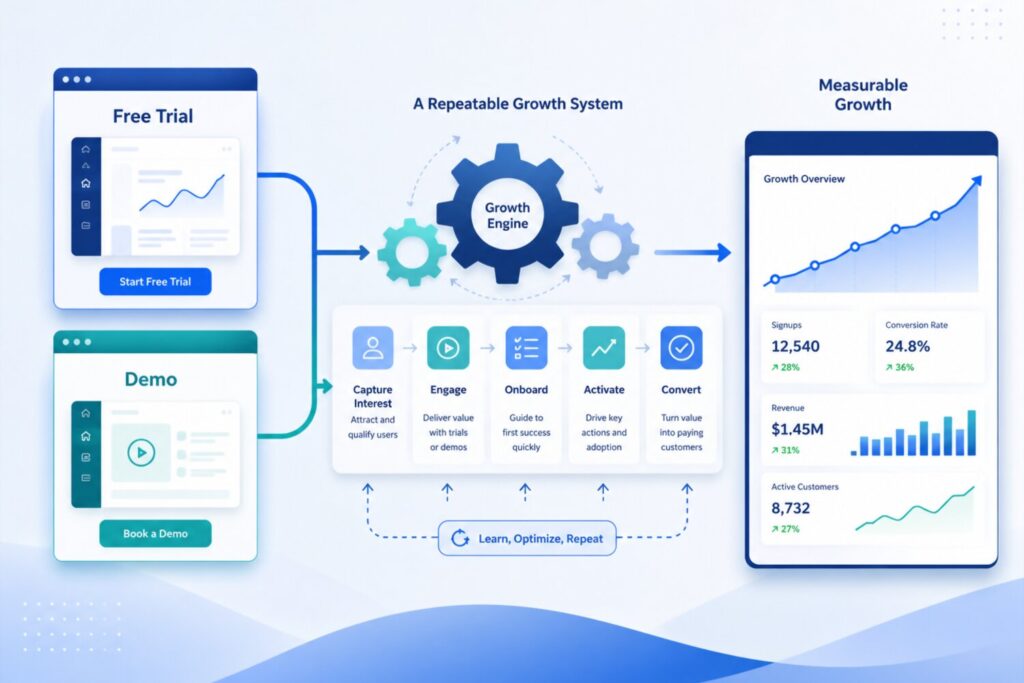
For SaaS startups, getting a signup or demo request is only the beginning. Real growth happens when marketing helps turn interest into activation, usage, trust, and paid conversion.
A free trial should not leave users alone to figure out the product. New users need a clear path to their first meaningful result. This may be creating a project, inviting a teammate, connecting an integration, importing data, or completing a key workflow. The sooner users experience value, the more likely they are to continue.
Guide users toward activation
Activation is the moment when a user understands why the product matters. It is different from simple account creation. A person can sign up and still feel confused, uncertain, or unmotivated. Strong SaaS marketing supports activation through welcome emails, product tours, helpful tutorials, use case based onboarding, and timely reminders. These messages should focus on the user’s goal, not only on product features.
Demos need the same level of structure. A good demo is not a general product walkthrough. It should connect the software to the prospect’s pain points, business context, and success metrics. Before the demo, the team should understand the company size, role of the buyer, current process, and reason for looking. After the demo, follow up should include relevant resources, pricing clarity, answers to objections, and a clear next step.
A strong SaaS conversion system usually includes:
- A welcome sequence that explains the fastest path to value
- Product prompts that guide users to important actions
- Educational emails based on behavior and intent
- Retargeting campaigns for visitors who did not convert
- Case studies that support trust during evaluation
- Sales follow up for high intent accounts
- Usage data that shows which users are likely to pay
The best trial and demo strategy is based on behavior. A user who explores pricing, invites teammates, or uses a core feature may need a different message than someone who signs up and never returns. Marketing and sales teams should work from shared data so they know which accounts need education, which need personal outreach, and which are ready for a buying conversation. This helps the startup avoid generic communication and focus effort where it can improve revenue.
SaaS startups should also measure what happens after the lead is captured. Important metrics include activation rate, trial to paid conversion, demo attendance, demo to close rate, time to value, and churn after the first billing cycle. These numbers show whether the marketing funnel is bringing the right users and whether the onboarding journey is helping them succeed. A growth system is not built by collecting more leads. It is built by helping the right users reach value faster.
Measure What Actually Matters and Improve Every Month
A SaaS marketing strategy should be measured by revenue quality, not just traffic. Page views, impressions, and followers can show visibility, but they do not prove that marketing is creating sustainable growth.
Focus on SaaS metrics that connect to revenue
The most useful metrics show how people move from first visit to paid customer. A startup should track where leads come from, how many convert, how much it costs to acquire them, and how long they stay. This gives the team a clearer view of which marketing activities create real business value. Without this discipline, a campaign may look successful because it brings attention, while quietly attracting users who never activate or pay.
Important SaaS marketing metrics include:
- Customer acquisition cost
- Lifetime value
- Trial to paid conversion rate
- Demo to close rate
- Activation rate
- Lead to customer conversion rate
- Churn rate
- Payback period
Customer acquisition cost shows how much the startup spends to win a new customer. Lifetime value estimates how much revenue that customer may generate over time. These two metrics should be reviewed together because low cost leads are not always good leads. A channel that brings expensive customers can still be profitable if those customers stay longer, buy larger plans, or expand their accounts.
Activation rate is especially important for SaaS startups. It shows whether users reach the first meaningful result inside the product. If many people sign up but few activate, the issue may be weak onboarding, unclear positioning, poor fit, or a product experience that does not deliver value quickly enough. Marketing should work with product and sales teams to understand this gap. Growth improves when the full customer journey is measured, not only the top of the funnel.
Monthly reviews help a SaaS team make better decisions. The team should compare channels, campaigns, landing pages, content topics, email sequences, and sales follow ups. They should look for patterns in qualified leads, paid conversions, retention, and expansion. Some campaigns may need better messaging. Some channels may deserve more budget. Some audiences may look attractive but produce high churn.
The goal is not to track every possible number. The goal is to identify the metrics that reveal whether marketing is helping the startup grow in a healthy way. A simple dashboard with a few meaningful numbers is better than a complex report nobody uses. When SaaS founders measure the right things every month, they can improve positioning, refine acquisition channels, strengthen onboarding, and invest in the activities that move customers toward long term value.
Conclusion
A strong SaaS digital marketing strategy is not built from random campaigns. It starts with market clarity, a precise ideal customer profile, clear positioning, focused acquisition channels, useful content, effective onboarding, and consistent measurement. Each part should support the same goal: helping the right customers understand the product, trust its value, and move confidently toward adoption.
For SaaS startups, growth depends on learning faster than the market changes. Founders and marketing teams should study customer behavior, test messages, review conversion data, and improve every month. This approach turns marketing from a collection of tactics into a repeatable growth system.
To explore related concepts in more detail, these Wikipedia resources may be useful: