
A Middle Python Developer is more than someone who can write Python scripts or complete small tickets. At this level, you are expected to build reliable features, understand tradeoffs, debug real production problems, write maintainable code, and collaborate effectively with other engineers. You do not need to know everything a senior developer knows, but you should be able to work with moderate independence and make decisions that improve the codebase instead of simply adding more code.
Becoming a Middle Python Developer means developing three kinds of expertise at the same time: strong Python fundamentals, production-oriented backend skills, and professional engineering habits. The goal is not just to “learn Python,” but to learn how Python is used in real projects: APIs, databases, tests, deployments, security, monitoring, and teamwork.
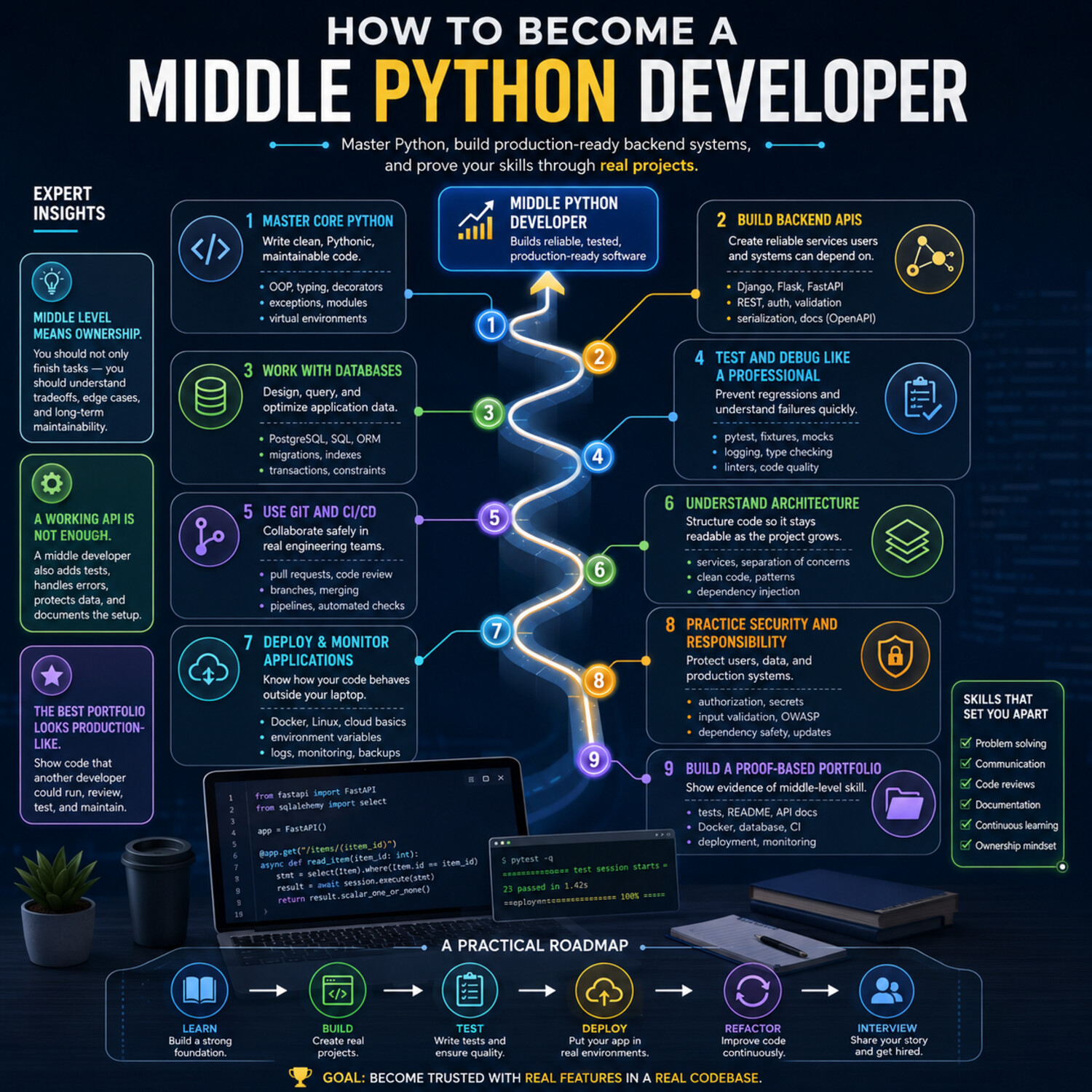
What Is a Middle Python Developer?
A Middle Python Developer, often called a mid-level Python developer, is a software engineer who can take a clearly defined business or technical problem and turn it into a working, tested, maintainable solution. Unlike a junior developer, you should not need step-by-step guidance for every task. Unlike a senior developer, you are usually not responsible for broad architecture decisions across multiple teams or systems.
At this level, you should be able to:
- Understand requirements and ask useful clarifying questions.
- Break a feature into smaller technical tasks.
- Write clean Python code that other developers can read and maintain.
- Work with databases, APIs, tests, Git, and deployment workflows.
- Debug issues without relying entirely on a senior developer.
- Review code and explain your own design decisions.
For example, a junior developer might be asked to “add a field to this API response.” A middle developer might be asked to “implement user notification preferences, including the database model, API endpoints, validation, tests, and documentation.” The difference is not only task size. It is the level of ownership.
To reach this level, you need practical experience. Reading tutorials helps, but middle-level skill comes from building, breaking, fixing, refactoring, and maintaining code.
Core Python Skills You Must Master
Python fundamentals are the foundation of everything else. A middle developer should not write Python by trial and error. You should understand how the language behaves and why certain patterns are preferred.
Start with the essentials: variables, functions, classes, modules, exceptions, comprehensions, iterators, generators, and context managers. Then move deeper into concepts that often separate junior code from professional code: object-oriented design, type hints, decorators, dependency management, packaging, and Pythonic style.
Type hints are especially important in modern Python projects. They make code easier to understand, improve editor support, and help catch certain mistakes before runtime. Python’s typing module provides support for basic and advanced type annotations, including concepts such as Union, Callable, TypeVar, and generics.
For example, this function is understandable but loose:
def calculate_total(items):
    return sum(item["price"] * item["quantity"] for item in items)
A more maintainable version makes expectations clearer:
from typing import TypedDict

class CartItem(TypedDict):
    price: float
    quantity: int

def calculate_total(items: list[CartItem]) -> float:
    return sum(item["price"] * item["quantity"] for item in items)
This does not make Python a statically typed language, but it helps your team understand what the function expects. It also works well with tools such as mypy or Pyright.
You should also learn virtual environments. Python’s official documentation describes venv as a way to create lightweight virtual environments with their own independent installed packages. This matters because real projects depend on specific package versions. Without isolated environments, one project’s dependencies can break another project.
A practical learning path for core Python looks like this:
- Rebuild small utilities without copying code.
- Read well-written open-source Python code.
- Refactor your own scripts into modules and packages.
- Add type hints and run a type checker.
- Write tests for your functions.
- Practice explaining why your code is structured the way it is.
The most important sign of progress is not that your code “works.” It is that your code is clear, predictable, and easy to change.
How Middle-Level Python Differs From Junior-Level Python
The transition from junior to middle developer is mostly about judgment. A junior developer often focuses on making the task pass. A middle developer also considers maintainability, edge cases, performance, security, and how the change affects the rest of the system.
For example, a junior developer might solve a repeated block of logic by copying it into three places. A middle developer notices duplication and extracts a function or service. A junior developer might catch an exception with a broad except Exception: block. A middle developer asks what errors are expected, which ones should be logged, which ones should be returned to the user, and which ones should fail loudly.
Middle-level developers also become better at reading code. This is important because professional software work usually involves existing codebases. You need to trace how data moves through the system, understand naming conventions, identify side effects, and make changes without introducing regressions.
To grow into this level, practice these habits:
- Before coding, identify the inputs, outputs, and failure cases.
- Before submitting code, read your own diff as if you were reviewing someone else.
- After solving a bug, write down the root cause, not just the fix.
- When receiving code review comments, look for the principle behind the comment.
- When using a library, read the documentation instead of relying only on examples.
Middle developers are valuable because they reduce uncertainty. They do not merely complete tickets; they make the codebase safer to work with.
Backend Development Skills: APIs, Web Frameworks, and Services
Many Middle Python Developer roles are backend-focused. That means you need to know how web applications and APIs work. You do not need to master every framework, but you should be confident with at least one major Python backend framework and familiar with the others.
The most common choices are Django, Flask, and FastAPI.
Django is a full-featured framework with built-in tools for models, admin panels, authentication, forms, and security features. It is useful for larger applications where convention and structure matter. Flask is lightweight and flexible, often used for smaller services or projects where the team wants more control. FastAPI is designed for building APIs with Python type hints and automatic interactive documentation. Its official documentation describes it as a modern framework for building APIs based on standard Python type hints.
A middle backend developer should understand:
- HTTP methods:
GET,POST,PUT,PATCH, andDELETE. - Status codes:
200,201,400,401,403,404,409, and500. - Request validation and response serialization.
- Authentication and authorization.
- Pagination, filtering, and sorting.
- API versioning.
- Error response design.
- OpenAPI documentation.
- Background jobs and scheduled tasks.
For example, creating an endpoint is easy. Designing a reliable endpoint is harder. Suppose you build an API that creates a customer order. You need to ask:
- What happens if the product does not exist?
- What happens if inventory changes during the request?
- Can the same request be submitted twice?
- Should the operation be atomic?
- What should the response include?
- How will this endpoint be tested?
- What should be logged if payment fails?
That kind of thinking marks middle-level backend work.
A strong learning project would be a REST API with user authentication, PostgreSQL, role-based permissions, automated tests, Docker, and API documentation. Build it as if another developer will maintain it after you.
Databases Every Middle Python Developer Should Know
Most production applications store and retrieve data. A Middle Python Developer should be comfortable with relational databases, especially PostgreSQL, and should understand how Python applications communicate with databases through raw SQL, query builders, or ORMs.
You should know SQL well enough to write and understand:
SELECT,INSERT,UPDATE, andDELETE.JOINqueries.GROUP BYand aggregate functions.- Indexes.
- Transactions.
- Constraints.
- Migrations.
- Query performance basics.
ORMs such as Django ORM or SQLAlchemy are useful because they allow you to work with database records using Python objects. But an ORM does not remove the need to understand SQL. In fact, middle developers often need to inspect the SQL generated by an ORM to solve performance problems.
For example, this kind of ORM code may look harmless:
orders = Order.objects.all()

for order in orders:
    print(order.customer.email)
But if each order.customer access triggers a separate database query, the result may be an N+1 query problem. A middle developer should recognize this and use tools such as select_related, prefetch_related, joins, or eager loading depending on the framework.
You should also learn when to use Redis. Redis is commonly used for caching, rate limiting, temporary data, distributed locks, and background job queues. You do not need to become a database administrator, but you should understand how caching can improve performance and how stale cache data can create bugs.
A practical way to build database expertise is to create a project that includes:
- A normalized relational schema.
- Database migrations.
- Indexes on frequently queried fields.
- A few slow queries that you intentionally optimize.
- Transaction handling for multi-step operations.
- Tests that verify database behavior.
Middle developers should treat the database as part of the application design, not as a passive storage box.
Testing, Debugging, and Code Quality
Testing is one of the clearest signs that a developer is moving beyond the junior level. A middle developer does not test only because a team requires coverage. You test because tests protect behavior, document expectations, and make future changes safer.
In Python, pytest is one of the most widely used testing tools. Its documentation covers core testing features such as assertions, fixtures, markers, parametrization, and temporary test files. Fixtures are especially useful because they provide a reliable context for tests, such as a configured database, test user, or temporary file.
You should understand several types of tests:
- Unit tests check small pieces of logic in isolation.
- Integration tests verify that components work together, such as an API endpoint and a database.
- End-to-end tests simulate complete user flows.
- Regression tests confirm that a previously fixed bug does not return.
For example, if you write a discount calculation function, unit tests are appropriate:
def apply_discount(price: float, percent: float) -> float:
    if percent < 0 or percent > 100:
        raise ValueError("Discount must be between 0 and 100")
    return price * (1 - percent / 100)
Useful tests would check normal discounts, zero discount, full discount, negative values, and values above 100.
Debugging is just as important as testing. Learn to use:
- Logging instead of random
print()statements. - Python’s built-in debugger,
pdb. - IDE debuggers.
- Stack traces.
- Error monitoring tools.
- Database query logs.
- Reproduction steps.
Code quality also includes style and readability. PEP 8 is Python’s official style guide for code in the standard library and remains an important reference for Python conventions. In professional projects, formatting tools such as Black, Ruff, isort, and linters help teams avoid wasting review time on style debates.
A middle developer’s testing mindset is simple: “How could this break, and how can I prove it works?”
Git, CI/CD, and Team Workflow
Professional development is collaborative. You need to know Git not just as a way to save code, but as a tool for teamwork.
A Middle Python Developer should be comfortable with:
- Creating branches.
- Writing meaningful commit messages.
- Opening pull requests.
- Resolving merge conflicts.
- Reviewing code.
- Rebasing when appropriate.
- Understanding release branches.
- Reading CI failures.
- Keeping changes focused.
Code review is especially important. When you open a pull request, you are not just asking, “Does this work?” You are asking, “Is this a good change for the codebase?” Your pull request should explain what changed, why it changed, how it was tested, and anything reviewers should pay attention to.
CI/CD stands for continuous integration and continuous delivery or deployment. At a middle level, you should understand what happens when you push code: tests run, linters check formatting, type checkers may run, Docker images may build, and deployment workflows may start.
You do not need to design a complex deployment platform, but you should know how to interpret common failures. For example:
- A test fails only in CI because an environment variable is missing.
- A package version differs between local and CI environments.
- A migration was not included.
- A Docker build fails because a dependency is not installed.
- A linter fails because imports are incorrectly ordered.
To gain this skill, add a CI pipeline to your portfolio project. Make it run tests and linting on every pull request. This proves that you understand professional workflow, not just local development.
Software Architecture and Clean Code Basics
Middle Python Developers should understand architecture at the application level. You are not expected to design a large distributed system alone, but you should know how to organize code so the project remains maintainable.
Important concepts include:
- Separation of concerns.
- Dependency injection.
- Service layers.
- Repository patterns.
- Configuration management.
- Error handling strategies.
- Domain models.
- Modular design.
- Avoiding circular imports.
- Avoiding unnecessary abstraction.
For example, in a web application, it is usually a mistake to put all business logic directly inside route handlers or views. A route handler should receive the request, validate input, call application logic, and return a response. The actual business rules should live in a separate function, service, or domain layer.
Poor structure:
@app.post("/orders")
def create_order():
    # validate request
    # check user
    # query product
    # calculate price
    # update inventory
    # create payment
    # send email
    # return response
Better structure:
@app.post("/orders")
def create_order(request: OrderRequest):
    order = order_service.create_order(request)
    return OrderResponse.from_order(order)
The second example is easier to test, reuse, and modify.
However, clean code does not mean adding patterns everywhere. Over-engineering is a common middle-level mistake. The best architecture is the simplest structure that supports the current requirements and reasonable future changes.
A useful rule: if a design pattern makes the code easier to understand and test, use it. If it mainly makes the code look more “advanced,” avoid it.
Working With APIs, External Services, and Async Python
Modern applications often depend on external services: payment providers, email services, analytics tools, identity providers, storage platforms, and third-party APIs. A Middle Python Developer should know how to integrate these services safely.
When calling external APIs, you should think about:
- Timeouts.
- Retries.
- Rate limits.
- Authentication tokens.
- Pagination.
- Idempotency.
- Error mapping.
- Logging.
- Sensitive data protection.
- Fallback behavior.
A common beginner mistake is making an HTTP request without a timeout. If the external service hangs, your application may also hang. A middle developer sets timeouts intentionally and decides whether the request should be retried.
You should also understand async Python. async and await are useful for I/O-heavy workloads, such as handling many network calls. They are not magic performance boosters for every situation. CPU-heavy work may need multiprocessing, background workers, or a different architecture.
FastAPI and other ASGI-based tools make async development common in Python backend work. FastAPI also supports dependency overrides for testing, allowing you to replace real dependencies with test-specific ones. This is valuable when testing code that normally depends on a database, authentication provider, or external service.
For example, if your endpoint depends on a payment client, your tests should not call the real payment provider. Instead, inject a fake client that returns predictable responses. This makes tests faster, safer, and more reliable.
Related concepts worth learning include:
- Webhooks.
- Message queues.
- Background workers.
- Celery or RQ.
- Event-driven architecture.
- API gateways.
- Circuit breakers.
- Idempotency keys.
A middle developer understands that network calls fail. Good code assumes failure is possible and handles it deliberately.
Deployment, Cloud, and DevOps Fundamentals
A Middle Python Developer does not need to be a full DevOps engineer, but you should understand how your code reaches production and how it behaves there.
Start with Linux basics. Many Python applications run on Linux servers or Linux-based containers. You should know how to navigate files, inspect logs, manage environment variables, check running processes, and understand file permissions.
Then learn Docker. Docker helps package applications with their dependencies so they can run consistently across environments. You should know how to write a basic Dockerfile, build an image, run a container, expose ports, and pass configuration. Docker’s documentation explains that build arguments and environment variables are used to pass information into the build process and parameterize builds. Docker Compose documentation also covers setting environment variables in container environments.
You should understand these deployment concepts:
- Environment variables.
- Secrets management.
- Application logs.
- Health checks.
- Reverse proxies.
- Static files.
- Database migrations.
- Rollbacks.
- Monitoring.
- Error tracking.
- Basic cloud services.
For example, a middle developer should know that secrets such as API keys and database passwords should not be committed to Git. They should be passed through environment variables or a secret management system.
You should also know how to troubleshoot production-like problems:
- The app starts locally but fails in Docker.
- The database connection works locally but fails in staging.
- A migration was applied in the wrong order.
- A new release increases response time.
- Logs show repeated timeout errors from an external service.
To gain deployment skill, deploy one real project. It can be small, but it should include a database, environment variables, logs, migrations, and a documented setup process.
Security Skills for Python Developers
Security is not only a senior responsibility. A middle developer should write code that avoids common vulnerabilities and protects user data.
The OWASP Top 10 is a widely used awareness resource for critical web application security risks. OWASP describes the Top 10 as a standard awareness document for developers and web application security.
Key security skills include:
- Validate and sanitize input.
- Use parameterized queries or ORM protections against SQL injection.
- Store passwords with secure hashing algorithms.
- Never log sensitive information.
- Check authorization, not just authentication.
- Protect secrets.
- Keep dependencies updated.
- Use HTTPS.
- Apply least privilege.
- Understand CSRF, XSS, SSRF, and CORS basics.
Authentication answers the question, “Who is this user?” Authorization answers, “What is this user allowed to do?” Middle developers must understand the difference. A user being logged in does not mean they should access every resource.
For example, this is a dangerous pattern:
@app.get("/orders/{order_id}")
def get_order(order_id: int):
    return db.get_order(order_id)
A safer version checks ownership or permissions:
@app.get("/orders/{order_id}")
def get_order(order_id: int, current_user: User):
    order = db.get_order(order_id)

    if order.user_id != current_user.id and not current_user.is_admin:
        raise PermissionError("Not allowed")

    return order
Even this is simplified, but it shows the mindset. Security should be part of normal development, not something added at the end.
AI Tools and Responsible Developer Productivity
AI coding assistants can help Python developers learn faster, generate boilerplate, explain unfamiliar code, suggest tests, and explore refactoring options. But middle developers must use these tools responsibly.
The key skill is verification. AI-generated code can look confident while being wrong, insecure, inefficient, or inconsistent with your project’s architecture. Stack Overflow’s Developer Survey reported that more developers actively distrust the accuracy of AI tools than trust it, with only a small percentage saying they highly trust the output.
Use AI tools for:
- Explaining unfamiliar code.
- Generating first drafts of tests.
- Suggesting edge cases.
- Comparing design options.
- Writing documentation drafts.
- Creating small utility functions.
- Learning new libraries.
Do not blindly use AI tools for:
- Security-sensitive code.
- Authentication and authorization logic.
- Database migrations you do not understand.
- Complex concurrency.
- Production incident fixes.
- Code involving private or confidential information.
A good workflow is:
- Ask AI for an explanation or draft.
- Read the relevant official documentation.
- Adapt the code to your project.
- Add tests.
- Run linters and type checkers.
- Review the code as if someone else wrote it.
- Ask a teammate for review when the risk is high.
Responsible AI use can make you faster, but it should not replace engineering judgment. At the middle level, your value is not typing speed. Your value is knowing what is correct, maintainable, and safe.
Portfolio Projects That Prove Middle-Level Skill
A strong portfolio for a Middle Python Developer should prove that you can build production-like software. Small scripts are useful for learning, but they rarely show middle-level ability by themselves.
A good portfolio project should include:
- A clear README.
- A real problem statement.
- API documentation.
- Authentication.
- Role-based permissions.
- PostgreSQL or another relational database.
- Database migrations.
- Tests.
- Docker setup.
- CI pipeline.
- Type hints.
- Error handling.
- Logging.
- Deployment instructions.
For example, you could build a task management API for teams. It might include users, teams, projects, tasks, comments, file metadata, labels, due dates, and notifications. To make it middle-level, do not stop at CRUD endpoints. Add permissions, pagination, filtering, tests, migrations, and background email notifications.
Another strong project is an e-commerce order service. It could include products, carts, orders, inventory checks, payment simulation, idempotency keys, and admin endpoints. This project demonstrates database modeling, transactions, API design, and failure handling.
Your repository should make the reviewer think, “This person understands how real backend work is organized.” That means clean commits, readable code, clear setup instructions, and tests that actually run.
Avoid portfolio projects that are only copied from tutorials. It is fine to learn from tutorials, but your final project should include your own decisions and tradeoffs. Add a short “Architecture Notes” section to the README explaining why you chose certain patterns.
Interview Preparation for Middle Python Developer Roles
Middle Python interviews usually test both coding ability and practical engineering judgment. You may be asked about Python fundamentals, APIs, databases, testing, debugging, Git, deployment, and system design basics.
Prepare for Python questions such as:
- What is the difference between a list and a tuple?
- How do decorators work?
- What are generators?
- What is the difference between
isand==? - How does exception handling work?
- What are mutable default arguments, and why can they be dangerous?
- How do context managers work?
- Why use type hints?
Prepare for backend questions such as:
- How would you design a REST API for orders?
- How do authentication and authorization differ?
- How would you handle pagination?
- What status code would you return for invalid input?
- How would you prevent duplicate requests?
- How would you handle a slow third-party API?
Prepare for database questions such as:
- What is an index?
- What is a transaction?
- What is a join?
- What causes N+1 queries?
- How do migrations work?
- When would you denormalize data?
For live coding, practice explaining your thinking. Interviewers often care about how you approach ambiguity, not only whether you reach the perfect answer. Say what assumptions you are making, identify edge cases, and test your solution.
For take-home tasks, prioritize:
- Correctness.
- Clear project structure.
- Tests.
- Simple setup.
- Meaningful README.
- Thoughtful error handling.
- Avoiding unnecessary complexity.
A middle-level interview is not about pretending to know everything. It is about showing that you can reason clearly, learn quickly, and build dependable software.
A Practical Roadmap to Become a Middle Python Developer
The fastest path to becoming a Middle Python Developer is not random learning. You need a structured plan that moves from fundamentals to production-like work.
Stage 1: Strengthen Python fundamentals.
Learn functions, classes, modules, exceptions, comprehensions, iterators, context managers, decorators, and type hints. Practice by building small tools, then refactor them for readability.
Stage 2: Build backend foundations.
Choose one framework: Django, Flask, or FastAPI. Learn routing, request validation, authentication, authorization, error handling, and API documentation. Build several small APIs before starting a larger project.
Stage 3: Learn databases seriously.
Practice SQL directly. Use PostgreSQL. Learn indexes, joins, transactions, constraints, and migrations. Then use an ORM and connect what the ORM does to the SQL underneath.
Stage 4: Add testing and quality tools.
Use pytest. Write unit and integration tests. Add fixtures. Run linters, formatters, and type checkers. Learn to treat tests as part of the feature, not as an afterthought.
Stage 5: Learn Git and team workflow.
Use branches, pull requests, and code reviews, even for personal projects. Write useful commit messages. Keep changes small and focused.
Stage 6: Deploy a project.
Containerize your app with Docker. Use environment variables. Connect a database. Run migrations. Add logs. Deploy the project and document the process.
Stage 7: Practice debugging and maintenance.
Introduce bugs intentionally and fix them. Optimize a slow query. Add logging to diagnose a failure. Refactor a messy module. Maintenance work builds middle-level judgment.
Stage 8: Prepare for interviews with real examples.
For every skill, prepare a story from your own work. Instead of saying, “I know testing,” explain a bug your test caught. Instead of saying, “I know databases,” explain how you fixed an N+1 query or designed a migration.
The final goal is not to collect technologies. The goal is to become the kind of developer who can be trusted with real features in a real codebase. A Middle Python Developer writes code that works, explains decisions clearly, handles common production concerns, and keeps improving the system with every change.