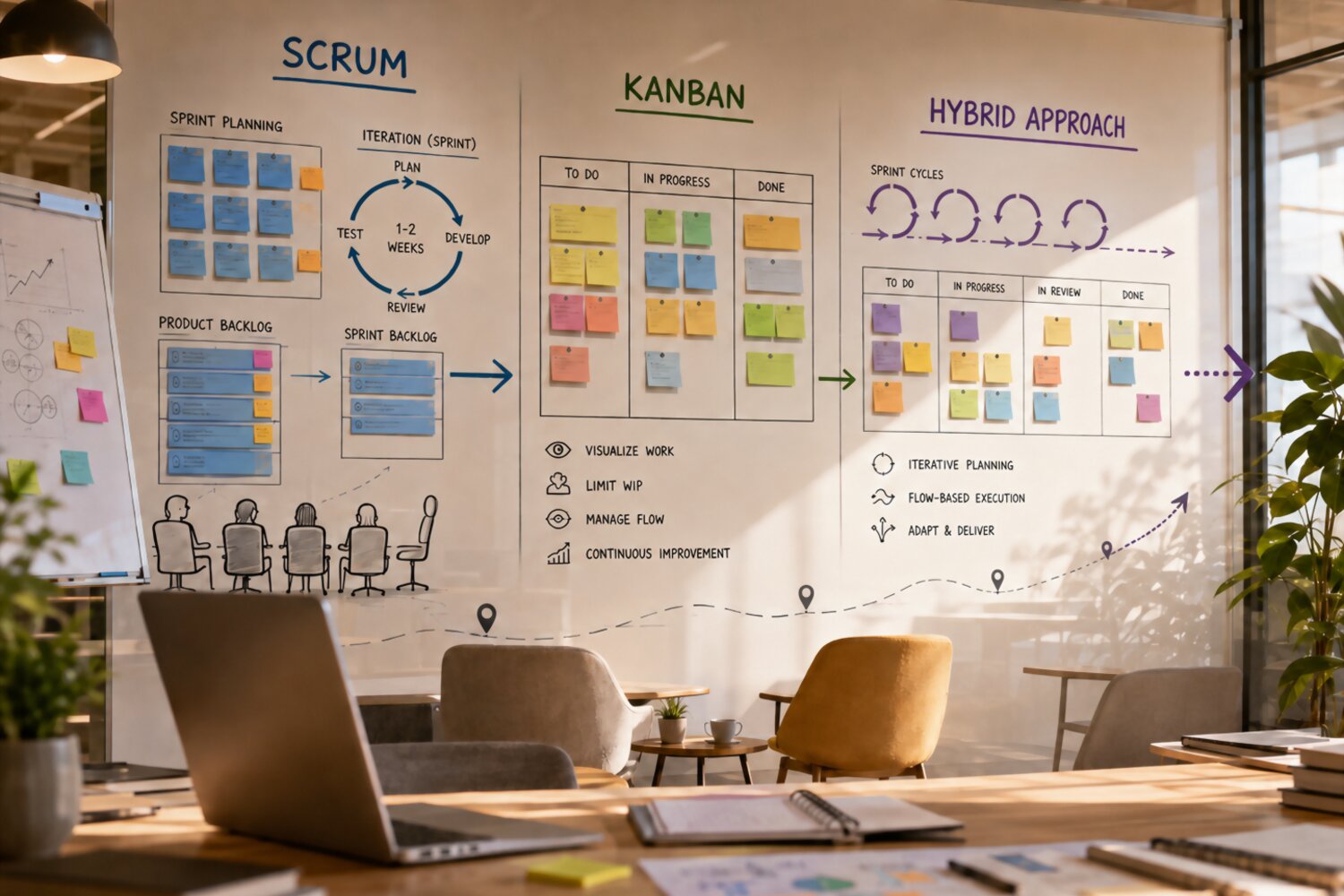
Introduction: What Is Agile Methodology?
Agile methodology is a flexible approach to managing work, especially in software and product development. Instead of creating a long, fixed plan and delivering everything at the end, Agile teams build in small, useful increments, test ideas early, and improve based on real feedback.
At its core, Agile is not just a process — it is a mindset. It helps teams respond to change without losing focus on customer value.
Agile is about delivering the right thing sooner, learning from users, and improving continuously.
Agile teams usually work through:
- Short cycles of planning, building, and reviewing
- Frequent feedback from customers or stakeholders
- Prioritized backlogs instead of rigid project plans
- Cross-functional collaboration between developers, designers, testers, product managers, and business teams
This is why Agile is popular far beyond software. Today, it is used in marketing, operations, HR, education, product management, and startup strategy — anywhere teams need to move quickly, adapt to uncertainty, and deliver meaningful results.
Agile Principles and How Agile Teams Work

Agile is not just a project management method; it is a way of thinking about work. Instead of trying to predict every detail upfront, Agile teams move in short, focused cycles, learn from feedback, and adjust their plans as new information appears. This makes Agile especially useful in environments where customer needs, market conditions, or technical requirements can change quickly.
At the heart of Agile is the idea of delivering value early and often. Rather than waiting months to release a “perfect” final product, teams break work into smaller pieces and deliver improvements step by step. Each cycle gives the team a chance to test assumptions, collect feedback, and decide what should happen next.
A typical Agile team works with several core practices:
- Backlog management: Work is collected and prioritized in a backlog, usually as features, tasks, bugs, or user stories.
- User stories: Requirements are written from the user’s perspective, helping the team focus on real needs rather than abstract specifications.
- Short iterations: Teams plan work in small timeframes, often one to four weeks, depending on the framework.
- Regular feedback: Customers, stakeholders, and team members review progress frequently.
- Continuous improvement: Teams reflect on what worked, what slowed them down, and how the process can be improved.
One important Agile principle is adaptability over rigid planning. This does not mean Agile teams work without structure. In fact, strong Agile teams are often highly disciplined. They plan carefully, but they do not treat the plan as fixed forever. When priorities shift or new insights appear, the team can respond without losing momentum.
Agile teams are usually cross-functional, meaning they include the skills needed to deliver a working result: product knowledge, design, development, testing, and sometimes marketing or operations. This reduces dependency on outside departments and helps teams move faster.
Another key concept is transparency. Agile teams make work visible through boards, backlogs, daily check-ins, reviews, and metrics. Everyone should be able to see what is being worked on, what is blocked, and what is coming next.
In simple terms, Agile teams work by asking three repeated questions: What is most valuable now? What can we deliver next? What can we improve after that? This cycle of prioritizing, delivering, learning, and adapting is what makes Agile different from traditional linear project management.
Scrum Explained: Roles, Sprints, and Ceremonies
Scrum is one of the most widely used Agile frameworks because it gives teams a clear structure for turning ideas into working results. While Agile describes the mindset, Scrum provides a practical system: defined roles, fixed-length work cycles, regular meetings, and a rhythm for continuous improvement.
At the center of Scrum is the sprint — a short, time-boxed period, usually lasting one to four weeks. During a sprint, the team commits to completing a selected set of work from the product backlog. The goal is not simply to stay busy, but to produce something valuable, testable, or usable by the end of the cycle.
Scrum teams usually include three main roles:
- Product Owner: Defines priorities, manages the product backlog, and represents customer or business needs.
- Scrum Master: Helps the team follow Scrum, removes obstacles, and supports better collaboration.
- Developers: The people who design, build, test, and deliver the product increment.
A common misunderstanding is that the Scrum Master is a traditional manager. In reality, this role is more about coaching and facilitation than command and control. The Scrum Master helps the team work effectively, but does not assign tasks in the old top-down style.
Scrum also relies on a set of recurring events, often called ceremonies:
- Sprint Planning: The team decides what work to complete during the sprint and how it will be approached.
- Daily Scrum: A short meeting where team members align on progress, blockers, and next steps.
- Sprint Review: The completed work is demonstrated to stakeholders for feedback.
- Sprint Retrospective: The team reflects on how the sprint went and identifies ways to improve.
One of Scrum’s strengths is its balance between structure and adaptability. The sprint creates focus, while reviews and retrospectives create regular opportunities to learn. This makes Scrum especially useful for product teams that need predictable delivery cycles but still want room to respond to feedback.
However, Scrum works best when teams take its principles seriously. Simply holding daily meetings or using a sprint board does not make a team Agile. Effective Scrum requires clear priorities, active product ownership, realistic planning, and a team culture where problems are surfaced early rather than hidden until the deadline.
Kanban Explained: Boards, Flow, and WIP Limits
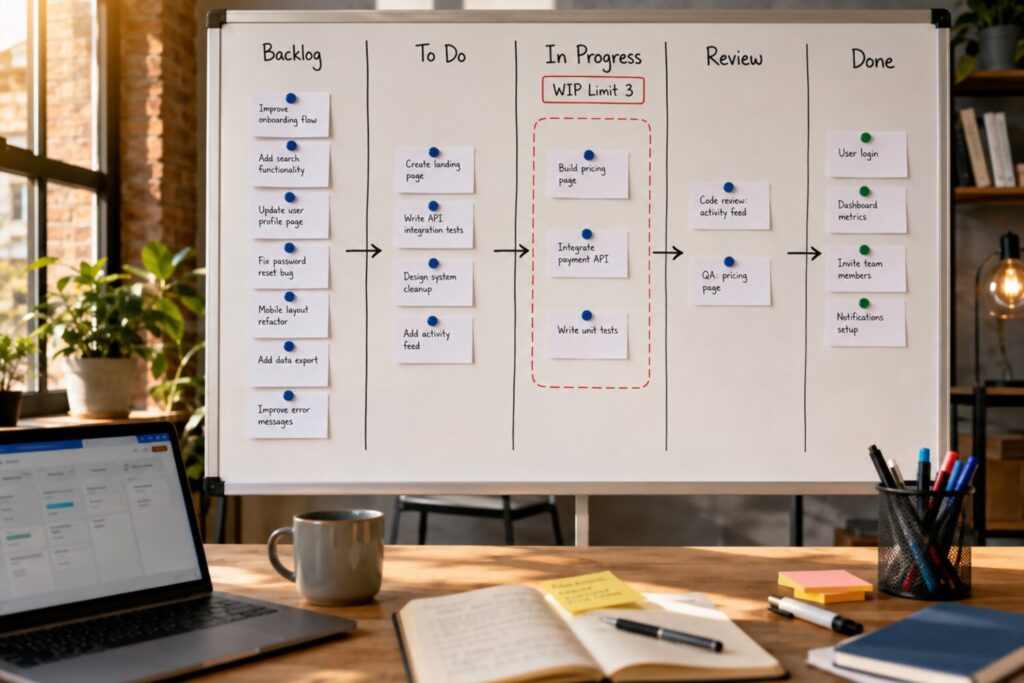
Kanban is an Agile approach focused on visualizing work, improving flow, and reducing bottlenecks. Unlike Scrum, which organizes work into fixed-length sprints, Kanban is usually continuous. New tasks can be added, prioritized, and completed as capacity becomes available, making it especially useful for teams with changing priorities or unpredictable workloads.
The most recognizable part of Kanban is the Kanban board. A basic board may include columns such as To Do, In Progress, Review, and Done. Each task moves across the board as it progresses, giving the team a clear picture of what is happening at any moment. This visual system helps prevent hidden work and makes delays easier to spot.
Kanban is built around a few practical ideas:
- Visualize the workflow: Make every task visible so the team can understand the real state of work.
- Limit work in progress: Set limits on how many tasks can be active at the same time.
- Manage flow: Focus on moving work smoothly from start to finish instead of simply starting more tasks.
- Improve continuously: Use data and team feedback to refine the process over time.
One of the most powerful Kanban concepts is the WIP limit, or work-in-progress limit. A WIP limit prevents too many tasks from entering the same stage at once. For example, if the “Review” column has a limit of three items, the team cannot keep adding more work there until something moves forward. This encourages people to finish existing tasks before starting new ones.
Kanban also helps teams measure performance through flow-based metrics. Cycle time shows how long it takes to complete a task once work begins. Lead time measures the full journey from request to delivery. Throughput tracks how many tasks are completed in a given period. These metrics help teams identify delays and make realistic delivery forecasts.
Kanban is often a strong choice for support teams, maintenance work, content production, operations, and product teams that handle frequent incoming requests. It gives teams flexibility without removing discipline. In fact, effective Kanban requires careful attention to priorities, capacity, and bottlenecks.
In simple terms, Kanban helps teams answer an important question: How can we deliver work more smoothly without overloading the system? By making work visible and limiting multitasking, Kanban creates a calmer, more predictable way to manage continuous delivery.
Scrum vs. Kanban: Key Differences and How to Choose
Scrum and Kanban are both Agile approaches, but they solve different types of workflow problems. Scrum is designed around structure, planning, and time-boxed delivery, while Kanban focuses on continuous flow, flexibility, and limiting overload. Neither is automatically better than the other; the right choice depends on the team’s work style, project complexity, and how often priorities change.
Scrum works well when a team can plan work in short cycles and commit to a clear sprint goal. For example, a product development team building a new feature may benefit from Scrum because it provides a rhythm: plan the sprint, build the feature, review the outcome, and improve the process. This structure helps teams stay focused and gives stakeholders predictable checkpoints.
Kanban is often more effective when work arrives continuously and priorities shift often. Support teams, operations teams, maintenance teams, and content teams may not be able to plan everything two weeks in advance. In these cases, Kanban allows work to move through the system as capacity becomes available. Instead of asking, “What can we finish this sprint?”, Kanban asks, “How can we keep work moving smoothly?”
A useful way to compare them is by looking at how each method handles change. In Scrum, the sprint backlog is usually protected during the sprint so the team can maintain focus. In Kanban, new work can be added when there is available capacity, making it easier to respond quickly. However, that flexibility requires discipline. Without clear priorities and WIP limits, Kanban can turn into an endless task list.
The choice between Scrum and Kanban often comes down to a few practical questions:
- Choose Scrum if your team needs structure, defined roles, sprint goals, and regular planning.
- Choose Kanban if your team needs flexibility, continuous delivery, and better visibility into workflow bottlenecks.
- Consider a hybrid approach if your team wants Scrum’s planning rhythm but Kanban’s flow management.
It is also important to remember that Agile success does not come from choosing the “perfect” framework. It comes from understanding the team’s real problems. A team struggling with unclear priorities may benefit from Scrum. A team overloaded with too many active tasks may benefit from Kanban. A team dealing with both issues may need elements of both.
Scrum vs. Kanban Comparison Table
| Comparison Area | Scrum | Kanban |
|---|---|---|
| Main focus | Delivering work in planned, time-boxed sprints | Improving continuous flow and reducing bottlenecks |
| Work cycle | Fixed-length sprints, usually 1–4 weeks | Continuous, with no required sprint cycle |
| Planning style | Work is planned before each sprint | Work is prioritized and pulled as capacity allows |
| Roles | Defined roles: Product Owner, Scrum Master, Developers | No required roles; teams can keep existing roles |
| Best for | Product development, feature delivery, teams needing structure | Support, operations, maintenance, service teams, changing priorities |
| Handling change | Changes are usually avoided during an active sprint | Changes can be introduced when capacity is available |
| Work visibility | Sprint board shows progress within the sprint | Kanban board shows the full workflow continuously |
| Commitment | Team commits to a sprint goal or sprint backlog | Team commits to managing flow and respecting WIP limits |
| Meetings | Sprint planning, daily scrum, sprint review, retrospective | Fewer required meetings; meetings are added as needed |
| Key metrics | Sprint velocity, burndown charts, sprint completion | Cycle time, lead time, throughput, WIP |
| Delivery rhythm | Delivery usually happens at the end of each sprint or increment | Delivery can happen continuously |
| Flexibility | Moderate; structure is prioritized during the sprint | High; work can be adjusted more frequently |
| Risk | Can become too meeting-heavy or rigid if misused | Can become chaotic if priorities and WIP limits are unclear |
| Team discipline needed | Strong sprint planning and backlog refinement | Strong prioritization and flow management |
| Common use case | Building a new product feature over several iterations | Managing bug fixes, requests, support tickets, or content tasks |
| Main advantage | Creates focus, rhythm, and accountability | Improves transparency, speed, and adaptability |
| Main limitation | Less flexible during active sprints | Less structured unless the team defines clear policies |
| Good fit when… | The team can plan work ahead and benefits from regular checkpoints | The team receives unpredictable work and needs fast response times |
Hybrid Agile and Scrumban: Combining Scrum and Kanban
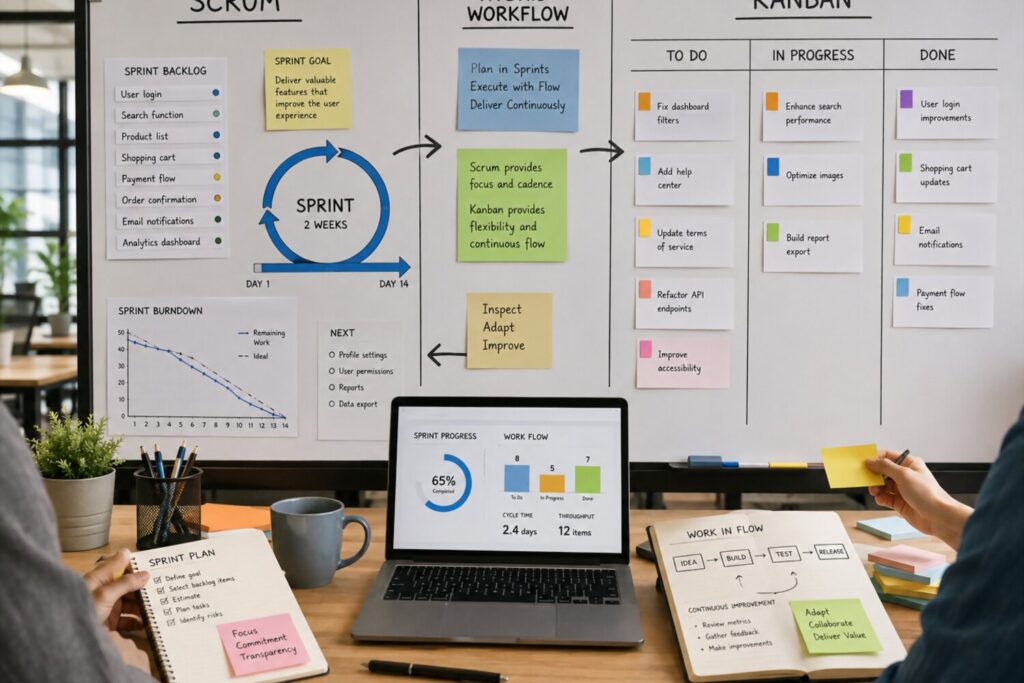
Many teams discover that pure Scrum or pure Kanban does not fully match the way they work. A product team may like Scrum’s sprint planning and review rhythm but still need Kanban’s flexibility for urgent bugs. A support team may use a Kanban board for daily requests but borrow Scrum-style retrospectives to improve collaboration. This is where hybrid Agile becomes useful.
Hybrid Agile means combining practices from different Agile frameworks to fit the team’s real workflow. The goal is not to create a random mix of methods, but to build a practical system that helps the team deliver value, manage change, and avoid overload.
One of the most common hybrid models is Scrumban. As the name suggests, Scrumban blends Scrum and Kanban. A team might keep Scrum’s planning cycles while using Kanban’s visual board and work-in-progress limits. This gives the team both structure and flow: Scrum helps answer “What should we focus on next?”, while Kanban helps answer “How do we move work through the system efficiently?”
A Scrumban team might use:
- Sprint planning to choose priorities for the next work period
- A Kanban board to visualize tasks from request to completion
- WIP limits to prevent too much work from being active at once
- Daily check-ins to identify blockers and coordinate work
- Retrospectives to improve the process regularly
- Flow metrics such as cycle time and throughput to understand delivery speed
Hybrid Agile is especially helpful for teams that handle both planned and unplanned work. For example, a software team may plan feature development in two-week cycles but also reserve capacity for bug fixes, production issues, or customer requests. Instead of forcing all work into a rigid sprint model, the team can use a hybrid system that reflects reality.
However, hybrid Agile should be used carefully. The biggest risk is creating a process that is unclear or overloaded with too many ceremonies. When teams borrow practices without understanding their purpose, hybrid Agile can become confusing. A team may have Scrum meetings, Kanban boards, multiple priority systems, and no shared agreement about how work actually moves forward.
To make hybrid Agile effective, teams should define simple working rules:
- What types of work follow a sprint plan?
- What types of work can enter the workflow anytime?
- Who decides priorities?
- What are the WIP limits?
- Which meetings are truly useful?
- Which metrics show whether the process is improving?
The best hybrid Agile systems are intentional. They do not copy frameworks blindly; they adapt them to the team’s context. In simple terms, hybrid Agile works when every practice has a clear purpose. If Scrum brings focus and Kanban improves flow, combining them can create a flexible, disciplined way to manage modern work.
How to Implement Agile Successfully
Implementing Agile is not just a matter of adding daily standups or creating a task board. A successful Agile transformation starts with a clear understanding of why the team wants to become more Agile. The goal may be faster delivery, better collaboration, improved product quality, more predictable planning, or quicker response to customer feedback. Without a clear purpose, Agile can quickly become a set of rituals with little real impact.
The first step is to understand the type of work the team handles. Teams building new products often benefit from Scrum because it creates structure, sprint goals, and regular review points. Teams dealing with support requests, maintenance, operations, or constantly changing priorities may prefer Kanban. Some teams need a hybrid approach, combining Scrum’s planning rhythm with Kanban’s visual workflow and WIP limits.
A practical Agile implementation usually includes several important steps:
- Define the business goal: Decide what Agile should improve, such as delivery speed, transparency, quality, or customer satisfaction.
- Choose the right framework: Select Scrum, Kanban, or a hybrid model based on the team’s workflow, not popularity.
- Create a clear backlog: Collect work in one place and organize it by value, urgency, and effort.
- Clarify roles and responsibilities: Make sure everyone understands who sets priorities, who removes blockers, and who delivers the work.
- Start small: Test Agile practices with one team or project before scaling them across the organization.
- Measure progress: Track meaningful metrics such as cycle time, lead time, sprint predictability, throughput, customer feedback, or defect rates.
- Improve continuously: Use retrospectives and team feedback to adjust the process over time.
One common mistake is trying to copy another company’s Agile process exactly. Agile works best when it is adapted to the team’s context. A startup, an enterprise IT department, and a marketing team may all use Agile, but their workflows, risks, and decision-making styles will be different.
Tools can support Agile implementation, but they should not drive it. Platforms such as Jira, Trello, Azure DevOps, Asana, and ClickUp can help teams visualize work, manage backlogs, and track progress. However, a tool cannot fix unclear priorities, poor communication, or lack of ownership. The process must be understood before it is automated.
Leadership also plays an important role. Agile teams need the freedom to make decisions, experiment, and surface problems early. If managers demand Agile speed while keeping traditional approval bottlenecks, the team will struggle. Agile requires trust, transparency, and a willingness to learn from results.
A good way to begin is with a simple question: What is slowing the team down right now? The answer may point toward better prioritization, fewer active tasks, clearer ownership, shorter feedback loops, or improved communication. Agile implementation becomes much easier when it focuses on solving real problems rather than following a framework mechanically.
Common Agile Mistakes and Best Practices
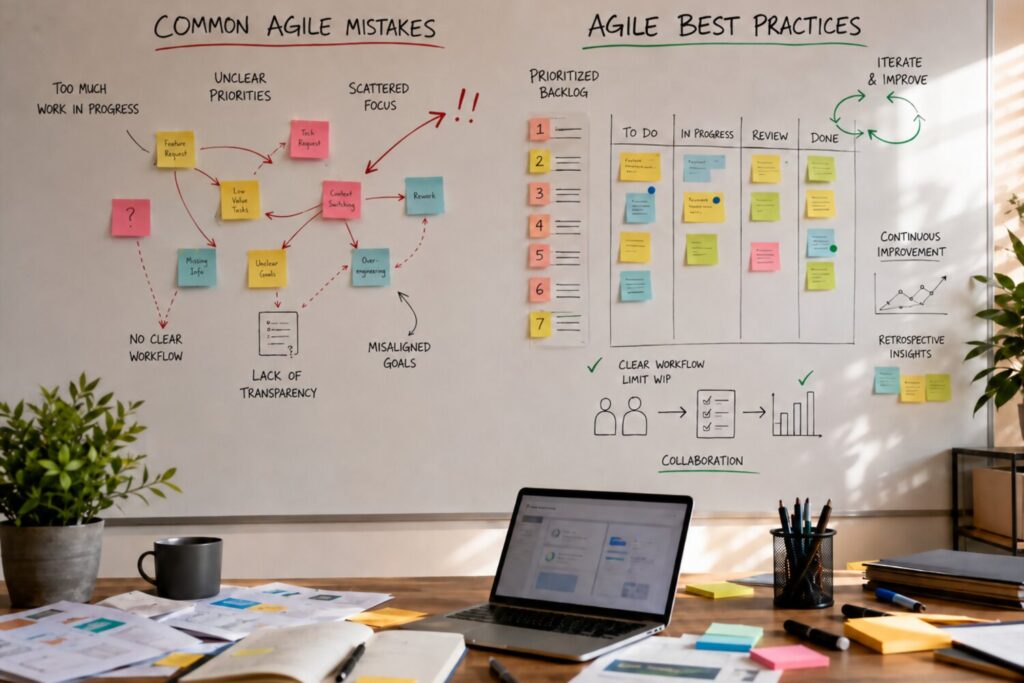
Agile can improve speed, transparency, and collaboration, but only when teams understand its purpose. One of the biggest mistakes is treating Agile as a checklist of meetings instead of a better way to deliver value. A team can have daily standups, sprint boards, and retrospectives and still work in a slow, rigid, non-Agile way.
Common Agile mistakes include:
- Too many meetings: Ceremonies should help the team make decisions, not fill the calendar.
- Unclear priorities: Without strong backlog management, teams waste time on low-value work.
- No real product ownership: Someone must be responsible for connecting team effort to customer and business value.
- Ignoring WIP limits: Starting too many tasks at once creates delays, context switching, and unfinished work.
- Skipping retrospectives: Without reflection, the same problems repeat from sprint to sprint.
- Using metrics incorrectly: Velocity, cycle time, and throughput should guide improvement, not pressure teams.
The best Agile teams keep the process simple and purposeful. They make work visible, focus on the most valuable tasks, limit distractions, and improve through regular feedback. Most importantly, they adapt Agile to their reality instead of copying a framework mechanically.
A useful rule is: if a practice does not improve clarity, delivery, quality, or learning, it should be questioned. Agile is not about doing more rituals; it is about creating a system where teams can deliver better work with less waste.
Conclusion: Choosing the Right Agile Approach
Agile is most effective when teams choose the method that matches their real workflow. Scrum is a strong choice for teams that need structure, sprint goals, and regular delivery checkpoints. Kanban works well for teams that manage continuous requests, shifting priorities, or operational work. Hybrid Agile is useful when teams need both: the planning rhythm of Scrum and the flexibility of Kanban.
The most important lesson is simple: do not follow a framework just because it is popular. Start with the team’s actual challenges. If priorities are unclear, Scrum may help create focus. If work is constantly stuck or overloaded, Kanban may expose bottlenecks. If the team handles both planned features and urgent requests, a hybrid approach may be the most realistic solution.
Many popular tools support Scrum boards, Kanban boards, backlog management, sprint planning, and workflow tracking. Common options include:
- Jira — widely used for software teams; supports Scrum and Kanban boards, sprint planning, backlogs, and issue tracking. Atlassian’s Jira documentation includes guidance for creating Scrum boards.
- Trello — a simple visual board tool built around lists and cards, often used for Kanban-style workflows. Trello’s official documentation describes boards as collections of lists and cards that can be moved between lists.
- Asana — useful for Agile teams that want Kanban boards, task ownership, project views, and workflow automation. Asana describes its Kanban software as a way to visualize progress and move tasks from to-do to done.
- monday.com — flexible work management software with Kanban views, custom workflows, automation, and project boards. Its Kanban feature focuses on visualizing task progress and identifying inefficiencies.
- ClickUp — an all-in-one productivity platform with board views, sprint management, task tracking, and reporting. ClickUp’s help center describes Board view as a go-to option for Agile teams and also provides sprint reporting guidance.
In the end, Agile tools are only useful when they support clear priorities, visible work, realistic planning, and continuous improvement. The best teams do not simply “use Agile”; they use Agile principles to build a smarter, more transparent, and more adaptable way of working.