
A Python Developer’s tech stack is more than a list of frameworks and libraries. It is the practical toolkit used to build backend services, automate workflows, connect systems, process data, test software, deploy applications, and keep products reliable in production.
Python remains valuable because it sits at the intersection of several high-demand areas: backend development, API engineering, automation, data workflows, cloud-based services, and AI-adjacent product development. For many teams, Python is not just a programming language. It is the foundation for business-critical systems that need to be readable, maintainable, testable, and adaptable.
This article explains the core technologies in a Python Developer tech stack, why each category matters, and how these tools appear in real work.
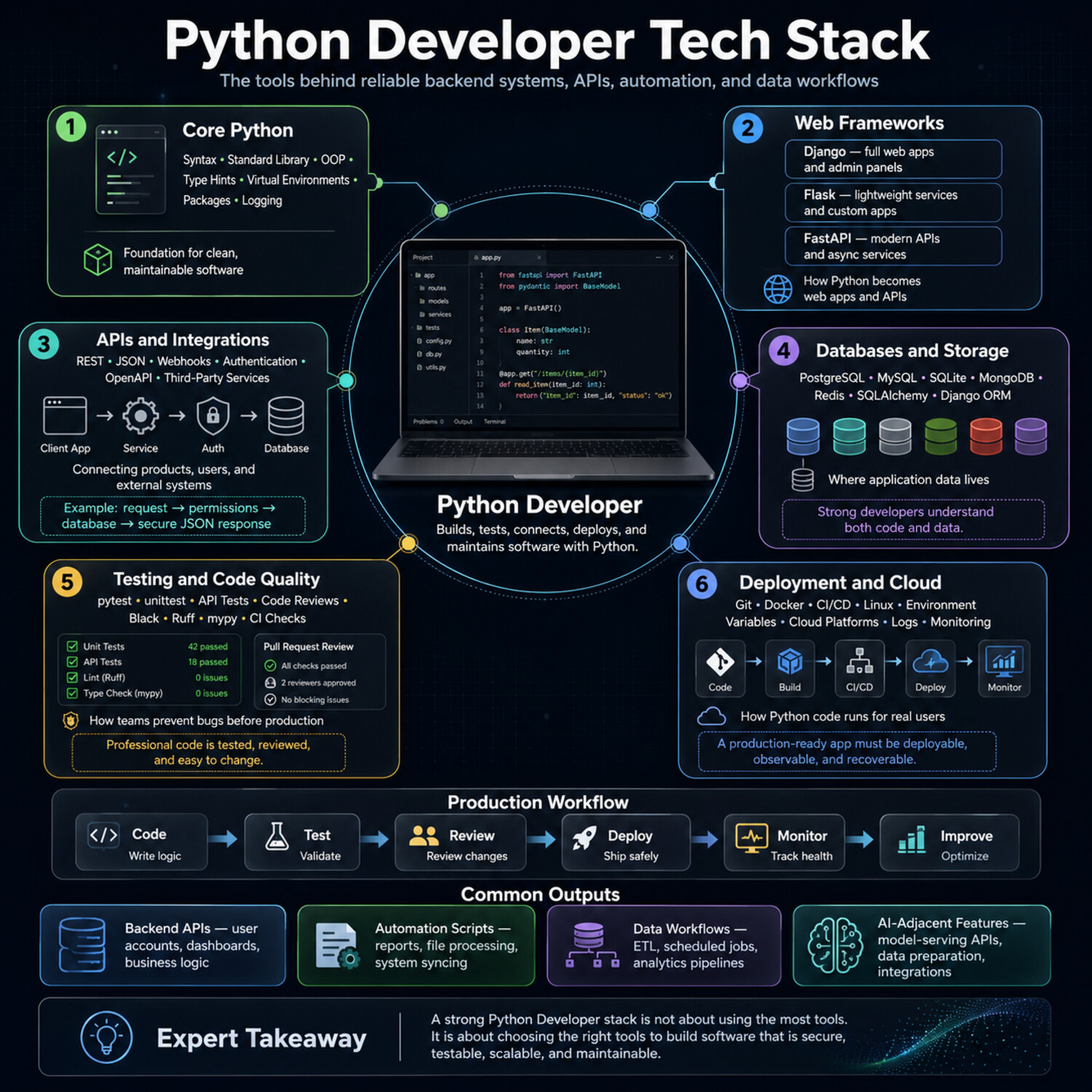
What Is a Python Developer?
A Python Developer is a software professional who uses Python to build, maintain, and improve applications, services, scripts, and data workflows. The exact role depends on the company, but Python Developers commonly work on backend systems, APIs, automation tools, internal platforms, data processing pipelines, integrations, and production software.
A Python Developer may write code that:
- Powers a web application’s backend
- Connects a frontend app to a database
- Automates repetitive business processes
- Processes files, reports, or analytics data
- Integrates third-party APIs
- Runs background jobs
- Supports machine learning or AI-enabled features
- Improves performance, reliability, or security
The role often overlaps with titles such as Backend Developer, Software Engineer, Automation Engineer, Data Engineer, or Full-Stack Developer. The difference usually comes down to focus. A backend-focused Python Developer spends more time on APIs, databases, and server-side logic. A data-focused Python Developer may work more with SQL, pipelines, pandas, and workflow tools. A full-stack Python Developer may combine Django or Flask with frontend technologies.
The broader software development field involves designing, testing, maintaining, documenting, and improving software systems, often in collaboration with other engineers, QA specialists, product managers, and stakeholders. The U.S. Bureau of Labor Statistics projects strong growth for software developers, quality assurance analysts, and testers from 2024 to 2034, which reflects continued demand for people who can build and maintain software systems responsibly.
Why the Python Developer Tech Stack Matters
A tech stack matters because it determines how software is built, tested, deployed, scaled, and maintained. For Python Developers, the right stack helps teams move from “the code works on my laptop” to “the application runs reliably for real users.”
A strong Python tech stack helps with five major goals.
First, it improves development speed. Python’s readable syntax, mature ecosystem, and extensive standard library allow developers to build useful functionality without starting from scratch. The official Python documentation describes the standard library as the collection of modules distributed with Python, covering many common programming needs.
Second, it supports maintainability. Good Python projects use clear structure, type hints, tests, linting, formatting, documentation, and dependency management. These practices make it easier for teams to understand code months or years after it was written.
Third, it enables production reliability. Production systems need logging, monitoring, error handling, database migrations, security controls, deployment workflows, and rollback strategies. A Python Developer who understands these areas can build software that survives real-world usage.
Fourth, it supports integration. Modern applications rarely work alone. They connect to payment systems, CRMs, analytics platforms, authentication providers, cloud services, internal databases, and third-party APIs. Python is widely used for this kind of glue work.
Fifth, it expands career flexibility without relying on hype. Python is used in backend development, automation, data engineering, analytics, AI tooling, infrastructure scripts, and internal platforms. Learning Python alone is not enough, but learning Python with the right surrounding technologies creates a practical foundation for many software roles.
Core Python Skills Every Developer Needs
The first layer of the tech stack is Python itself. A Python Developer should be comfortable with the language beyond basic syntax.
Important fundamentals include:
- Variables, functions, classes, and modules
- Object-oriented programming
- Data structures such as lists, dictionaries, sets, tuples, and dataclasses
- Error handling with exceptions
- File handling
- Logging
- Type hints
- Virtual environments
- Dependency management
- Package organization
- Working with the Python standard library
A beginner may write Python scripts that solve small tasks. A professional Python Developer writes code that other people can understand, test, review, deploy, and maintain.
For example, a junior-level script might read a CSV file and print results. A production-ready version would validate the input, handle missing values, log errors, include tests, use configuration safely, and produce output in a format another system can consume.
Type hints are especially useful in larger Python codebases. Python is dynamically typed, which gives developers flexibility, but that flexibility can become risky as projects grow. Type hints help make function contracts clearer:
def calculate_discount(price: float, percentage: float) -> float:
    return price * (percentage / 100)
This does not make Python identical to a statically typed language, but it improves readability and supports tools that catch certain mistakes earlier.
A strong Python Developer also understands environments and dependencies. Tools such as venv, pip, pyproject.toml, Poetry, pip-tools, or uv help isolate packages and make projects reproducible. Without proper dependency management, one developer’s machine may run different package versions than production, which can create difficult bugs.
Backend Frameworks: Django, Flask, and FastAPI
Many Python Developer roles involve backend development. This means building the server-side logic that powers web applications, APIs, dashboards, internal tools, and platform services.
The three most common Python web frameworks to understand are Django, Flask, and FastAPI.
Django
Django is often used for full-featured web applications. It includes many built-in components, such as routing, models, templates, forms, an admin interface, authentication, and security protections.
Django is a strong choice when a project needs:
- User accounts
- Admin dashboards
- Database-backed web applications
- Content management
- Authentication and permissions
- Server-rendered pages
- A structured framework with conventions
Django’s authentication system handles users, groups, permissions, and cookie-based sessions, and its documentation includes guidance for common authentication needs. Django also provides security guidance around input validation and other web application risks.
A practical example: a company might use Django to build an internal operations portal where employees can log in, manage customer records, approve requests, and generate reports. Django’s admin interface and ORM make this kind of application faster to build than assembling every piece manually.
Flask
Flask is a lightweight Python web framework. It gives developers the basics for routing requests and building web applications, while leaving many architectural choices open. The official Flask documentation describes it as a lightweight WSGI web application framework designed to get started quickly while still being able to scale to complex applications.
Flask is useful for:
- Smaller web applications
- Lightweight APIs
- Prototypes
- Microservices
- Custom architectures
- Teams that want flexibility
A practical example: a developer may use Flask to build a small service that receives webhook events from a payment processor, validates the payload, stores the result, and notifies another internal system.
Flask’s flexibility is also its trade-off. Developers must make more decisions about authentication, project structure, database integration, validation, and security. That can be powerful for experienced teams, but confusing for beginners if the project grows without clear conventions.
FastAPI
FastAPI is a modern Python framework for building APIs. It is built around Python type hints and is widely used for JSON APIs, async services, and backend systems that benefit from automatic interactive documentation. The official FastAPI documentation describes it as a modern, high-performance web framework for building APIs with Python based on standard Python type hints.
FastAPI is useful for:
- REST APIs
- Async endpoints
- Microservices
- Internal platform APIs
- AI or machine learning model-serving APIs
- Services that need OpenAPI documentation
A practical example: a SaaS product might use FastAPI to expose endpoints such as /users, /subscriptions, /usage, and /reports. The frontend sends requests, FastAPI validates the inputs, business logic runs, the database is queried, and the response is returned as JSON.
FastAPI is especially attractive when API clarity matters. Type hints and automatic documentation make it easier for frontend developers, QA engineers, and external API consumers to understand how endpoints behave.
Choosing Between Django, Flask, and FastAPI
The best framework depends on the project.
| Framework | Best For | Main Strength |
|---|---|---|
| Django | Full web applications and admin-heavy systems | Built-in structure and features |
| Flask | Lightweight services and custom apps | Flexibility and simplicity |
| FastAPI | Modern APIs and async services | Type-hint-driven API development |
A Python Developer does not need to master every framework at once. It is better to understand one deeply, then learn how the others solve similar problems differently.
APIs and Integrations
APIs are central to modern Python development. An API, or Application Programming Interface, allows systems to communicate with each other. For Python Developers, API work often means creating endpoints, consuming external services, validating data, handling errors, and securing access.
Common API concepts include:
- REST
- GraphQL
- JSON
- HTTP methods such as GET, POST, PUT, PATCH, and DELETE
- Status codes
- Authentication
- Authorization
- Webhooks
- Pagination
- Rate limits
- OpenAPI documentation
A practical backend API endpoint might work like this:
- A frontend app sends a request to
/api/orders/123. - The backend checks whether the user is authenticated.
- The application verifies whether the user is allowed to view that order.
- The code queries the database.
- The response is returned as JSON.
- Errors are logged for debugging and monitoring.
Good API development is not just about returning data. It also requires designing clear contracts. What fields are required? What happens when data is invalid? How should the system respond when a third-party API is down? What should be logged? What should never be exposed?
Python Developers should also understand third-party integrations. Many real applications depend on external APIs for payments, email, analytics, maps, authentication, messaging, search, or customer relationship management. In these cases, the developer must think about timeouts, retries, idempotency, and failure modes.
For example, if a payment webhook is delivered twice, the application should not create two paid orders. This is where concepts such as idempotency, event processing, and deduplication become important.
Databases and Data Storage
Most useful applications need to store and retrieve data. A Python Developer should understand both how to write application code and how that code interacts with databases.
Common database technologies in Python stacks include:
- PostgreSQL
- MySQL
- SQLite
- MongoDB
- Redis
- Elasticsearch or OpenSearch
- Cloud object storage
For many backend applications, PostgreSQL is a common production database because it is reliable, feature-rich, and well suited to structured relational data. SQLite is often used for local development, prototypes, small applications, and embedded use cases. MongoDB may appear in systems that use document-style data models. Redis is often used for caching, rate limiting, sessions, queues, and temporary fast-access data.
A Python Developer should understand:
- Tables, rows, columns, and relationships
- Primary keys and foreign keys
- Indexes
- Joins
- Transactions
- Migrations
- Query performance
- Connection pooling
- Object-relational mappers
An ORM, or Object-Relational Mapper, lets developers interact with database records using Python objects. Django has its own ORM. SQLAlchemy is another widely used option. ORMs can speed up development, but they do not remove the need to understand SQL. Poor ORM usage can still create slow queries, unnecessary database calls, and performance problems.
For example, a developer may accidentally create an “N+1 query” problem by loading one list of users, then querying the database again for each user’s orders. In small tests, this may seem fine. In production, it can slow an application dramatically. A strong Python Developer learns to inspect queries, add indexes carefully, and choose efficient data access patterns.
Testing, Debugging, and Code Quality
Testing is one of the clearest differences between casual coding and professional software development. A Python Developer should be able to write tests that give the team confidence when code changes.
Common testing categories include:
- Unit tests: Test small pieces of logic in isolation.
- Integration tests: Test how components work together.
- API tests: Test request and response behavior.
- Regression tests: Prevent old bugs from returning.
- End-to-end tests: Test larger user flows across the system.
Python includes unittest in the standard library, while pytest is widely used for readable and scalable testing. The pytest documentation states that pytest helps developers write small, readable tests and can scale to support complex functional testing for applications and libraries.
A simple test might check whether a discount calculation works. A more valuable production test might verify that a user cannot access another customer’s private data, or that an API returns the correct error when required fields are missing.
Code quality tools are also part of the stack. Common tools include:
- Black for formatting
- Ruff or Flake8 for linting
- mypy or Pyright for type checking
- pre-commit for running checks before commits
- coverage.py for measuring test coverage
These tools are not about style for its own sake. They reduce friction in teams. When formatting is automated, code reviews can focus on architecture, correctness, security, and maintainability instead of indentation or line length.
Debugging is equally important. Python Developers should know how to read tracebacks, use logging, inspect variables, reproduce bugs locally, and identify whether a problem comes from code, data, configuration, infrastructure, or an external dependency.
Git, Collaboration, and Engineering Workflow
A Python Developer rarely works alone. Even solo developers benefit from professional workflow tools, but team environments make them essential.
Git is the foundation of modern software collaboration. The Git documentation describes version control as a system that records changes to files over time so earlier versions can be recalled later.
A professional workflow usually includes:
- Branches
- Pull requests
- Code reviews
- Commit history
- Issue tracking
- CI checks
- Documentation
- Release notes
- Team conventions
A typical workflow might look like this:
- A developer creates a branch for a new API feature.
- They write code and tests.
- They open a pull request.
- Automated checks run.
- A teammate reviews the code.
- The developer makes revisions.
- The branch is merged.
- The change is deployed through a controlled process.
This workflow helps teams catch mistakes before they reach production. It also creates a history of why changes were made, which is valuable when debugging or onboarding new developers.
Python Developers should also be comfortable communicating technical trade-offs. For example, choosing Django over FastAPI is not just a personal preference. It may affect admin features, development speed, async support, team familiarity, hiring, documentation, and long-term maintenance.
DevOps, Deployment, and Cloud Tools
A Python Developer does not always need to be a DevOps engineer, but modern Python Developers should understand how applications run outside the development environment.
Important deployment and DevOps concepts include:
- Linux basics
- Environment variables
- Secrets management
- Docker
- CI/CD pipelines
- Cloud platforms
- Logging
- Monitoring
- Health checks
- Rollbacks
- Infrastructure configuration
Docker is especially common because it packages applications with their dependencies. Docker’s documentation defines a container as a runnable instance of an image that can be created, started, stopped, moved, or deleted using Docker tools.
For Python projects, Docker helps reduce “works on my machine” problems. A team can define the Python version, system dependencies, environment variables, and startup commands in a repeatable way.
A simple production-minded Python service may include:
- A Dockerfile
- A
requirements.txtorpyproject.toml - Environment-specific settings
- Database migrations
- A CI workflow that runs tests
- A deployment pipeline
- Logs sent to a monitoring system
- Health check endpoints
Cloud platforms such as AWS, Google Cloud, and Microsoft Azure may host Python applications, databases, queues, object storage, and serverless functions. A Python Developer does not need to know every cloud service, but they should understand the basics of deployment, permissions, networking, configuration, and observability.
A useful rule: writing the code is only part of the job. A production service must also be deployable, configurable, observable, and recoverable.
Performance, Scalability, and Asynchronous Python
Performance work begins with understanding where time is actually spent. Python is often fast enough for business applications, but bottlenecks can appear in database queries, network calls, serialization, loops, file processing, or inefficient architecture.
Important performance concepts include:
- Profiling
- Caching
- Query optimization
- Pagination
- Background jobs
- Async I/O
- Queue-based processing
- Connection pooling
- Memory usage
- Load testing
A common mistake is trying to “optimize Python” before understanding the system. If an API endpoint is slow because it makes 200 database queries, rewriting a Python loop will not solve the real problem. A better fix may involve adding a database index, reducing queries, caching a result, or changing the data model.
Asynchronous Python is useful when an application spends time waiting on external resources, such as APIs, databases, file systems, or network calls. FastAPI is often used in async-capable API services, but async is not magic. It can improve throughput in I/O-heavy workloads, but it also adds complexity. CPU-heavy work may require different strategies, such as background workers, multiprocessing, optimized libraries, or moving expensive tasks outside the request-response cycle.
Background job tools are also common. For example:
- Celery can run background tasks such as sending emails or processing files.
- Redis or RabbitMQ may act as message brokers.
- RQ is a simpler Redis-backed queue option.
- Airflow or Prefect may orchestrate scheduled data workflows.
A practical example: when a user uploads a large CSV file, the API should not force the user to wait while the entire file is processed. Instead, the backend can accept the upload, create a job, process the file in the background, and notify the user when processing is complete.
Security Basics for Python Developers
Security is part of the Python Developer tech stack because backend code often handles sensitive data, authentication, permissions, and business logic. A developer does not need to be a security specialist to write safer code, but they should know the common risks.
Important security concepts include:
- Authentication
- Authorization
- Password hashing
- Input validation
- Output encoding
- SQL injection prevention
- Cross-site scripting awareness
- Cross-site request forgery protection
- Secure session handling
- Secrets management
- Dependency scanning
- Principle of least privilege
APIs deserve special attention. OWASP’s API Security project focuses on strategies and solutions for understanding and reducing API-specific security risks. The OWASP API Security Top 10 includes broken authentication as a major risk, noting that authentication mechanisms are often implemented incorrectly in ways that can compromise user identity and API security.
For Python Developers, practical security habits include:
- Never hardcode API keys or passwords in source code.
- Validate user input before processing it.
- Use parameterized queries or trusted ORM patterns.
- Check authorization at the object level, not just the route level.
- Avoid returning sensitive fields in API responses.
- Keep dependencies updated.
- Use secure password hashing.
- Log security-relevant events without exposing secrets.
- Treat all user-controlled data as untrusted.
For example, checking whether a user is logged in is not always enough. If an endpoint returns /orders/123, the system must also verify that the logged-in user is allowed to access order 123. This distinction between authentication and authorization is one of the most important backend security concepts.
Data Engineering, Automation, and AI-Adjacent Work
Python is widely used outside traditional web development. Many Python Developer roles involve automation, data processing, or AI-adjacent product features.
Common tools and concepts include:
- pandas
- NumPy
- SQL
- CSV and JSON processing
- Jupyter notebooks
- Airflow
- Prefect
- dbt-adjacent workflows
- API-based data extraction
- Data validation
- Scheduled jobs
- Model-serving APIs
A Python Developer might write a script that pulls sales data from an API, cleans it, stores it in PostgreSQL, and sends a daily summary to an internal dashboard. Another developer might build an API that sends user input to a machine learning model and returns a prediction. In both cases, Python acts as the practical layer connecting data, business logic, and application behavior.
It is important not to confuse every Python Developer role with data science or machine learning. Many Python jobs are backend-focused and do not involve model training. However, Python’s presence in data and AI ecosystems makes it useful for teams that need software engineers who can collaborate with data scientists or integrate model outputs into applications.
Related terms readers may encounter include:
- ETL: Extract, transform, load
- ELT: Extract, load, transform
- Data pipeline: A workflow that moves and transforms data
- Feature store: A system for managing machine learning features
- Model serving: Making a model available through an API
- Batch processing: Processing data on a schedule
- Streaming: Processing data continuously as it arrives
A practical Python Developer does not need to master all of these at once. The key is understanding how Python connects systems and turns raw data into reliable application behavior.
Example Python Developer Tech Stacks by Role Type
The Python tech stack changes depending on the job. Here are realistic examples.
Backend Python Developer Stack
A backend-focused Python Developer might use:
- Python
- FastAPI or Django
- PostgreSQL
- Redis
- SQLAlchemy or Django ORM
- pytest
- Docker
- GitHub Actions
- AWS or Google Cloud
- OpenAPI documentation
- Logging and monitoring tools
This stack is useful for building APIs, authentication systems, dashboards, customer portals, internal platforms, and microservices.
Automation Python Developer Stack
An automation-focused Python Developer might use:
- Python
- Requests or HTTPX
- pandas
- Beautiful Soup, Selenium, or Playwright
- APIs and webhooks
- CSV, Excel, and JSON processing
- cron, Airflow, or Prefect
- Logging
- Git
- Docker for repeatable execution
This stack is useful for automating repetitive workflows, syncing systems, generating reports, processing files, and reducing manual operations.
Data-Focused Python Developer Stack
A data-focused Python Developer might use:
- Python
- SQL
- pandas
- PostgreSQL or Snowflake
- Airflow or Prefect
- Object storage
- Data validation tools
- APIs
- Docker
- Git
- Monitoring and alerting
This stack is useful for pipelines, reporting systems, data ingestion, transformation jobs, and analytics infrastructure.
Full-Stack Python Developer Stack
A full-stack Python Developer might use:
- Python
- Django or Flask
- PostgreSQL
- HTML and CSS
- JavaScript or TypeScript
- React, Vue, or server-rendered templates
- pytest
- Docker
- Git
- CI/CD tooling
This stack is useful for smaller teams where one developer may work across both backend and frontend layers.
How to Evaluate a Python Developer’s Tech Stack
A strong Python Developer tech stack should be evaluated by practical capability, not by the number of tools listed on a resume.
Must-Have Skills
A Python Developer should usually understand:
- Python fundamentals
- Git
- Testing
- APIs
- Databases
- Debugging
- Dependency management
- Basic security
- Code organization
These skills show that the developer can contribute to real software, not just complete isolated tutorials.
Strong Differentiators
More advanced or specialized Python Developers may also know:
- Docker
- Cloud deployment
- CI/CD
- Async programming
- Caching
- Background jobs
- Performance profiling
- Security review basics
- Data pipelines
- System design
These skills matter because production systems require more than working code. They require operational thinking.
Senior-Level Signals
Senior Python Developers often show strength in:
- Architecture decisions
- Trade-off analysis
- Mentoring
- Code review leadership
- Incident response
- Performance troubleshooting
- Security-aware design
- Long-term maintainability
- Cross-team communication
A senior developer should be able to explain not only what they used, but why they chose it and what trade-offs came with the decision.
For example, choosing Django may speed up development for an admin-heavy product, while FastAPI may be a better fit for a standalone API service. Choosing Redis may improve performance, but it also introduces cache invalidation problems. Adding microservices may improve team autonomy, but it can also increase operational complexity.
Expertise appears in these trade-offs.
Common Mistakes When Learning the Python Developer Stack
Many learners struggle not because Python is impossible, but because they approach the stack in the wrong order.
Learning Too Many Frameworks at Once
Django, Flask, and FastAPI are all useful, but trying to learn all three before building anything substantial can slow progress. It is better to build one complete project with authentication, a database, tests, and deployment than to skim five frameworks superficially.
Skipping Databases
Some beginners focus heavily on Python syntax but avoid SQL. This creates problems because most backend applications depend on data storage. A Python Developer should understand how to model data, query it, migrate schemas, and optimize common access patterns.
Ignoring Testing
Code that is not tested becomes harder to change. Even basic tests create a safety net. Testing also improves design because code that is difficult to test is often too tightly coupled or poorly structured.
Building Only Tutorial Projects
Tutorials are useful, but they often hide real-world complexity. Strong portfolio or practice projects should include messy details: validation, authentication, errors, logging, background tasks, deployment, and documentation.
Avoiding Deployment
A project that runs locally is not the same as a project that runs in production. Deployment teaches configuration, environments, secrets, networking, logs, and operational constraints.
Treating AI Tools as a Replacement for Fundamentals
AI coding assistants can help generate code, explain concepts, and speed up repetitive work. However, they do not replace the need to understand correctness, security, architecture, testing, and debugging. A Python Developer still needs to know whether generated code is safe, efficient, and appropriate.
Practical Learning Path for a Python Developer Stack
A practical learning path should move from fundamentals to production readiness.
- Learn Python fundamentals. Focus on syntax, data structures, functions, classes, modules, errors, and the standard library.
- Build small scripts. Automate file renaming, CSV processing, API calls, or report generation.
- Learn Git. Practice commits, branches, pull requests, and code review habits.
- Learn testing. Start with pytest and write tests for small functions, then API behavior.
- Build a REST API. Use FastAPI, Django, or Flask to create endpoints that accept input and return structured responses.
- Add a database. Use PostgreSQL or SQLite, then learn migrations, relationships, indexes, and query patterns.
- Add authentication and authorization. Understand the difference between logging in and being allowed to access a specific resource.
- Improve code quality. Add formatting, linting, type hints, and clear project structure.
- Containerize the app. Use Docker to make the project easier to run consistently.
- Deploy a simple version. Learn environment variables, logs, database configuration, and rollback basics.
- Add production features. Include logging, monitoring, background jobs, error handling, and documentation.
- Review trade-offs. Ask why each tool is used, what problem it solves, and what complexity it adds.
This path does not guarantee a specific job outcome, but it builds practical competence in the technologies Python Developers commonly use.
FAQ: Python Developer Tech Stack
Is Python enough to become a backend developer?
Python is a strong foundation, but backend development usually also requires APIs, databases, Git, testing, deployment basics, and security awareness. Python alone is the language layer; the full stack includes the surrounding tools needed to build production software.
Should I learn Django, Flask, or FastAPI first?
Choose based on your goal. Learn Django if you want to build full web applications with built-in structure. Learn Flask if you want a lightweight framework and more control. Learn FastAPI if your focus is modern API development.
Do Python Developers need cloud skills?
Not every Python Developer role requires deep cloud expertise, but basic deployment knowledge is increasingly useful. Understanding Docker, environment variables, logs, CI/CD, and cloud-hosted databases helps developers build software that can run beyond a local machine.
Is Python used only for data science?
No. Python is used for backend development, APIs, automation, internal tools, data pipelines, testing, scripting, AI-adjacent integrations, and more. Data science is one important use case, but it is not the only one.
What is the difference between a Python Developer and a Data Engineer?
A Python Developer often focuses on application logic, APIs, automation, and backend systems. A Data Engineer focuses more on data pipelines, data storage, transformation, orchestration, and data infrastructure. The roles can overlap, especially in smaller teams.
What makes a Python Developer stack production-ready?
A production-ready stack includes more than framework knowledge. It includes testing, secure configuration, dependency management, database migrations, logging, monitoring, deployment workflows, error handling, and clear documentation.
Final Takeaway
A Python Developer tech stack is valuable because it connects readable code with real-world software delivery. Python provides the foundation, but professional work depends on the surrounding ecosystem: frameworks, APIs, databases, tests, Git workflows, containers, cloud deployment, security practices, and performance tools.
The best Python Developers do not simply collect technologies. They understand how each tool supports a larger goal: building software that is useful, secure, maintainable, and reliable.
A strong Python stack should answer practical questions:
- Can the application be tested?
- Can it be deployed?
- Can it handle real data?
- Can it recover from errors?
- Can other developers understand it?
- Can it protect user information?
- Can it grow without becoming unmanageable?
When the answer is yes, the stack is doing its job.