
Python development is one of the most flexible career paths in software engineering. A Python Developer may build back-end systems, automate business workflows, create data pipelines, support machine learning products, develop APIs, or improve internal tools that help teams work faster. That flexibility is one of Python’s biggest strengths—but it can also make the career path confusing for beginners.
Becoming a Python Developer is not only about learning Python syntax. Employers usually look for people who can solve problems, write maintainable code, work with databases and APIs, test their work, understand software design basics, and communicate clearly with other technical and nontechnical team members. Python is the main tool, but the career is really about building useful software.
Python remains popular because it is readable, versatile, and supported by a large ecosystem. The official Python website describes it as a language that helps developers “work quickly and integrate systems more effectively,” and Python.org also emphasizes its clean syntax and ease of learning for both beginners and experienced programmers. Stack Overflow’s 2025 Developer Survey also notes that Python adoption accelerated from 2024 to 2025, reflecting its continued relevance in modern development work.
This article explains what Python Developers do, the main career paths available, the skills to build, the projects that prove job readiness, and how to grow after your first role.
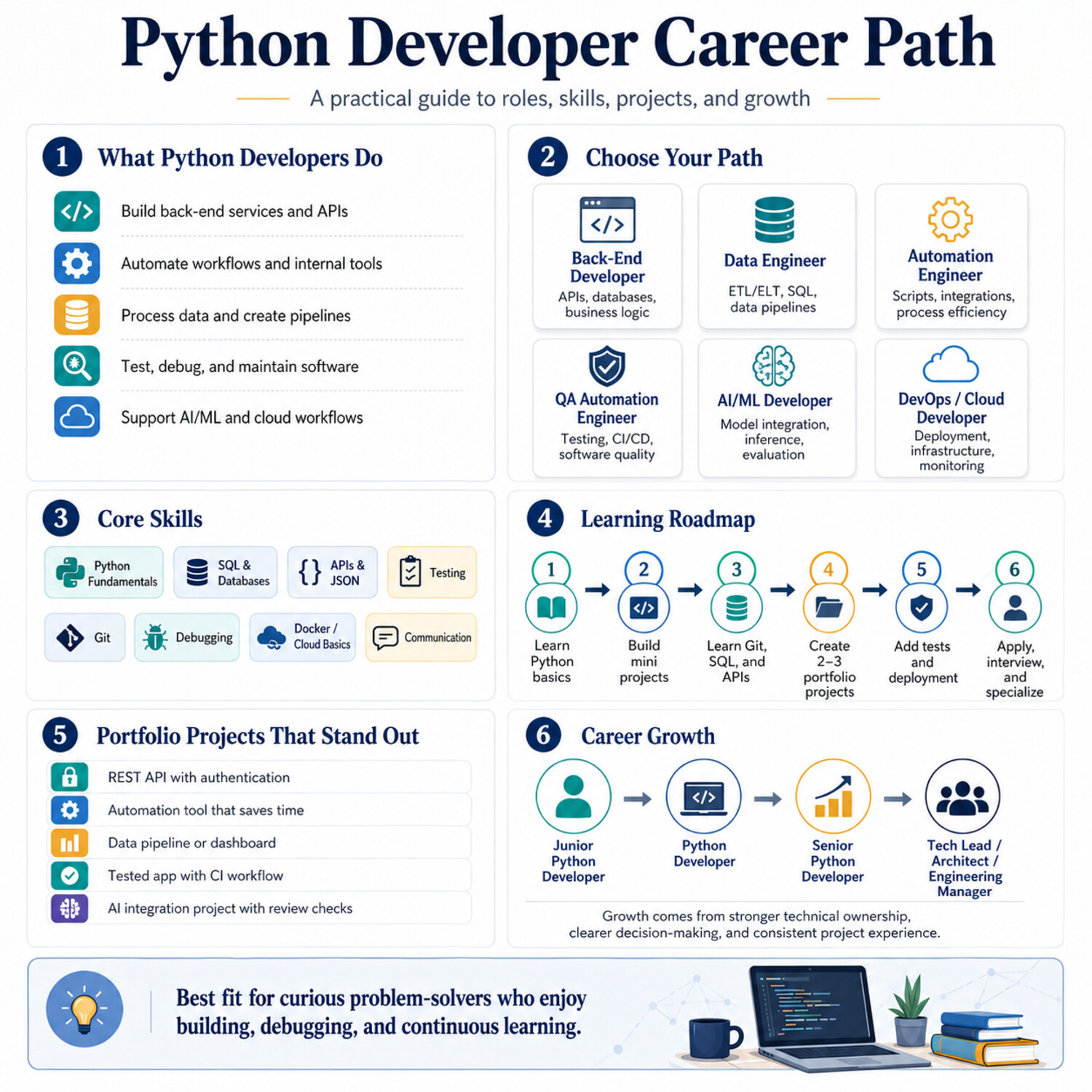
What Does a Python Developer Do?
A Python Developer designs, builds, tests, and maintains software using the Python programming language. The exact work depends on the company and specialization. In one job, a Python Developer may build APIs for a web application. In another, they may automate financial reports, process large datasets, or help deploy machine learning models into production.
At a broader occupational level, O*NET describes software developers as professionals who research, design, and develop computer or network software, analyze user needs, create software solutions, update software capabilities, and apply computer science, engineering, and mathematical principles. That description fits many Python Developer roles, especially those focused on production software rather than one-off scripts.
Common responsibilities include:
- Writing clean, readable Python code
- Building and maintaining APIs
- Connecting applications to databases
- Debugging errors and improving performance
- Writing automated tests
- Reviewing code from other developers
- Creating documentation
- Deploying applications or supporting deployment workflows
- Automating repetitive technical or business processes
- Collaborating with product managers, designers, data teams, QA engineers, and DevOps teams
For example, a Python Developer at a logistics company might build an internal tool that calculates delivery routes and exposes the results through an API. A Python Developer at a healthcare technology company might work on secure back-end services that process appointment data. A Python Developer at a financial firm might automate reporting workflows, validate data quality, and create tools that reduce manual spreadsheet work.
The title “Python Developer” can overlap with other job titles, including Software Developer, Back-End Developer, Data Engineer, Automation Engineer, QA Automation Engineer, Machine Learning Engineer, and DevOps Engineer. The difference usually depends on the main business problem being solved.
Why Python Is Used in Modern Software Development
Python is popular because it balances readability, speed of development, and ecosystem depth. Its syntax is usually easier to read than many lower-level or more verbose languages, which makes it attractive for teams that need to move quickly while keeping code understandable.
Python is often used for:
- Back-end web development
- API development
- Automation and scripting
- Data analysis
- Data engineering
- Machine learning and AI workflows
- Testing and QA automation
- DevOps and cloud automation
- Internal business tools
Python’s ecosystem is also a major advantage. Developers can use frameworks such as Django, Flask, and FastAPI for web development; pytest for testing; pandas and NumPy for data work; and many cloud, automation, and machine learning libraries depending on the project.
However, Python is not always the best choice. For extremely high-performance systems, real-time applications, mobile apps, embedded systems, or performance-critical game engines, other languages may be more appropriate. A strong Python Developer understands both Python’s strengths and its limitations.
Main Python Developer Career Paths
The phrase “Python Developer” does not describe just one career. Python can lead to several different professional tracks. Choosing a track helps you decide which skills, tools, and projects to prioritize.
1. Back-End Python Developer
A Back-End Python Developer builds the server-side logic behind websites, apps, and digital products. This is one of the most common Python career paths.
Typical work includes:
- Building APIs
- Handling user authentication
- Connecting applications to databases
- Processing business logic
- Managing permissions and roles
- Integrating third-party services
- Improving application performance
- Writing tests for back-end behavior
Common tools and concepts include Django, Flask, FastAPI, PostgreSQL, REST APIs, JSON, Docker, Git, and CI/CD.
Example project:
A back-end Python Developer might build an inventory API for an e-commerce company. The API could allow the front-end application to display product availability, update stock counts, and notify warehouse staff when items run low.
This path is a good fit for people who enjoy structured software design, databases, business logic, and building systems that other applications depend on.
2. Full-Stack Developer with Python
A Full-Stack Developer works on both the back end and the front end. In this path, Python is often used for the server side, while JavaScript, TypeScript, HTML, CSS, and front-end frameworks are used for the user interface.
Typical work includes:
- Creating web pages or user interfaces
- Building APIs with Python
- Connecting front-end forms to back-end services
- Managing databases
- Handling authentication
- Deploying full web applications
Example project:
A full-stack developer might build a customer portal where users can log in, view invoices, update profile information, and submit support requests. Python handles the back-end logic, while the front end displays the experience in the browser.
This path is useful for people who want to build complete products rather than focus only on server-side systems.
3. Data-Focused Python Developer
A Data-Focused Python Developer uses Python to collect, clean, transform, validate, and analyze data. This role can overlap with data engineering, analytics engineering, or business intelligence.
Typical work includes:
- Writing scripts to clean messy data
- Building data pipelines
- Connecting to databases and APIs
- Creating reports or dashboards
- Validating data quality
- Automating recurring data workflows
Common tools and concepts include pandas, NumPy, SQL, Jupyter notebooks, ETL pipelines, data validation, CSV/JSON processing, and cloud storage.
Example project:
A data-focused Python Developer might build a pipeline that pulls sales data from several systems, cleans inconsistent fields, checks for missing values, and loads the results into a reporting database.
This path is a good fit for people who enjoy patterns, data quality, business questions, and turning raw information into usable systems.
4. Data Engineer Using Python
A Data Engineer builds the infrastructure and pipelines that move data through an organization. Python is commonly used for orchestration, transformation, validation, and automation.
Typical work includes:
- Building batch or streaming data pipelines
- Moving data between systems
- Designing data workflows
- Optimizing database queries
- Monitoring pipeline failures
- Creating reusable data tools
- Supporting analytics and machine learning teams
Example project:
A data engineer might create a nightly pipeline that extracts customer activity data, transforms it into a clean format, loads it into a warehouse, and alerts the team if the pipeline fails.
This path requires stronger knowledge of databases, data modeling, cloud platforms, workflow orchestration, and reliability than a basic scripting role.
5. AI or Machine Learning Python Developer
Python is heavily used in AI and machine learning workflows. An AI/ML Python Developer may not always design new models from scratch. In many companies, the work is more practical: integrating models, preparing data, building services around models, testing outputs, and making AI features reliable enough for users.
Typical work includes:
- Preparing datasets
- Training or fine-tuning models
- Calling model APIs
- Building AI-powered product features
- Evaluating model outputs
- Creating pipelines for inference
- Monitoring performance and errors
- Working with data scientists or ML engineers
Example project:
A Python Developer might build a document classification feature that receives uploaded files, extracts text, sends the text to a model, stores the classification result, and allows users to review uncertain outputs.
This path requires strong judgment. AI tools and models can be useful, but developers still need to validate results, test edge cases, and design systems that fail safely. Stack Overflow’s 2025 survey reports broad AI tool usage among developers, but also notes concerns around AI-generated answers that are almost correct and the difficulty of debugging AI-assisted code.
6. Automation Engineer or Scripting Specialist
An Automation Engineer uses Python to reduce manual work. This path is common in operations, IT, finance, analytics, QA, and internal business teams.
Typical work includes:
- Automating file processing
- Generating reports
- Moving data between systems
- Creating command-line tools
- Scheduling recurring scripts
- Automating browser or API workflows
- Building internal productivity tools
Example project:
An automation-focused Python Developer might create a script that reads hundreds of supplier invoices, extracts key fields, validates totals, and uploads the results into an internal system.
This path can be a strong entry point because automation projects often solve visible business problems. However, professional automation still requires testing, logging, error handling, documentation, and maintainability.
7. QA Automation Engineer with Python
A QA Automation Engineer uses Python to test software automatically. Instead of manually checking every feature, they write tests that verify whether an application behaves correctly.
Typical work includes:
- Writing automated test scripts
- Testing APIs
- Creating test data
- Running tests in CI/CD pipelines
- Reporting bugs clearly
- Collaborating with developers
- Improving test reliability
Common tools and concepts include pytest, unittest, Selenium, Playwright, API testing, mocking, and continuous integration.
Example project:
A QA Automation Engineer might write automated tests that verify whether a checkout flow correctly calculates tax, applies discounts, processes payment responses, and handles failed transactions.
This path is a good fit for people who enjoy quality, precision, edge cases, and breaking systems constructively before users do.
8. DevOps or Cloud Automation Developer
Python is also used in DevOps, infrastructure, and cloud automation. In this path, Python helps automate deployments, manage infrastructure, monitor systems, and connect cloud services.
Typical work includes:
- Writing deployment scripts
- Automating cloud tasks
- Creating monitoring tools
- Managing configuration
- Working with containers
- Supporting CI/CD pipelines
- Building internal tools for engineering teams
Example project:
A cloud automation developer might build a Python tool that checks whether cloud resources are configured correctly, flags risky settings, and generates reports for the infrastructure team.
This path usually requires knowledge beyond Python, including Linux, Docker, cloud platforms, networking basics, CI/CD, and reliability practices.
9. Technical Lead, Architect, or Engineering Manager
After several years of experience, a Python Developer may grow into leadership or architecture roles. These roles involve less beginner-level coding and more technical decision-making.
Possible advanced paths include:
- Senior Python Developer
- Lead Developer
- Tech Lead
- Software Architect
- Platform Engineer
- Engineering Manager
- Staff Engineer
- Principal Engineer
At this level, developers are expected to make design decisions, mentor others, review architecture, reduce technical debt, and connect engineering choices to business outcomes.
O*NET lists related software developer titles such as Application Developer, DevOps Engineer, Infrastructure Engineer, Software Architect, Software Developer, Software Engineer, and Systems Engineer, which reflects the range of career directions that can grow from software development experience.
Core Skills Every Python Developer Needs
A strong Python Developer needs both language-specific skills and general software engineering skills.
Python Fundamentals
Start with the language itself:
- Variables and data types
- Strings, lists, dictionaries, tuples, and sets
- Functions
- Loops and conditionals
- Error handling
- Modules and packages
- File handling
- Virtual environments
- Object-oriented programming
- Working with dates, JSON, and external libraries
Beginners often move too quickly into frameworks before mastering these basics. That can create fragile knowledge. A developer who understands Python fundamentals can debug problems instead of copying solutions blindly.
Problem-Solving and Debugging
Professional development is mostly problem-solving. Code rarely works perfectly the first time. Python Developers must learn how to inspect errors, reproduce issues, isolate causes, and fix problems carefully.
Useful debugging habits include:
- Reading the full error message
- Reproducing the bug consistently
- Checking assumptions with small tests
- Using print statements or a debugger
- Writing tests before fixing complex bugs
- Documenting what changed and why
Example:
If an API returns incorrect totals, a weak developer may patch the final result. A stronger developer traces the data flow, checks the database query, validates input types, tests edge cases, and fixes the root cause.
Databases and SQL
Most useful applications store data. Python Developers should understand how to work with databases, especially relational databases such as PostgreSQL, MySQL, or SQLite.
Important concepts include:
- Tables, rows, and columns
- Primary keys and foreign keys
- Joins
- Indexes
- Transactions
- Query performance basics
- Object-relational mappers, often called ORMs
Even if a project uses an ORM, SQL knowledge is still valuable. Developers who understand databases can design better data models and debug performance problems more effectively.
APIs and Web Concepts
Many Python jobs involve APIs. An API allows systems to communicate with each other.
Important concepts include:
- REST
- HTTP methods such as GET, POST, PUT, PATCH, and DELETE
- Status codes
- JSON
- Authentication
- Authorization
- Rate limits
- Request validation
- API documentation
Example:
A weather app might call an external API to retrieve forecast data. A Python back end could receive a user’s location, request forecast data from the provider, clean the response, and return only the fields the front end needs.
Testing
Testing separates hobby scripts from production-ready software. Python Developers should know how to write automated tests that verify code behavior.
Important testing concepts include:
- Unit tests
- Integration tests
- Test fixtures
- Mocking
- Regression tests
- Edge-case testing
- Continuous integration
A portfolio project with tests is usually more convincing than a project that only works in a demo video. Tests show that the developer thinks about reliability.
Git and Collaboration
Git is essential for professional software development. Developers use it to track changes, collaborate, review code, and manage releases.
Important Git skills include:
- Cloning repositories
- Creating branches
- Committing changes
- Writing clear commit messages
- Opening pull requests
- Resolving merge conflicts
- Reviewing code
Professional development is rarely solo work. A Python Developer must be able to explain changes, accept feedback, and improve code based on review.
Communication and Documentation
BLS emphasizes communication, analytical ability, creativity, detail orientation, interpersonal skills, and problem-solving as important qualities for software development roles. These skills matter because software is built by teams, not just individuals.
Strong developers can explain:
- What problem they solved
- Why they chose a specific approach
- What trade-offs they considered
- How to run and test the project
- What limitations still exist
Good documentation also improves trust. A project with a clear README, setup instructions, examples, and known limitations feels more professional.
Python Tools, Frameworks, and Technologies to Learn
A beginner does not need to learn every Python tool. The best approach is to choose tools based on the career path.
For back-end development, focus on:
- FastAPI, Django, or Flask
- PostgreSQL or another relational database
- REST APIs
- Authentication
- Docker basics
- API testing
- Deployment basics
For data-focused development, focus on:
- pandas
- NumPy
- SQL
- Jupyter notebooks
- Data cleaning
- Data validation
- ETL concepts
- Visualization basics
For automation, focus on:
- File processing
- APIs
- Command-line tools
- Scheduling scripts
- Logging
- Error handling
- Excel, CSV, JSON, and PDF workflows where appropriate
For QA automation, focus on:
- pytest
- unittest
- API testing
- Selenium or Playwright
- Test design
- Mocking
- CI/CD test runs
For DevOps or cloud automation, focus on:
- Linux command line
- Docker
- Cloud basics
- Infrastructure scripts
- CI/CD
- Monitoring
- Security fundamentals
A useful rule: learn one stack deeply enough to build and explain complete projects before collecting more tools.
Education Paths: Degree, Bootcamp, Self-Taught, or Career Switch
There is no single path into Python development. Different employers value different backgrounds.
Computer Science or Related Degree
A degree can provide structure, theory, and access to internships. It may cover algorithms, data structures, operating systems, databases, software engineering, networks, and mathematics. BLS notes that software developers typically need a bachelor’s degree, though actual hiring requirements vary by employer and role.
A degree can be especially useful for competitive software engineering roles, AI/ML work, systems design, or companies with formal hiring requirements.
Coding Bootcamp
A bootcamp can help learners build projects quickly and practice job-search skills. The quality varies widely, so learners should evaluate outcomes carefully. A good bootcamp should teach fundamentals, projects, Git, testing, databases, deployment, and interview preparation—not just surface-level framework usage.
Self-Taught Path
The self-taught path is possible, but it requires discipline. A self-taught learner needs a roadmap, consistent practice, projects, feedback, and evidence of skill. The main risk is tutorial dependency: watching many lessons without building original work.
A strong self-taught plan includes:
- Python fundamentals
- Git and GitHub
- Small scripts
- One web/API project
- One database-backed project
- One tested and documented project
- One deployed project
- Interview practice
- Code review from more experienced developers when possible
Career Switch from Another Field
People often enter Python development from analytics, finance, QA, IT support, operations, science, education, or engineering. These backgrounds can become strengths when paired with technical skills.
For example:
- A financial analyst may become a data-focused Python Developer.
- A QA tester may become a QA Automation Engineer.
- An IT support specialist may move toward DevOps automation.
- A scientist may move into data engineering or research software.
- An operations manager may build automation tools for internal workflows.
The key is to connect previous domain knowledge to Python projects that solve real problems.
Beginner-to-Job-Ready Learning Roadmap
A realistic Python learning roadmap should move from fundamentals to practical software.
Phase 1: Learn Python Basics
Focus on syntax, data structures, functions, control flow, error handling, modules, and file processing. Build small scripts instead of only completing exercises.
Example projects:
- Tip calculator
- File renaming script
- Simple command-line to-do list
- CSV cleaner
- Password strength checker
Phase 2: Learn Git, the Command Line, and Development Setup
Learn how professional developers manage code. Set up a code editor, use virtual environments, install packages, and publish projects to GitHub.
Example task:
Create a GitHub repository with a clear README, setup instructions, and a working Python script.
Phase 3: Build Practical Applications
Move from isolated exercises to applications with multiple parts.
Example projects:
- Weather API client
- Expense tracker
- Task manager with a database
- Web scraper with respectful usage and clear limits
- API that stores and retrieves user-submitted data
Phase 4: Learn Databases and APIs
Build projects that use persistent data and external services.
Example project:
Create a book review API where users can add books, submit reviews, update ratings, and search by author or genre.
This project can demonstrate routing, database models, input validation, error handling, and documentation.
Phase 5: Add Testing and Documentation
Improve existing projects instead of constantly starting new ones. Add tests, logging, error handling, and better README files.
Example improvements:
- Add unit tests for business logic
- Add integration tests for API endpoints
- Add sample environment variables
- Add setup instructions
- Add screenshots or example API requests
- Add a “known limitations” section
Phase 6: Deploy a Project
Deployment shows that you understand more than local development. Even a simple deployment can teach environment variables, dependencies, logs, database connections, and production settings.
A deployed project is useful because employers can interact with it, and you can discuss real-world issues you encountered.
Phase 7: Prepare for Interviews
Interview preparation should include:
- Python fundamentals
- Data structures and algorithms appropriate to the role
- Debugging questions
- SQL basics
- API design
- Project walkthroughs
- Behavioral examples
- Code review discussions
You should be able to explain your best project clearly: what it does, why you built it, how it works, what trade-offs you made, and what you would improve next.
Portfolio Projects That Demonstrate Real Python Skills
A portfolio should show that you can build useful, reliable software. Three strong projects are usually better than ten shallow ones.
Project 1: REST API with Database
Build an API for a realistic use case, such as habit tracking, appointment booking, inventory management, or expense tracking.
What it proves:
- API design
- Database modeling
- Request validation
- Authentication basics
- Error handling
- Documentation
- Testing
Project 2: Automation Tool
Build a tool that solves a repetitive problem.
Examples:
- Invoice data extractor
- CSV report generator
- File organizer
- Email attachment processor
- Data quality checker
- Internal workflow script
What it proves:
- Practical problem-solving
- File handling
- Logging
- Error handling
- Usability
- Business awareness
Project 3: Data Pipeline or Dashboard
Build a project that collects, cleans, and presents data.
Examples:
- Public dataset cleaner
- Sales reporting pipeline
- Data validation tool
- Lightweight dashboard
- API-to-database pipeline
What it proves:
- Data processing
- SQL
- Data quality thinking
- Reproducibility
- Clear communication
Project 4: Testing-Focused Application
Take an existing project and make it reliable.
Add:
- Unit tests
- Integration tests
- CI workflow
- Mocked external API calls
- Clear test documentation
What it proves:
- Professional engineering habits
- Reliability mindset
- Maintainability
- Code quality
Project 5: AI Integration Project
Build a practical AI-powered tool with clear limitations.
Examples:
- Document summarizer
- Support ticket classifier
- Resume keyword analyzer
- Meeting notes organizer
- Search assistant for a small knowledge base
What it proves:
- API integration
- Prompt or model workflow design
- Evaluation thinking
- Output validation
- Responsible use of AI tools
Avoid presenting AI output as automatically correct. A stronger project explains how outputs are checked, what failure cases exist, and how users can review results.
What Employers Look For in Python Developer Candidates
Employers usually want evidence that a candidate can contribute to real software. That evidence may come from work experience, internships, freelance projects, open-source contributions, portfolio projects, or strong technical interviews.
Important signals include:
Clean, Readable Code
Readable code is easier to review, debug, and maintain. Use clear names, small functions, consistent formatting, and meaningful comments where needed.
Ability to Explain Technical Decisions
A candidate should explain why they used a framework, how they designed the database, why they wrote certain tests, and what trade-offs they considered.
Debugging Ability
Debugging is one of the clearest signs of real skill. Employers value developers who can investigate issues calmly and methodically.
Familiarity with Databases and APIs
Many Python jobs involve moving data between systems. Understanding APIs and databases makes a candidate more useful in practical roles.
Testing Mindset
Testing shows that a developer cares about reliability. It also shows maturity: the developer is not just trying to make code work once, but trying to make sure it keeps working.
Collaboration Skills
Software development involves code reviews, planning discussions, documentation, and shared ownership. A developer who communicates clearly is easier to trust.
Entry-Level Python Developer Job Search Strategy
The entry-level job search can be competitive. A good strategy is to search for several related job titles, not only “Python Developer.”
Useful job titles include:
- Junior Python Developer
- Python Developer
- Software Developer, Python
- Back-End Developer
- Junior Back-End Developer
- API Developer
- QA Automation Engineer
- Automation Engineer
- Data Engineer, Python
- Data Analyst with Python
- DevOps Automation Engineer
Read job descriptions carefully. A posting may mention Python but actually require heavy data engineering, cloud experience, front-end work, or machine learning knowledge. Instead of applying to every job with the word “Python,” match your projects to the role.
For example:
- For a back-end role, highlight APIs, databases, authentication, and tests.
- For an automation role, highlight scripts that saved time or reduced errors.
- For a data role, highlight SQL, data cleaning, pipelines, and validation.
- For QA automation, highlight test frameworks, CI, and bug reporting.
- For AI integration, highlight model evaluation, output review, and responsible system design.
A strong entry-level resume should include:
- Technical skills grouped by category
- Projects with measurable or concrete outcomes
- GitHub links where appropriate
- Clear descriptions of what you built
- Relevant work experience, even if not formally software-related
- Evidence of collaboration, documentation, or testing
Avoid vague claims such as “expert in Python” if you are early in your career. It is stronger to say what you can actually build.
Career Growth After the First Python Developer Job
The first job is only the beginning. Career growth usually comes from deeper technical ownership, stronger judgment, and broader system understanding.
Junior Python Developer
A junior developer usually works on well-defined tasks, bug fixes, small features, tests, and documentation. The goal is to learn the codebase, understand team practices, and become reliable.
Mid-Level Python Developer
A mid-level developer can own features more independently. They understand the application architecture, write maintainable code, review basic pull requests, debug production issues, and communicate trade-offs.
Senior Python Developer
A senior developer solves larger problems. They design systems, mentor others, improve reliability, reduce technical debt, guide architecture, and help teams make better technical decisions.
Lead Developer or Tech Lead
A tech lead coordinates technical direction for a team. They may still code, but they also guide architecture, review designs, help prioritize technical work, and unblock other developers.
Software Architect
An architect focuses on high-level system design. This path requires deep experience with scalability, maintainability, integrations, security, data flow, and long-term trade-offs.
Engineering Manager
An engineering manager focuses more on people, process, delivery, and team health. This path is less about being the strongest coder and more about helping teams succeed.
Specialist Paths
Python Developers can also specialize in:
- Data engineering
- Machine learning engineering
- Platform engineering
- DevOps
- Security engineering
- API architecture
- Test automation
- Developer tooling
- Cloud infrastructure
The best path depends on your strengths. Some developers enjoy deep technical specialization. Others prefer product ownership, team leadership, or cross-functional problem-solving.
Challenges of Becoming a Python Developer
A credible career guide should be honest about the challenges.
Python Syntax Is Only the Beginning
Python is approachable, but professional development requires much more than syntax. Developers need databases, APIs, testing, Git, deployment, architecture, and debugging skills.
Entry-Level Competition Can Be Strong
Many people learn Python because it is beginner-friendly. To stand out, candidates need evidence of practical ability: projects, tests, documentation, deployed applications, and clear explanations.
Tutorial Dependency
A common mistake is following many tutorials without building independently. Tutorials are useful, but they should lead to original projects.
A better approach is:
- Follow a tutorial to learn the concept.
- Rebuild the project without looking.
- Change the requirements.
- Add tests.
- Document what you learned.
- Build a new version with your own idea.
Framework Overload
Beginners often try to learn Django, Flask, FastAPI, pandas, TensorFlow, Selenium, Docker, and cloud platforms all at once. This creates shallow knowledge.
Choose a path first, then learn the tools that support that path.
Weak Portfolio Projects
A calculator or to-do list can be useful for learning, but it is usually not enough for a job-ready portfolio. Stronger projects solve realistic problems, use databases or APIs, include tests, and explain design decisions.
Overreliance on AI Tools
AI coding tools can help with learning, brainstorming, and boilerplate, but they can also produce incorrect or fragile code. A Python Developer still needs to understand, test, and review the code. AI-generated code is not a substitute for engineering judgment.
Difficulty Explaining Projects
Some candidates build projects but cannot explain them well. This is a problem because interviews often test communication as much as code.
Practice explaining:
- The problem
- The users
- The architecture
- The database design
- The hardest bug
- The trade-offs
- The next improvement
Market Outlook and Demand Signals
Python development sits inside the broader software development labor market. BLS projects overall employment of software developers, quality assurance analysts, and testers to grow 15% from 2024 to 2034, which it classifies as much faster than the average for all occupations.
That does not mean every Python learner will quickly get a job. Demand varies by location, experience level, industry, specialization, and employer needs. Entry-level roles may be more competitive than experienced roles. Market conditions can also change.
A responsible way to evaluate demand is to look at current job postings in your target location or remote market, identify recurring requirements, and compare them with your current skill set. Track patterns across many postings rather than relying on one article, one influencer, or one job board.
For Python specifically, demand is often connected to:
- Back-end web services
- Automation
- Data pipelines
- AI and machine learning workflows
- Internal tools
- QA automation
- Cloud and DevOps scripting
The safest conclusion is not “Python guarantees a job.” The more accurate conclusion is: Python is a widely used language with many career applications, and candidates improve their prospects by pairing Python with practical software engineering skills.
Is a Python Developer Career Right for You?
A Python Developer career may be a good fit if you:
- Enjoy solving logical problems
- Like building tools, applications, or systems
- Can work patiently through errors
- Are willing to keep learning
- Like improving messy processes
- Can read documentation
- Care about clean, maintainable work
- Can explain technical ideas clearly
It may be less ideal if you want a career with no continuous learning, no debugging, no ambiguity, or no collaboration. Software development often involves incomplete requirements, changing priorities, legacy code, and unexpected bugs.
A useful self-check is this: Do you enjoy the process of figuring things out, not just the feeling of getting the final answer? If yes, Python development may be a strong path to explore.
Step-by-Step Action Plan
Here is a practical sequence for building toward a Python Developer role.
Step 1: Learn Python Fundamentals
Focus on syntax, data structures, functions, modules, error handling, and file processing. Build small programs regularly.
Step 2: Use Git and GitHub
Create repositories, commit changes, write README files, and learn how to manage branches.
Step 3: Choose a Career Direction
Pick one initial path:
- Back-end development
- Automation
- Data engineering
- QA automation
- AI/ML integration
- DevOps automation
You can change later, but choosing a direction helps you avoid scattered learning.
Step 4: Build Two or Three Strong Projects
Create projects that match your target role. Add documentation, tests, and clear setup instructions.
Step 5: Learn Databases and APIs
Most professional Python work involves data and system communication. SQL and API knowledge are essential for many roles.
Step 6: Add Testing
Use pytest or another testing framework. Show that your code is reliable, not just functional.
Step 7: Deploy or Demonstrate Your Work
A deployed project, demo video, or detailed project walkthrough helps employers understand what you built.
Step 8: Practice Interviews
Prepare to discuss Python fundamentals, debugging, SQL, APIs, project decisions, and trade-offs.
Step 9: Apply Strategically
Apply to roles that match your strongest evidence. Customize your resume and project descriptions for each type of role.
Step 10: Keep Improving
After each project or interview, identify one weakness and address it. Career growth in software development is built through iteration.
FAQ: Python Developer Career Path
What does a Python Developer do every day?
A Python Developer writes code, fixes bugs, reviews requirements, works with databases or APIs, tests software, reads documentation, and collaborates with other team members. The daily work depends on the specialization.
Is Python enough to get a developer job?
Python alone is usually not enough. You also need software engineering skills such as Git, databases, APIs, testing, debugging, documentation, and project design.
Do Python Developers need a computer science degree?
Some employers prefer or require a degree, especially for formal software engineering roles. Others may consider candidates with strong portfolios, relevant experience, bootcamp training, or self-taught backgrounds. Requirements vary by role and employer.
What should I learn after Python basics?
After Python basics, learn Git, SQL, APIs, testing, and one practical specialization such as back-end development, automation, data engineering, QA automation, or cloud scripting.
Is Python better for back-end development, data, or AI?
Python is used in all three. The best path depends on your interests. Back-end development focuses on applications and APIs. Data work focuses on pipelines and analysis. AI work focuses on model workflows, integration, and evaluation.
How many portfolio projects do I need?
A few strong projects are better than many shallow ones. Two or three well-documented, tested, realistic projects can be more valuable than ten tutorial clones.
What is the difference between a Python Developer and a Data Scientist?
A Python Developer usually builds software systems, APIs, automation tools, or production services. A Data Scientist usually focuses more on analysis, statistics, experiments, and modeling. The roles can overlap, especially in AI and data-heavy companies.
Can I become a Python Developer without professional experience?
It is possible, but you need evidence of ability. Strong projects, testing, documentation, GitHub activity, internships, freelance work, open-source contributions, or relevant experience from another field can help.
What mistakes do beginners make when learning Python?
Common mistakes include skipping fundamentals, copying tutorials without understanding them, avoiding debugging, ignoring tests, neglecting Git, learning too many tools at once, and building projects that do not solve realistic problems.
How do I know when I am ready to apply for jobs?
You may be ready to apply when you can build a project from scratch, use Git, connect to a database or API, write basic tests, debug errors, explain your code, and discuss trade-offs. You do not need to know everything before applying, but you do need evidence that you can learn and contribute.
Final Thoughts
A Python Developer career can lead in many directions: back-end engineering, automation, data engineering, AI integration, QA automation, DevOps, technical leadership, or software architecture. The best path is not the one with the trendiest title. It is the path where your interests, skills, and project evidence come together.
Python is a powerful starting point because it is readable, widely used, and practical across industries. But the real career advantage comes from using Python to build reliable, useful, well-tested software. Learn the fundamentals, choose a direction, build realistic projects, document your work, and keep improving through feedback. That is the foundation of a sustainable Python Developer career.